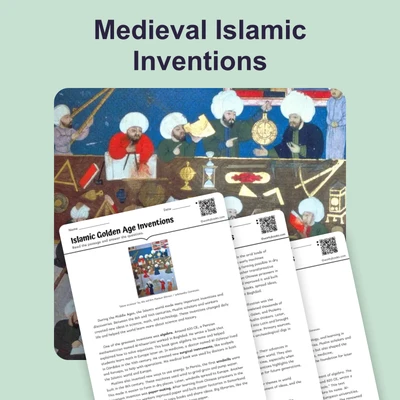
Medieval Inventions
Interactive passage with audio narration, comprehension questions, and printable PDF.
By completing this purchase you agree to our Terms of Use and Privacy Policy. Your subscription renews automatically until you cancel. You can cancel anytime from your account settings. All sales are final and non-refundable. Digital content is available for download in your account immediately upon purchase.
What's included
Medieval Inventions preview and details
About this printable Medieval Inventions reading passage (Grades 5-8)
Sample passage and quiz from Medieval Inventions
Reading passage and comprehension quiz preview
Inventions We Use Today: Medieval Innovations
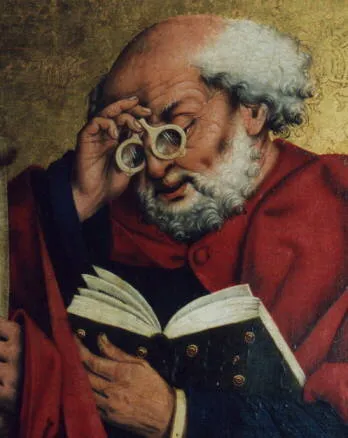
"Friedrich Herlin, Reading Saint Peter (1466)" / Wikimedia Commons.
The Middle Ages, which lasted from about 500 to 1500 CE, were a time of remarkable invention and innovation. Many tools, ideas, and devices that people use today were first developed or improved during this period, often to solve problems of daily life or to advance society. Far from being a time of only castles and knights, the medieval world was filled with creative thinkers who laid the foundation for many aspects of the modern age.
One of the most influential medieval inventions was the mechanical clock. By the 13th century, towns in Europe, such as Milan and Salisbury, began building large public clocks. These clocks, powered by weights and gears, helped people organize their days and allowed for more accurate timekeeping in busy cities. Monks in monasteries also used clocks to schedule prayers, as described in the writings of Brother Richard of Wallingford, who built an advanced astronomical clock in the early 1300s. The mechanical clock made it possible for societies to coordinate work, trade, and religious life in new ways.
Another key medieval innovation was the invention of eyeglasses, first documented in Italy around 1286. Early eyeglasses were simple convex lenses set into wooden or leather frames. They helped scholars, monks, and craftsmen read and work as they aged. A 14th-century sermon by Friar Giordano da Pisa praised eyeglasses as a "marvelous invention" that allowed people to read even in old age. This device made learning more accessible and extended careers for many medieval people.
The Middle Ages also saw advances in power technology, especially with the development of windmills. First appearing in Persia and spreading to Europe by the 12th century, windmills used the wind to grind grain or pump water. In places like the Netherlands, windmills became essential for managing water and farming. Archaeological evidence from English and Dutch villages shows how windmills improved food production and supported larger populations.
Perhaps one of the most lasting contributions of the Middle Ages was the creation of universities. The University of Bologna, founded in 1088, and the University of Paris, established before 1150, became centers for higher learning. These institutions brought together students and teachers from many regions, creating a community of scholars who shared ideas about science, law, and philosophy. Daily life for students in medieval universities involved lectures, debates, and the study of texts written in Latin. Over time, universities spread across Europe and shaped the way knowledge was shared and developed.
The impact of these inventions can be seen in their continued use today. Clocks structure our daily routines, eyeglasses help millions of people see clearly, windmills generate clean energy, and universities remain centers of research and learning. The innovations of the medieval era reveal how human creativity responds to challenges, leading to lasting changes in society.
These examples show how geography, social needs, and the search for knowledge drove medieval people to create tools that solve problems and connect communities. Studying these inventions helps us understand the continuity and change in world history and encourages us to look for innovation in all time periods.
Interesting Fact: The earliest known eyeglasses were called "spectacles" and were so valuable that owners sometimes chained them to desks to prevent theft!
Comprehension quiz (8 questions)
1. When were eyeglasses first documented?
2. Who built an advanced clock in the early 1300s?
3. Where did windmills become essential for managing water?
4. How did clocks affect medieval society?
5. Why were universities important in the Middle Ages?
6. What effect did windmills have on food production?
7. Eyeglasses were first created in Persia. True or false?
8. What does 'innovation' mean?
Perfect for the way you teach
- Build comprehension skills
- Auto-graded quiz
- Differentiated reading
- Read together at home
- Improve fluency
- Quiet reading time
- Reading curriculum support
- Independent practice
- Track Lexile growth