Plant vs. Animal Cells
Interactive passage with audio narration, comprehension questions, and printable PDF.
What's included
Plant vs. Animal Cells preview and details
About this printable Plant vs. Animal Cells science reading passage, NGSS-aligned (Grades 5-8)
Sample passage and quiz from Plant vs. Animal Cells
Reading passage and comprehension quiz preview
Plant vs. Animal Cells
Photosynthesis is the fundamental process that transforms solar energy into chemical energy, supporting nearly all life on Earth. This process takes place inside plant cells, which have specialized structures that allow them to make their own food. In contrast, animal cells must obtain energy by consuming other organisms. The structures inside these two cell types reflect their different lifestyles and roles in ecosystems.
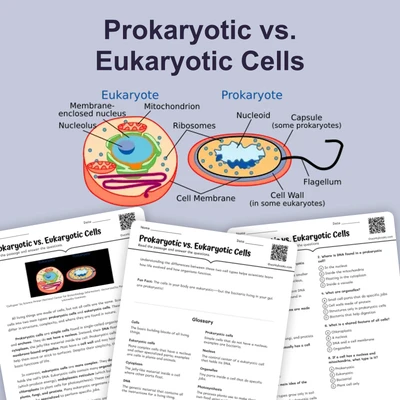
Both plant and animal cells are eukaryotic, meaning they have a defined nucleus and complex internal organization. However, plant cells contain structures that are not found in animal cells, and vice versa. Understanding these differences helps scientists explain how plants and animals adapt to their environments and fulfill their roles in nature.
Unique Structures in Plant and Animal Cells
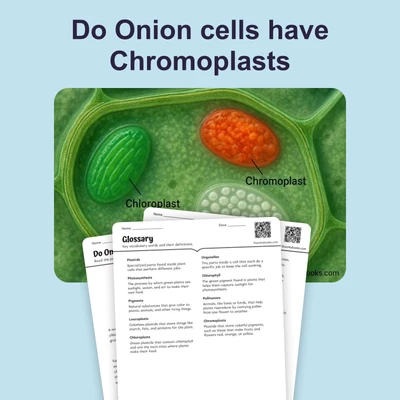
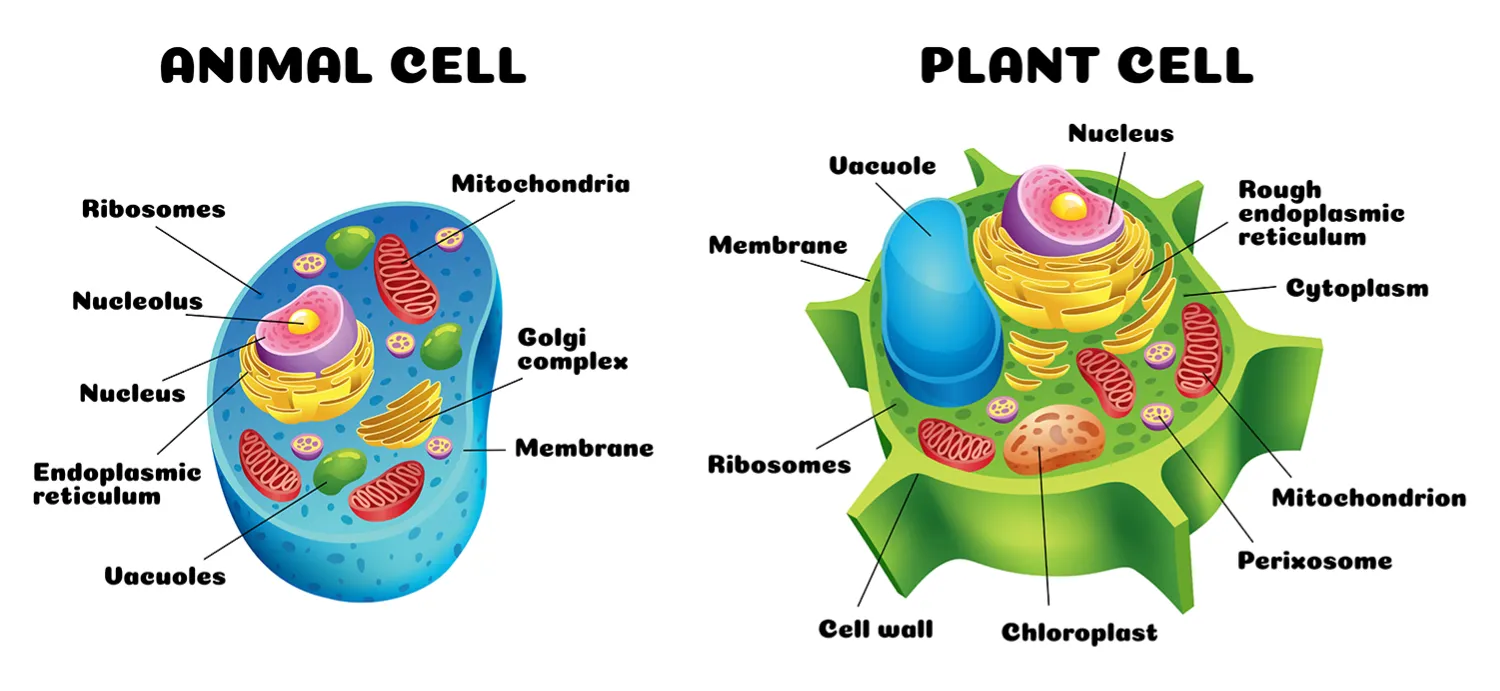
Plant cells are surrounded by a rigid cell wall made of cellulose, which provides support and protects the cell. This wall helps plants maintain their shape and withstand the pressure caused by water inside the cell. Another unique feature is the large central vacuole, which stores water and nutrients and helps keep the plant upright by maintaining turgor pressure. Plant cells also contain chloroplasts, the green organelles where photosynthesis happens. In comparison, animal cells have a flexible cell membrane without a cell wall, allowing them to change shape and move more easily. Animal cells have small vacuoles and contain centrioles, which play a key role in cell division but are not present in plant cells.
Similarities and Interactions
Despite their differences, plant and animal cells share many essential parts. Both have a nucleus, which stores genetic information, and mitochondria, which produce energy for the cell. Other shared structures include the endoplasmic reticulum (ER), Golgi apparatus, and ribosomes, all of which help build and transport proteins. The cell membrane in both types controls what enters and leaves the cell, maintaining balance and responding to changes in their environment.
Why Do These Differences Exist?
The unique features of plant and animal cells are the result of evolutionary adaptations to their lifestyles. Plants are generally stationary and must make their own food through photosynthesis, so the cell wall, large vacuole, and chloroplasts are essential for their survival. The cell wall provides structural support, allowing plants to grow tall and reach sunlight, while chloroplasts enable them to convert light into energy. In contrast, animals move to find food and respond quickly to their surroundings. The absence of a rigid wall and the presence of centrioles support flexibility and efficient cell division. These differences highlight how cell structure is linked to function and survival in different environments.
Scientists have used microscopes to measure and compare these cell features. For example, the central vacuole in a plant cell can take up to 90% of the cell’s volume, while animal cell vacuoles are much smaller. This quantitative data helps researchers understand how structure influences function.
Understanding the similarities and differences between plant and animal cells is not only important for science, but also has real-world applications. For instance, knowledge of plant cell walls has led to advances in agriculture and biofuels, while research on animal cells supports medical treatments and biotechnology. Both cell types play vital roles in supporting life on Earth.
Interesting Fact: If you removed all the cell walls from a tree, it would collapse into a soft pile because the cell walls provide almost all the structure!
Comprehension quiz (10 questions)
1. What is the main function of chloroplasts in plant cells?
2. Which structure is found only in animal cells and helps with cell division?
3. Which of the following is present in both plant and animal cells?
4. What does the central vacuole in a plant cell mainly store?
5. What word in the passage means 'the pressure of water inside a plant cell that keeps it rigid'?
6. In the passage, what does the term 'eukaryotic' refer to?
7. Why do plant cells need a cell wall while animal cells do not?
8. If a plant's cell walls were removed, what would happen to the plant?
9. True or False: Both plant and animal cells have a cell wall.
10. True or False: The central vacuole in plant cells helps keep the plant upright.
Perfect for the way you teach
- Build comprehension skills
- Auto-graded quiz
- Differentiated reading
- Read together at home
- Improve fluency
- Quiet reading time
- Reading curriculum support
- Independent practice
- Track Lexile growth