Herodotus
Interactive passage with audio narration, comprehension questions, and printable PDF.
By completing this purchase you agree to our Terms of Use and Privacy Policy. Your subscription renews automatically until you cancel. You can cancel anytime from your account settings. All sales are final and non-refundable. Digital content is available for download in your account immediately upon purchase.
What's included
Part of this bundle

Herodotus preview and details
About this printable Herodotus reading passage (Grades 6-8)
Sample passage and quiz from Herodotus
Reading passage and comprehension quiz preview
Herodotus the Historian

Statue of the ancient greek historian Herodotus at the parliament of Vienna
Wikimedia Commons
Herodotus was an ancient Greek writer who is often called the "Father of History" because he was the first to systematically collect and record stories about the past. Born around 484 BCE in Halicarnassus, a Greek city-state in Asia Minor (now Turkey), Herodotus traveled widely throughout the ancient world. His most famous work, called Histories, is considered the earliest surviving example of historical writing in Western civilization.
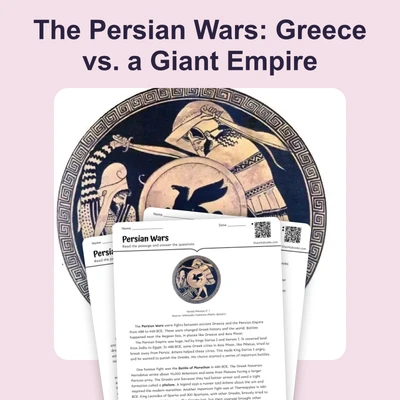
Herodotus's Histories focused mainly on the causes and events of the Persian Wars, a series of conflicts between the Greek city-states and the vast Persian Empire from 499 to 449 BCE. He used a unique approach for his time by gathering eyewitness accounts, visiting important battle sites, and recording the customs of different peoples. For example, he described the famous Battle of Marathon (490 BCE) by noting both Greek and Persian perspectives. He also included stories he heard from priests in Egypt and traders in Babylon. Although some of his tales are difficult to verify, Herodotus often explained when information was based on rumor or when he could not confirm a fact.
Geography played a large role in Herodotus’s writing. He carefully described rivers, mountains, and cities, helping readers understand why certain battles took place at specific locations. For instance, he explained how the narrow pass at Thermopylae allowed a small Greek force to hold off the much larger Persian army in 480 BCE. Herodotus also paid attention to social hierarchy and daily life. He wrote about kings, soldiers, and ordinary people, describing their beliefs, traditions, and even their food and clothing. By doing so, he showed how culture and geography shaped the choices of individuals and the outcomes of historical events.
Herodotus’s method was groundbreaking because he wanted to explain not just what happened, but why it happened. He looked for cause-and-effect relationships, such as how the ambitions of Persian kings led to wars with Greece, or how alliances between Greek city-states changed over time. His work demonstrated both continuity and change by showing how some customs remained the same while others evolved. Although later historians sometimes criticized Herodotus for including legends and hearsay, his emphasis on research and multiple perspectives set a standard for historical writing.
Herodotus’s influence continues today. His efforts to gather evidence, compare sources, and respect different perspectives helped shape the discipline of history. By reading his work, students and historians can learn not only about the ancient world, but also about the importance of asking questions and thinking critically about the past. The study of Herodotus connects to broader themes in history, such as the role of geography, the diversity of cultures, and the methods historians use to uncover and explain the past.
Interesting Fact: The word “history” in English comes from the Greek word “historia,” which means inquiry or investigation—a term Herodotus used for his work.
Comprehension quiz (8 questions)
1. Where was Herodotus born?
2. What is Herodotus’s most famous work?
3. Which wars did Herodotus write about?
4. Why did Herodotus visit battle sites?
5. How did geography influence Herodotus’s writing?
6. Why is Herodotus called 'Father of History'?
7. Herodotus always believed rumors he heard. True or false?
8. Which word means ranking in society?
Perfect for the way you teach
- Build comprehension skills
- Auto-graded quiz
- Differentiated reading
- Read together at home
- Improve fluency
- Quiet reading time
- Reading curriculum support
- Independent practice
- Track Lexile growth