Inflectional Ending: ed
Interactive worksheet with auto-grading, instant feedback, and printable PDF.
By completing this purchase you agree to our Terms of Use and Privacy Policy. Your subscription renews automatically until you cancel. You can cancel anytime from your account settings. All sales are final and non-refundable. Digital content is available for download in your account immediately upon purchase.
What's included
Inflectional Ending: ed preview and details
About this worksheet
This interactive and printable worksheet,, titled "Inflectional Ending: ed," is a valuable learning resource designed to help young learners understand and practice the correct pronunciation of words ending with the "ed" suffix. This resource is available in both interactive and printable formats, allowing for diverse learning experiences.
Through this worksheet, children will learn the different sounds associated with the "ed" ending, including the "t" sound (e.g., passed), "d" sound (e.g., buzzed), and "ed" sound (e.g., planted). They will practice identifying these sounds by reading the provided words and coloring the corresponding flowers based on the ending sound.
Learning Outcomes
Through this worksheet, children will achieve the following learning objectives:
Cognitive
- Understand the concept of past tense and its relation to the "ed" ending.
- Recognize the different sounds associated with the "ed" ending.
- Distinguish between the "t," "d," and "ed" sounds in words.
Psychomotor
- Practice reading words aloud with the "ed" ending.
- Develop fine motor skills through coloring activities.
Affective
- Foster a positive attitude towards learning and engaging with language concepts.
- Encourage self-confidence in reading and pronouncing words.
Interpersonal/Social
- Promote collaborative learning through group activities or peer discussions.
- Develop effective communication skills by verbalizing their understanding.
Tags
Inflectional Ending, ed Pronunciation, Past Tense, Reading Practice, Phonics, Elementary Education, Language Arts, Printable Worksheet, Interactive Worksheet, Learning Resources
Common Core standards covered
Determine or clarify the meaning of unknown and multiple-meaning words and phrases based on grade 1 reading and content, choosing flexibly from an array of strategies.
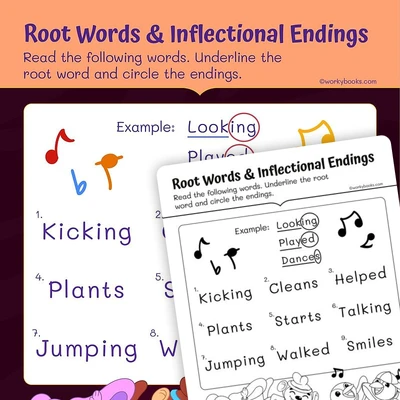
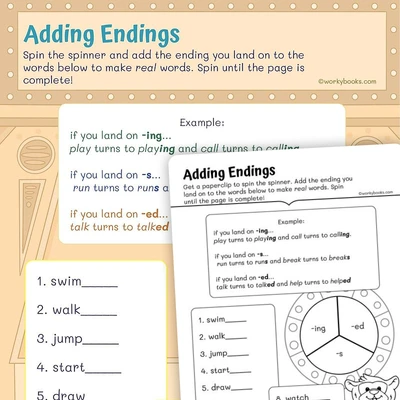
Identify frequently occurring root words (e.g., look) and their inflectional forms (e.g., looks, looked, looking).
Read words with inflectional endings.
Perfect for the way you teach
- Assign in one click
- Track progress per student
- Auto-graded results
- Practice at home
- Print or do on-screen
- Build skill mastery
- Standards-aligned
- Self-paced
- Ready-to-use today