Teaching Metric System Conversions to 4th Graders
Metric system conversions are one of those upper-elementary skills that look intimidating and turn out to be wonderfully predictable. You already know the moment: a student stares at “3 meters = ______ centimeters,” pencil frozen, and quietly asks, “Do I multiply or divide?” After many years of teaching this exact skill, I can promise you two things. First, that question is the whole ballgame. Second, once kids can answer it with confidence, the metric system stops feeling like a maze and starts feeling like a staircase they already know how to climb.
This guide walks through how I teach metric system conversions to elementary students — the reasoning, the memory tricks, and the everyday examples that make it stick. We’ll cover the one rule that drives every problem, an easy way to remember the units, and plenty of worked examples for basic metric conversions. Keep a good metric conversions chart nearby as you read; it’s the single most useful reference in the room.
What Is the Metric System, Really?
The metric system is a way of measuring built entirely on the number 10. That one fact is why metric to metric conversions are so much friendlier than the customary system (where kids have to memorize that 12 inches make a foot, 3 feet make a yard, and 5,280 feet make a mile — no pattern at all).
In metric, we measure three big things with three base units:
- Length with the meter (m)
- Mass with the gram (g)
- Capacity with the liter (L)
Every other unit is just one of those base units made bigger or smaller by a power of 10. A kilometer is 1,000 meters. A centimeter is one-hundredth of a meter. Same prefixes, same pattern, across all three measures. Learn the pattern once and you’ve learned it everywhere.
Why Every Conversion Comes Down to One Question
Because the whole system runs on tens, all unit conversions boil down to a single decision: am I moving to a smaller unit or a bigger unit?
- Moving to a smaller unit? Multiply. Smaller units mean you need more of them to measure the same thing, so the number gets bigger.
- Moving to a bigger unit? Divide. Bigger units mean you need fewer of them, so the number gets smaller.
I write that “multiply or divide” rule at the top of every lesson, and I keep it front and center on our classroom conversions chart. When students trust that one rule, they stop guessing.
Here’s the intuition I use with kids: imagine measuring your classroom in meters, then in centimeters. Centimeters are tiny, so it takes a lot of them — the number shoots up. That’s multiplying. Now measure a pencil in millimeters, then in meters. Meters are big, so you only need a small fraction of one — the number shrinks. That’s dividing.
Meet the Metric System Conversions Chart
Before students memorize anything, they need something to look at. A metric conversion chart poster for length, mass, and capacity — a classroom reference with units, symbols, equivalents, and a quick multiply or divide rule — does exactly that. Instead of interrupting their thinking to hunt through a notebook, a student glances up, finds the measurement type, and reads the equivalence they need.
I organize our metric conversions chart into three sections so kids can find the right family fast:
| Length | Mass | Capacity |
|---|---|---|
| 1 km = 1,000 m | 1 kg = 1,000 g | 1 L = 1,000 mL |
| 1 m = 100 cm | 1 g = 1,000 mg | 1 L = 100 cL |
| 1 cm = 10 mm | 1 cL = 10 mL |
These are the common metric conversions students meet again and again. Seeing them grouped — and color-coded — helps kids notice that “1,000” shows up over and over, which is exactly the base-10 pattern doing its work.
How to Memorize Metric Conversions (The Mnemonic That Works)
Every teacher eventually gets asked how to memorize metric conversions, and my honest answer is: don’t memorize dozens of separate facts — memorize one ladder and let it generate the facts for you.
The classic trick for how to remember metric conversions is the sentence:
King Henry Died By Drinking Chocolate Milk.
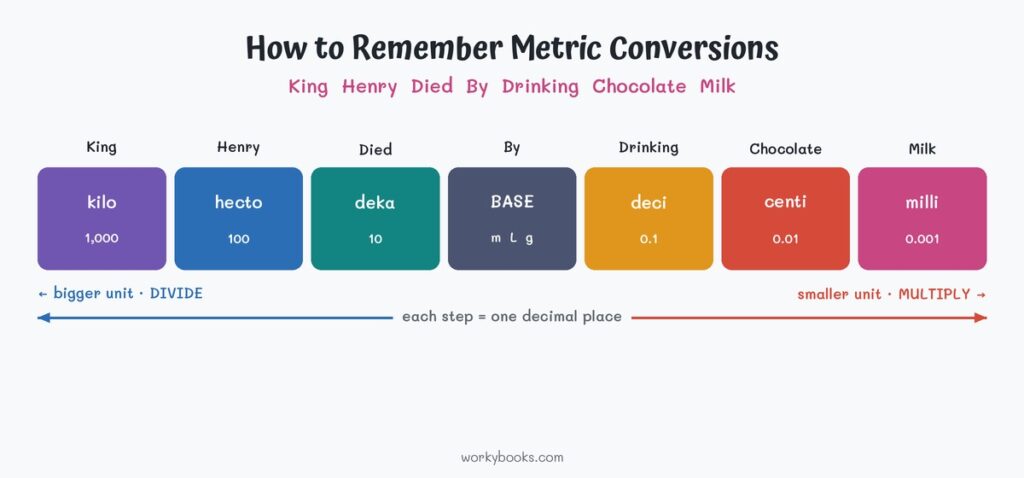
Each word is a prefix, in order from biggest to smallest:
Kilo (1,000) · Hecto (100) · Deka (10) · Base — m, L, g (1) · Deci (0.1) · Centi (0.01) · Milli (0.001)
Now the trick becomes physical. Picture those prefixes as stairs. Each step you move is one power of 10, which is the same as one hop of the decimal point:
- Going down the stairs (toward smaller units)? Move the decimal right — you’re multiplying by 10 each step.
- Going up the stairs (toward bigger units)? Move the decimal left — you’re dividing by 10 each step.
That’s the beauty of it: kids don’t need to remember whether 1 meter is 100 or 1,000 centimeters. They count the steps and slide the decimal. One tool, every conversion.
Worked Examples
Let’s put it to work with the kind of problems that show up on every test.
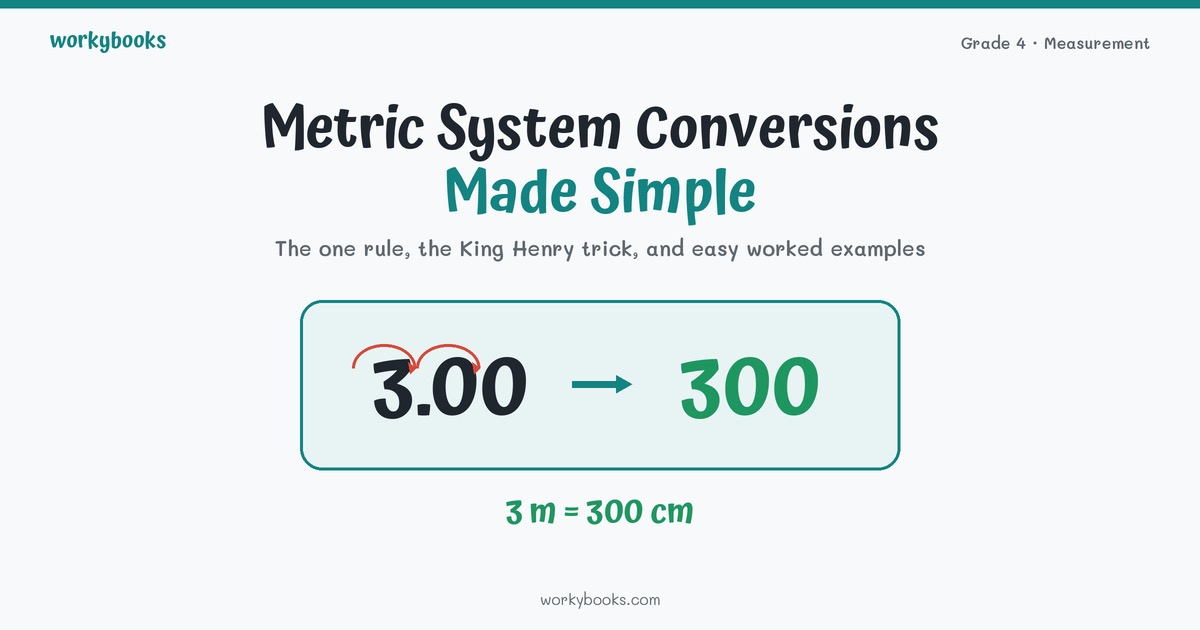
Example 1 — Convert 3 meters to centimeters. On the ladder, meters → centimeters is 2 steps down (m → dm → cm). Down means smaller units, so multiply — slide the decimal 2 places right. 3.00 → 300. So 3 m = 300 cm.

Example 2 — Convert 5 kilograms to grams. Kilograms → grams is 3 steps down (kg → hg → dag → g). Multiply by 10 three times: 5 × 1,000. So 5 kg = 5,000 g.
Example 3 — Convert 2,000 milliliters to liters. Milliliters → liters is 3 steps up (mL → cL → dL → L). Up means bigger units, so divide — slide the decimal 3 places left. 2000 → 2. So 2,000 mL = 2 L.
Notice how each answer confirms the rule: smaller unit, bigger number; bigger unit, smaller number. When a student’s answer breaks that pattern, it’s an instant signal to check their work.
Time Conversion Activities
Here’s a twist that trips up a lot of students: time is a measurement too, but it does not run on tens. Sixty seconds make a minute, twenty-four hours make a day, seven days make a week. The multiply-or-divide logic is identical, but the numbers change at every step, so kids need a separate reference.
A time conversion chart poster for seconds, minutes, hours, days, and years — a classroom reference with clock and calendar units plus a multiply or divide rule — sits right beside our metric chart. Same habit (“smaller unit, multiply; bigger unit, divide”), different equivalents. For example, converting 2 hours to minutes means multiplying by 60: 2 hr = 120 min. Converting 72 hours to days means dividing by 24: 72 hr = 3 days.
Telling time accurately is an essential life skill that children need to master. This worksheet provides a fun and engaging way for them to practice this skill through a series of visual representations.
Bringing It Together in the Classroom
Here’s the routine I recommend for basic metric conversions:
- Name the measure — length, mass, or capacity. (Point to the matching section of the conversions chart.)
- Ask the direction — smaller unit or bigger unit?
- Count the steps on the K-H-D-B-D-C-M ladder.
- Slide the decimal that many places — right for smaller, left for bigger.
Post a metric conversions chart and a companion time chart on the wall, keep the King Henry ladder visible, and let students self-check against them. The goal isn’t to make kids dependent on the poster — it’s the opposite. Reference charts free up working memory so students can focus on reasoning, and the reasoning is what eventually lets them do the conversions without looking.
Quick Recap
- The metric system is built on powers of 10, which makes metric to metric conversions predictable.
- Every conversion answers one question: smaller unit, multiply; bigger unit, divide.
- For how to remember metric conversions, use King Henry Died By Drinking Chocolate Milk and slide the decimal one place per step.
- The common metric conversions (1 km = 1,000 m, 1 m = 100 cm, 1 kg = 1,000 g, 1 L = 1,000 mL) come straight off the ladder.
- Keep a metric conversions chart — and a time conversion chart — on the wall so students can check their thinking and build independence.
Give students the pattern, the mnemonic, and a clear chart to lean on, and that frozen-pencil moment disappears. They stop asking “multiply or divide?” — because now they know exactly how to figure it out.
Exploring 4th Grade Math Resources from Workybooks Library
Fourth grade is where math starts to feel real — kids measure, convert, and reason their way through problems that connect to the world around them. This Workybooks library brings together 4th grade math worksheets and activities built for exactly that, starting with our Measurement & Conversions strand.
Inside you’ll find 4th grade printables you can use right away: anchor charts and posters for metric and time conversions, quick infographics that make big ideas click in a single glance, and worksheets that turn practice into real understanding. Every one is standards-aligned to Grade 4 (CCSS 4.MD), designed to print clean in color or black and white, and made to give students a reference they can lean on until the skill becomes their own.
More 4th grade math worksheets and printables — covering multiplication, fractions, and geometry — are on the way. Explore, print, and build your students’ confidence one concept at a time.
Related Posts
5th Grade Fraction Word Problems: A Simple Guide from a Teacher
10 Animal Symmetry Worksheets for Grade 4