10 Animal Symmetry Worksheets for Grade 4
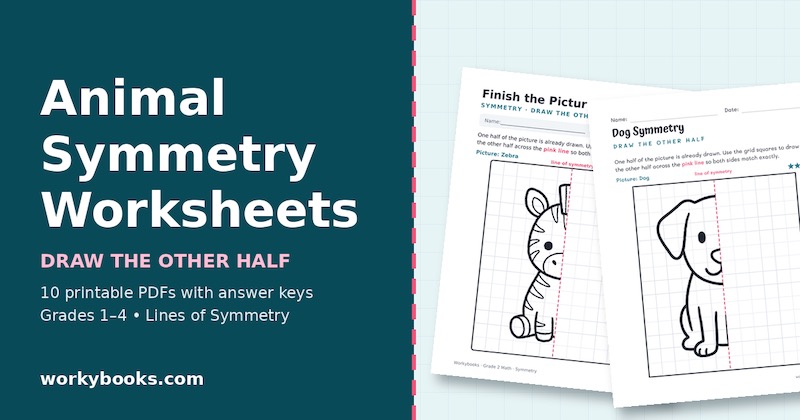
Symmetry worksheets are some of the most satisfying math printables to hand out. Give a child half of a lion’s face and ask them to complete it, and suddenly geometry feels like art class. That’s exactly what our animal symmetry worksheets are designed to do — turn an abstract concept, the line of symmetry, into a hands-on drawing activity kids genuinely enjoy.
In this post, you’ll find our full collection of draw-the-other-half symmetry worksheets featuring ten favorite animals, plus tips on using them in the classroom and the standards they support. Whether you need a quick drawing activity for first graders or geometry worksheets for grade 4 aligned to Common Core, this set fits right in.
What Is a Line of Symmetry?
A line of symmetry is an imaginary line that divides a shape or picture into two matching halves — mirror images of each other. Fold a symmetrical picture along its line of symmetry, and the two halves line up perfectly.
Animals are a perfect way to introduce this idea. A bear’s face, an owl’s face, an elephant’s ears — nature is full of symmetry, and kids spot it intuitively. Our worksheets build on that intuition: each symmetry worksheet PDF shows half of an animal on a grid, and students draw the missing half to complete the mirror image.
Our Animal Symmetry Worksheets Collection
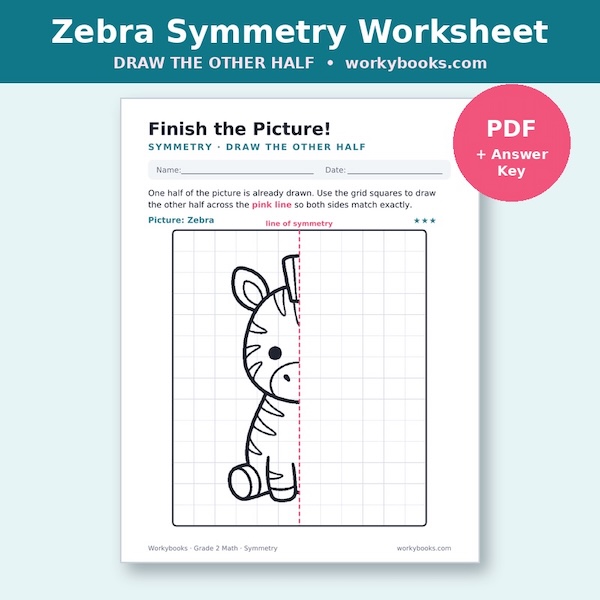
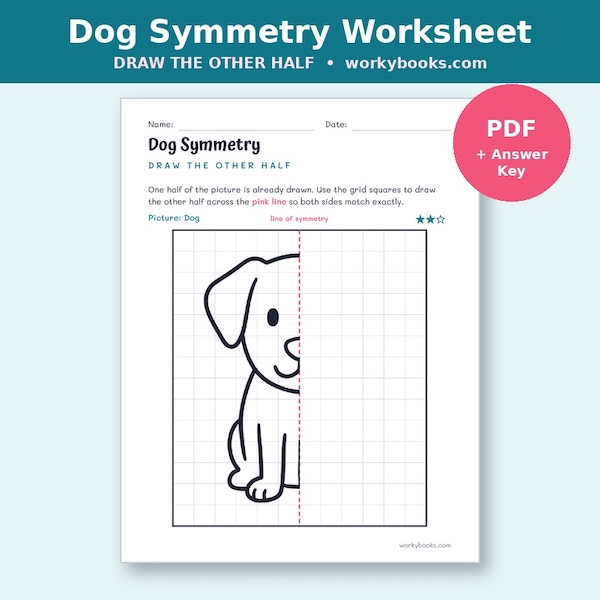
Each printable in this set follows the same simple format: half of the animal is drawn, a dotted line marks the line of symmetry, and students complete the other half square by square. Every symmetry worksheet comes with answers, so checking work (or self-checking!) is easy.
- Bear Symmetry Worksheet – Draw the Other Half — A friendly bear face with big round ears, great for beginners.
- Dog Symmetry Worksheet – Draw the Other Half — Floppy ears make this one a fun fine-motor challenge.
- Elephant Symmetry Worksheet – Draw the Other Half — Those big ears and trunk give students plenty to mirror.
- Fox Symmetry Worksheet – Draw the Other Half — Pointed ears and a narrow snout add a step up in difficulty.
- Lion Symmetry Worksheet – Draw the Other Half — Complete the king of the jungle’s magnificent mane.
- Owl Symmetry Worksheet – Draw the Other Half — Owls are naturally symmetrical, making this a class favorite.
- Pig Symmetry Worksheet – Draw the Other Half — A simple, rounded design that’s perfect for younger learners.
- Puppy Symmetry Worksheet – Draw the Other Half — An adorable companion to the dog worksheet.
- Rabbit Symmetry Worksheet – Draw the Other Half — Long ears mean long, careful mirror lines.
- Zebra Symmetry Worksheet – Draw the Other Half — Stripes add an extra layer of pattern-matching fun.
What Grade Are Symmetry Worksheets For?
Symmetry is introduced informally as early as 1st and 2nd grade, when students explore shapes and patterns. It becomes a formal standard in 4th grade, where the Common Core standard 4.G.A.3 asks students to recognize and draw lines of symmetry in two-dimensional figures.
That makes this collection flexible:
- Grades 1–2: Use the simpler animals (pig, bear, puppy) as a drawing and visual-discrimination activity. Focus on the idea of “matching halves.”
- Grade 3: Introduce the vocabulary — line of symmetry, mirror image, symmetrical, asymmetrical — while students complete the drawings.
- Grade 4: Pair the worksheets with formal instruction on 4.G.A.3. Ask students to identify the line of symmetry, complete the figure, and explain how they know the halves match. If you’re searching for a symmetry worksheet for grade 4 in PDF format, this is the sweet spot.
Five ways to use symmetry worksheets in your classroom
- Math centers. Print a stack and let students choose their animal — choice boosts engagement instantly.
- Early finisher work. Because the format is self-explanatory, these need zero re-teaching.
- Art + math crossover. After completing the mirror half, students color the whole animal. Symmetric coloring doubles the practice.
- Assessment warm-up. Before a geometry quiz, use one worksheet as a five-minute review of lines of symmetry.
- At-home practice. Send a symmetry worksheet PDF home — no special materials required beyond a pencil.
How to use grid symmetry in your classroom
- Warm-Up with Real-Life Examples: Show photos of animals, owl, or architecture to highlight natural mirror symmetry.
- Anchor the Line of Symmetry: Have students draw over the central dashed line using a bright colored pencil before drawing.
- Count the Grid Units: Teach kids to pick a landmark (like the outer tip of an owl’s wing), count how many grid squares it sits from the center line, and mark the corresponding point on the blank side.
- Color for Symmetrical Balance: Turn finished drawings into a symmetry coloring design by requiring matching colors on both halves of the image
Why Grid-Based “Draw the Other Half” Practice Works
Completing a mirror image on a grid isn’t just fun — it builds several skills at once:
- Spatial reasoning: Students must track position and distance relative to the line of symmetry.
- Visual-motor integration: Transferring what the eye sees into an accurate drawing strengthens fine motor control.
- Geometric vocabulary: Words like reflection, congruent, and mirror image become concrete instead of abstract.
- Attention to detail: One square off, and the zebra’s stripes don’t line up — instant, visual feedback.
Get the Full Set on Workybooks
All ten animal symmetry worksheets are available in the Workybooks library as printable PDFs with answer keys — and like everything on Workybooks, they’re standards-aligned and ready to assign digitally or print for your classroom.
Explore the full symmetry collection
Whether you need a quick symmetry task card setup, springtime symmetry extensions, or targeted 4th grade lines of symmetry practice, these animal grid drawings provide the perfect blend of rigor and creativity! Check out our worksheets on 2D shapes, patterns, and more in the Workybooks math library.
FAQ
What is a symmetry worksheet? A symmetry worksheet gives students practice identifying or drawing lines of symmetry. In “draw the other half” worksheets, half of a picture is shown and students complete the mirror image.
Where can I find these symmetry worksheets? All ten animal symmetry worksheets are available in the Workybooks library as printable PDFs with answers included.
What grade level are symmetry worksheets for? They work for grades 1–4. Symmetry is formally taught in 4th grade under Common Core standard 4.G.A.3, but younger students can use them as drawing and pattern activities.
How do you teach lines of symmetry? Start with real objects and pictures (like animals), fold paper shapes along the line of symmetry, then move to draw-the-other-half grid worksheets before identifying symmetry in abstract shapes.
Related Posts
5th Grade Fraction Word Problems: A Simple Guide from a Teacher
America 250 Color by Number: Adding Tens