This learning resource is available in interactive and printable formats. The interactive worksheet can be played online and assigned to students. The Printable PDF version can be downloaded and printed for completion by hand.
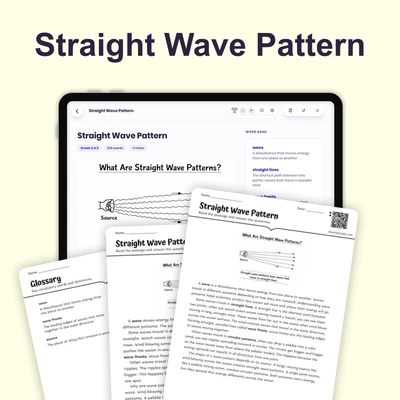
This engaging 250-word science passage introduces Grade 4-5 students to circular wave patterns and how they behave in nature. Students learn how circular waves spread outward in rings from a central point, using the familiar example of dropping a pebble into still water. The passage explains why these waves get weaker as they travel farther, connecting the concept to energy distribution over larger areas. Aligned with NGSS 4-PS4-1 (Develop a model of waves to describe patterns in terms of amplitude and wavelength), this audio-integrated reading passage includes concrete examples like pond ripples, raindrops, and stadium waves. The content features age-appropriate vocabulary with terms like ripples, energy, and circular waves naturally defined within the text. Students explore cause-and-effect relationships between wave spreading and energy distribution. The passage includes a simplified differentiated version for diverse learners, Spanish translations, an illustrated glossary, comprehension quiz, writing activities, and graphic organizers. All activities encourage scientific thinking and real-world connections. The audio integration supports multiple learning styles and helps develop reading fluency while building science content knowledge about wave behavior and patterns.
CONTENT PREVIEW
Expand content preview
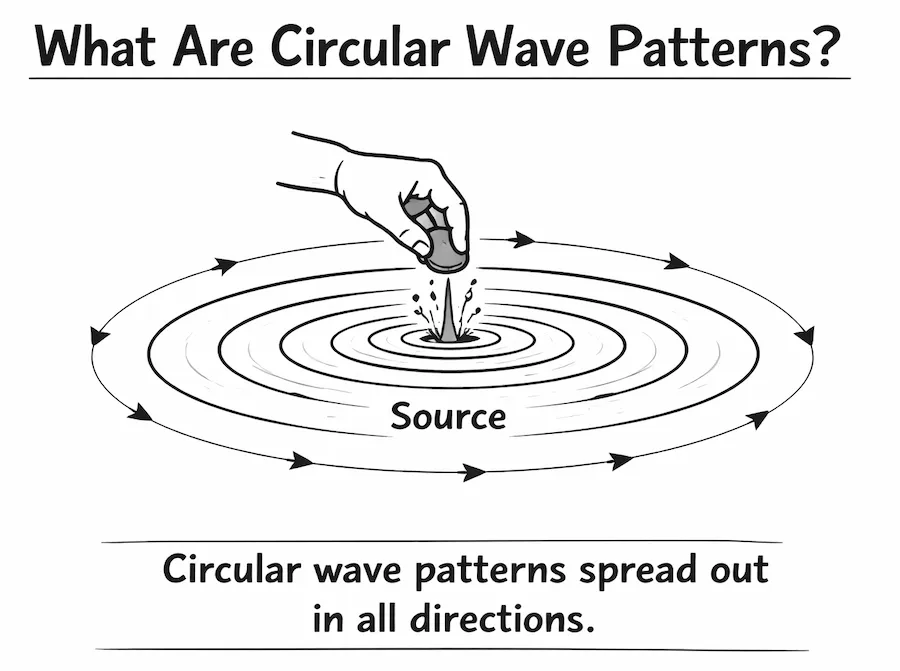
Waves form a pattern of rings, called ripples in water.Image credit Pixabay / Pexels.
Circular waves are waves that spread outward in rings from a central point. When you drop a pebble into still water, you create circular waves that move away from where the pebble landed. These waves form a pattern of rings, called ripples, that get bigger and bigger as they travel across the water. Scientists study circular waves because they help us understand how energy moves through water, air, and other materials.
When a pebble hits the water, it transfers energy to the water molecules around it. Energy is the ability to make things move or change. This energy pushes the water up and down, creating the first wave. That wave then passes energy to the water next to it, forming another ring. Each new ring spreads outward, carrying energy farther from the center point. The rings keep forming one after another, creating the circular pattern we see.
As circular waves spread outward, something interesting happens—they get weaker and weaker. The waves look smaller and have less energy the farther they travel. This happens because the same amount of energy must cover a larger and larger area. Think of it like spreading frosting on a cake: if you have one spoonful of frosting and try to cover a bigger and bigger area, the frosting layer gets thinner and thinner. The energy in the wave works the same way.
You can observe circular waves in many places besides ponds. When a raindrop hits a puddle, it creates tiny circular ripples. If you tap a table, invisible sound waves spread outward in circles through the air. Even when people do "the wave" in a stadium, the pattern spreads outward in a circular shape from where it started. All these examples show the same pattern—waves spreading outward in rings.
The size and strength of circular waves depend on how much energy starts them. A small pebble makes small, gentle ripples. A large rock makes bigger, stronger waves that travel farther before they disappear. But no matter the size, all circular waves follow the same rule: they spread outward and get weaker as they go.
Understanding circular wave patterns helps scientists in many ways. They use this knowledge to study earthquakes, which send circular waves through the ground. They also study ocean waves, sound waves, and light waves. Circular waves are an important pattern in nature that shows us how energy travels and spreads through the world around us.
What are circular waves?
Waves that move in straight linesWaves that spread in rings outwardWaves that stay in one placeWaves that only happen in oceans
What are the rings on water called?
CirclesBubblesRipplesSplashes
What does energy do to water?
Makes it freezeMakes it move up and downMakes it disappearMakes it turn colors
Why do waves get weaker farther out?
The water gets colderEnergy spreads over a larger areaThe pebble stops movingWind blows them away
What makes bigger circular waves?
Dropping a small pebbleUsing warm waterDropping a large rockAdding salt to water
How do raindrops create circular waves?
By hitting puddles and making ripplesBy evaporating into the airBy freezing on the groundBy mixing with dirt
All circular waves spread outward and weaken.
TrueFalse
What is a pattern?
Something that never repeatsA repeating design or arrangementA type of waterA kind of energy
Perfect For:
👩🏫 Teachers
• Reading comprehension practice
• Auto-graded assessments
• Literacy skill development
👨👩👧👦 Parents
• Reading practice at home
• Comprehension improvement
• Educational reading time
🏠 Homeschoolers
• Reading curriculum support
• Independent reading practice
• Progress monitoring
Reading Features:
📖
Reading Passage
Engaging fiction or nonfiction text
❓
Comprehension Quiz
Auto-graded questions
📊
Instant Feedback
Immediate results and scoring
📄
Printable Version
Download for offline reading
🔊
Read Aloud
Voice-over with word highlighting
Reviews & Ratings
No reviews yet. Be the first to share your experience!
Related Content
Wave Amplitude
This engaging 350-word reading passage introduces Grade 4-5 students to the concept of wave amplitude and its relationsh...
NGSS 4-PS4-1
Wave Crests and Troughs
This engaging 250-word passage introduces Grade 4-5 students to the fundamental parts of transverse waves: crests and tr...