Endoplasmic Reticulum Function — Reading Comprehension
Rate this
Premium Resource
Present
Present in classroom. No work saved
Assign
Classroom with student accounts, Track progress
Quick Play
No student accounts, assign with a link
Grades
5
6
7
8
PRINT+DIGITAL RESOURCE
This learning resource is available in interactive and printable formats. The interactive worksheet can be played online and assigned to students. The Printable PDF version can be downloaded and printed for completion by hand.
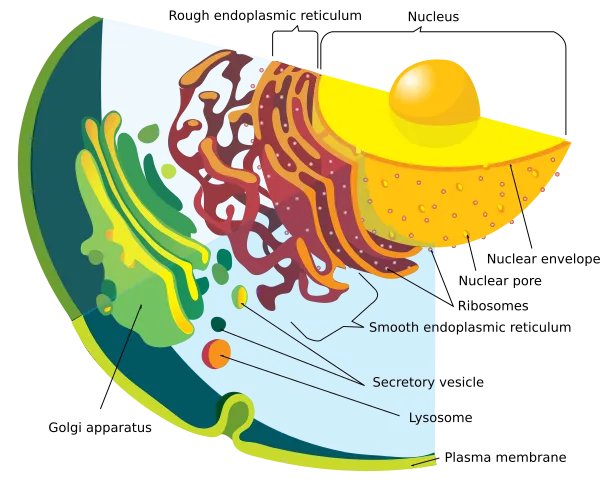
"Endomembrane system diagram" by Mariana Ruiz LadyofHats / Wikimedia Commons.
The endoplasmic reticulum, or ER, is a large, maze-like structure inside the cell that helps make and move important materials. It stretches from the nucleus to other parts of the cell, acting like a highway system. There are two types of ER: rough ER and smooth ER, and each has a different job.
The rough endoplasmic reticulum is covered with ribosomes, which give it a bumpy appearance under a microscope. These ribosomes build proteins, and the rough ER helps fold and transport those proteins to other places in the cell. Some proteins are sent to the Golgi apparatus for packaging, while others are used right away by the cell.
The smooth endoplasmic reticulum does not have ribosomes, so it looks smooth. Instead of helping with proteins, it makes lipids, which are fats used in cell membranes and energy storage. The smooth ER also helps remove harmful substances from the cell, especially in liver cells.
Together, both types of ER help the cell stay organized and efficient. Without the ER, the cell would not be able to make or move the materials it needs to grow, repair damage, or stay healthy. Different cells have different amounts of rough and smooth ER depending on what they do. For example, cells that make lots of proteins have more rough ER, while cells that produce hormones or clean toxins may have more smooth ER.
Fun Fact: The endoplasmic reticulum is so large that it makes up more than half the total membrane in many cells!
What does the endoplasmic reticulum help the cell do?
Store DNAMake and move materialsMake ribosomesControl cell division
What gives the rough ER its bumpy appearance?
LipidsNucleusRibosomesCytoplasm
What is the main job of the rough ER?
Break down foodMake DNABuild and move proteinsStore energy
What does the smooth ER produce?
ProteinsSugarsLipidsDNA
Which type of cell would likely have more smooth ER?
Muscle cellLiver cellSkin cellBlood cell
Where do some proteins go after leaving the rough ER?
MitochondriaCytoplasmNucleusGolgi apparatus
What is the main idea of the passage?
The ER helps cells divideThe ER stores energyThe ER helps make and move cell materialsThe ER is found only in plant cells
What would happen if the ER didn’t work properly?
The cell would stop growing and repairingThe cell would have too much DNAThe nucleus would disappearThe ribosomes would stop making DNA
Perfect For:
👩🏫 Teachers
• Reading comprehension practice
• Auto-graded assessments
• Literacy skill development
👨👩👧👦 Parents
• Reading practice at home
• Comprehension improvement
• Educational reading time
🏠 Homeschoolers
• Reading curriculum support
• Independent reading practice
• Progress monitoring
Reading Features:
📖
Reading Passage
Engaging fiction or nonfiction text
❓
Comprehension Quiz
Auto-graded questions
📊
Instant Feedback
Immediate results and scoring
📄
Printable Version
Download for offline reading
🔊
Read Aloud
Voice-over with word highlighting
Reviews & Ratings
No reviews yet. Be the first to share your experience!
Related Content
What's The Main Idea?
These short science texts are a great way to practice main idea. Students will read the paragraphs and then choose the m...
RI.2.6
Reading for Main Details—Birds
This informational text on birds is a great way to practice main idea. Students will read the passage, then give the mai...
RI.2.6RI.2.8
Koi Fish—What’s the Main Idea?
This informational text on koi fish is a great introduction to teaching main idea. Students will be asked, in multiple c...
RI.3.2RF.3.4RI.3.1
Spider—Main Idea
This informational text on spiders is a great introduction to teaching main idea. Students will be asked, in multiple ch...
RI.3.2RF.3.4RI.3.1RI.2.6
Reading for Main Details—Beavers Teeth
This informational text on beavers is a great way to practice main idea. Students will read the passage, then give the m...
RI.2.6RI.2.10
Reading for Main Details—Veternarians
Practie summarizing paragraphs with this fun informational text on veternarians! Students will give the main idea of eac...
RI.2.2RI.2.10
Penguins— Main Purpose
This informational text on penguins with comprehension questions is a great way to practice reading fluency and main ide...
RI.1.2RI.1.10RF.1.4.ARF.1.4.B
Informational Text —Learn About Dinosaurs
This informational text on dinosaurs with comprehension questions to follow is perfect for teaching main idea. Students ...
RF.3.4RF.3.4.ARF.3.4.CRI.3.2
Reading for Main Details—Orcas
Practie summarizing paragraphs with this fun science informational text on orcas! Students will give the main idea of ea...
RI.2.2RI.2.10
Informational Text — Habitats
This short informational text on habitats will teach your students what a habitat is, as well as provide some examples o...
RF.3.4.A
Informational Text —Elephants Facts
This informational text on elephants with comprehension questions to follow is perfect for teaching main idea. Students ...
RF.2.4.ARI.2.1RI.2.2RI.2.6
Main Idea and Supporting Details in Informational Text
RI.3.1RI.3.2RI.3.8
Informational Text — Astronauts
Practice this second grade context clues worksheet with this informational text on astronauts. Students will read the te...
RI.2.4RI.2.10RI.3.4RI.3.10
Informational Text —Importance of Sound
This Reading Informational Text Common Core standards calls for 4th graders to be able to effectively describe and analy...
RI.4.5
Informational Text — Penguins
This informational text on penguins is a great way to practice reading comprehension. Students will read the short passa...
RI.2.1RI.2.10
Informational Text — Armadillos
This informational text on armadillos is a great way to practice reading comprehension. Students will read the short pas...
RI.2.1RI.2.10
Informational Text —Sea Stars
Use this second grade worksheet on context clues with this informational text on sea stars. Students will read the text ...
RI.2.4RI.2.10RI.3.4RI.3.10
Informational Text —Bioluminescence
This informational text on bioluminescence will teach your students about this phenomenon. Examples in nature are provid...
RI.3.10RF.3.4RF.3.4.ARI.3.1
Informational Text —Snowflakes
This informational text on snowflakes will teach your students how snowflakes are formed. Images of several different fl...
RI.3.10RF.3.4RF.3.4.ARI.3.1
Informational Text—Tardigrades
This informational text on tardigrades will teach your students all about this strange animal! Free response comprehensi...