How Many Hearts Does an Octopus Have? — Reading Comprehension
Rate this
Premium Resource
Present
Present in classroom. No work saved
Assign
Classroom with student accounts, Track progress
Quick Play
No student accounts, assign with a link
Grades
3
4
5
6
7
8
PRINT+DIGITAL RESOURCE
This learning resource is available in interactive and printable formats. The interactive worksheet can be played online and assigned to students. The Printable PDF version can be downloaded and printed for completion by hand.
This interactive science reading passage, titled "How Many Hearts Does an Octopus Have? A Triple Beat!", answers a common and fascinating question about octopus anatomy. Aligned with NGSS Life Science standards, particularly MS-LS1-3 (Body Systems), the passage explains that octopuses possess three hearts: two branchial hearts to pump blood through their gills for oxygenation, and one systemic heart to circulate oxygenated blood to the rest of their body. It highlights their unique blue blood, which contains copper-based hemocyanin for oxygen transport. The text emphasizes how this complex triple-heart circulatory system is a vital adaptation for their active, intelligent lifestyle, ensuring efficient oxygen delivery in their marine environment. This resource is excellent for fostering reading comprehension, expanding vocabulary related to animal physiology and adaptations, and sparking curiosity about unique biological systems.
CONTENT PREVIEW
Expand content preview
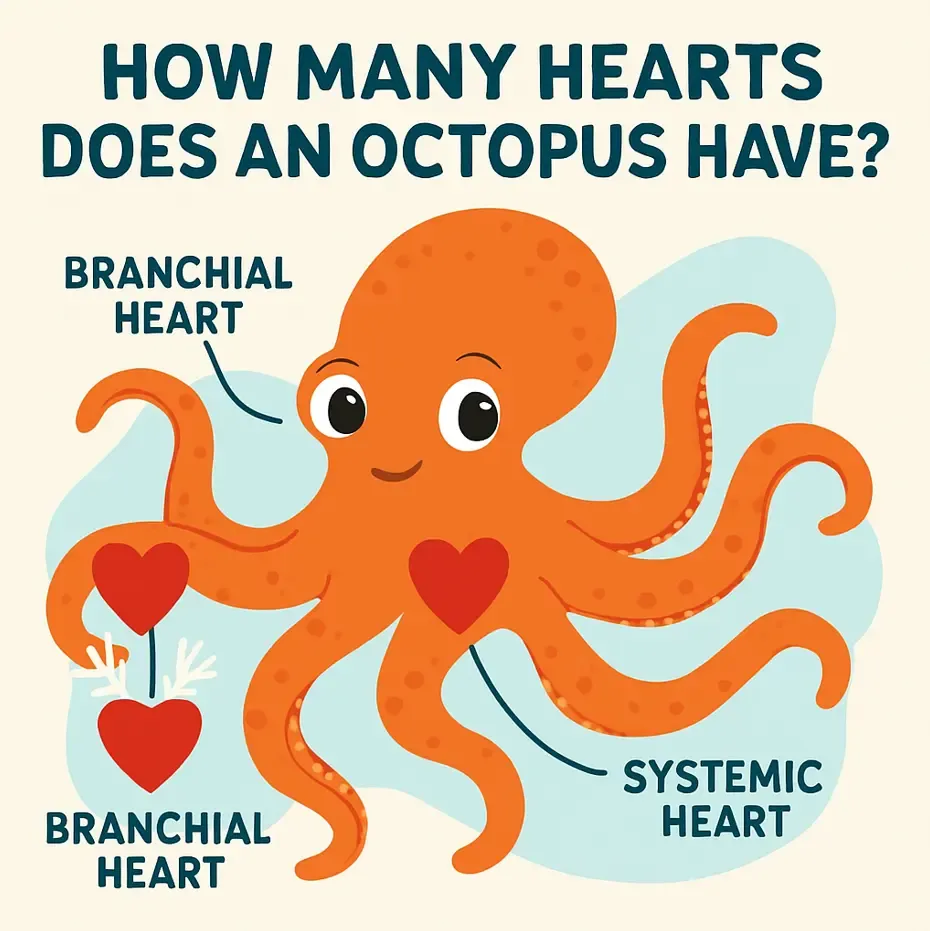
Have you ever wondered about the incredible anatomy of an octopus, one of the ocean's most intelligent and mysterious creatures? Beyond their eight arms and incredible camouflage, octopuses hide another fascinating secret: how many hearts does an octopus have? The answer is a surprising three!
That's right, these remarkable marine animals possess not one, but three distinct hearts, each playing a vital role in their unique circulatory system. Two of these are called branchial hearts. These smaller hearts are located near the octopus's gills and their specific job is to pump blood through the two gills, where it picks up oxygen from the seawater. Think of them as dedicated pumps for respiration.
The third heart is the systemic heart. This larger, main heart is responsible for circulating oxygenated blood to the rest of the octopus's body, including its brain, arms, and organs. This specialized setup ensures that the octopus gets a high-pressure flow of oxygen-rich blood throughout its active body, allowing it to be a swift hunter and a quick thinker.
Adding to their uniqueness, octopus blood isn't red like ours; it's a distinctive blue! This is because their blood uses a copper-based protein called hemocyanin to transport oxygen, rather than the iron-based hemoglobin found in vertebrates. This complex circulatory system with three hearts and blue blood is a brilliant adaptation that allows the octopus to thrive in its watery environment, supporting its highly active and intelligent lifestyle.
How many hearts does an octopus have?
OneTwoThreeFour
What do the two smaller hearts pump blood to?
The brainThe armsThe gillsThe eyes
What is the main heart called?
Arm heartSystemic heartGill heartBlue heart
What color is octopus blood?
RedGreenBlueClear
What protein makes octopus blood this color?
HemoglobinKeratinHemocyaninCollagen
What does this protein help transport?
FoodWaterOxygenWaste
What is the main idea of this passage?
Octopuses have many arms.Octopuses have three hearts for efficient blood flow.Octopus blood is always cold.Octopus hearts are very small.
What does having three hearts help the octopus do?
Swim slowlyHunt activelyStay stillBreathe less
Perfect For:
👩🏫 Teachers
• Reading comprehension practice
• Auto-graded assessments
• Literacy skill development
👨👩👧👦 Parents
• Reading practice at home
• Comprehension improvement
• Educational reading time
🏠 Homeschoolers
• Reading curriculum support
• Independent reading practice
• Progress monitoring
Reading Features:
📖
Reading Passage
Engaging fiction or nonfiction text
❓
Comprehension Quiz
Auto-graded questions
📊
Instant Feedback
Immediate results and scoring
📄
Printable Version
Download for offline reading
🔊
Read Aloud
Voice-over with word highlighting
Reviews & Ratings
No reviews yet. Be the first to share your experience!
Related Content
What's The Main Idea?
These short science texts are a great way to practice main idea. Students will read the paragraphs and then choose the m...
RI.2.6
Reading for Main Details—Birds
This informational text on birds is a great way to practice main idea. Students will read the passage, then give the mai...
RI.2.6RI.2.8
Koi Fish—What’s the Main Idea?
This informational text on koi fish is a great introduction to teaching main idea. Students will be asked, in multiple c...
RI.3.2RF.3.4RI.3.1
Reading for Main Details—Beavers Teeth
This informational text on beavers is a great way to practice main idea. Students will read the passage, then give the m...
RI.2.6RI.2.10
Spider—Main Idea
This informational text on spiders is a great introduction to teaching main idea. Students will be asked, in multiple ch...
RI.3.2RF.3.4RI.3.1RI.2.6
Reading for Main Details—Veternarians
Practie summarizing paragraphs with this fun informational text on veternarians! Students will give the main idea of eac...
RI.2.2RI.2.10
Penguins— Main Purpose
This informational text on penguins with comprehension questions is a great way to practice reading fluency and main ide...
RI.1.2RI.1.10RF.1.4.ARF.1.4.B
Informational Text —Learn About Dinosaurs
This informational text on dinosaurs with comprehension questions to follow is perfect for teaching main idea. Students ...
RF.3.4RF.3.4.ARF.3.4.CRI.3.2
Reading for Main Details—Orcas
Practie summarizing paragraphs with this fun science informational text on orcas! Students will give the main idea of ea...
RI.2.2RI.2.10
Informational Text — Habitats
This short informational text on habitats will teach your students what a habitat is, as well as provide some examples o...
RF.3.4.A
Ocean Animal Adaptations
Students will read a passage that provides information about various adaptations that marine animals have developed to t...
W.4.9.B
Informational Text —Elephants Facts
This informational text on elephants with comprehension questions to follow is perfect for teaching main idea. Students ...
RF.2.4.ARI.2.1RI.2.2RI.2.6
Main Idea and Supporting Details in Informational Text
RI.3.1RI.3.2RI.3.8
Informational Text — Astronauts
Practice this second grade context clues worksheet with this informational text on astronauts. Students will read the te...
RI.2.4RI.2.10RI.3.4RI.3.10
Informational Text —Importance of Sound
This Reading Informational Text Common Core standards calls for 4th graders to be able to effectively describe and analy...
RI.4.5
Informational Text — Penguins
This informational text on penguins is a great way to practice reading comprehension. Students will read the short passa...
RI.2.1RI.2.10
Informational Text — Armadillos
This informational text on armadillos is a great way to practice reading comprehension. Students will read the short pas...
RI.2.1RI.2.10
Informational Text —Bioluminescence
This informational text on bioluminescence will teach your students about this phenomenon. Examples in nature are provid...
RI.3.10RF.3.4RF.3.4.ARI.3.1
Informational Text —Sea Stars
Use this second grade worksheet on context clues with this informational text on sea stars. Students will read the text ...
RI.2.4RI.2.10RI.3.4RI.3.10
Informational Text —Snowflakes
This informational text on snowflakes will teach your students how snowflakes are formed. Images of several different fl...