Pollination: A Crucial Ecosystem Service — Reading Comprehension
Rate this|
3
Present
Present in classroom. No work saved
Assign
Classroom with student accounts, Track progress
Quick Play
No student accounts, assign with a link
Grades
4
5
Standards
RI.4.2
RI.4.3
RI.4.4
RI.5.1
RI.5.3
RI.5.4
PRINT+DIGITAL RESOURCE
This learning resource is available in interactive and printable formats. The interactive worksheet can be played online and assigned to students. The Printable PDF version can be downloaded and printed for completion by hand.
Explore the vital role of pollination beyond plant reproduction, as it sustains ecosystems by ensuring food security, promoting biodiversity, and maintaining healthy ecosystems. Learn how over 75% of the world's food crops depend on insect pollination, and discover the importance of cross-pollination in enhancing genetic diversity among plants. Understand how pollinators contribute to the well-being of various organisms, including birds, mammals, and insects. Test your comprehension with included multiple choice questions.
CONTENT PREVIEW
Expand content preview
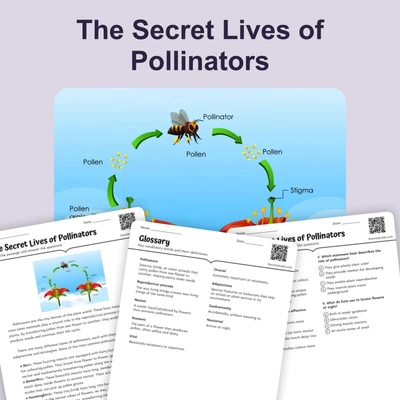
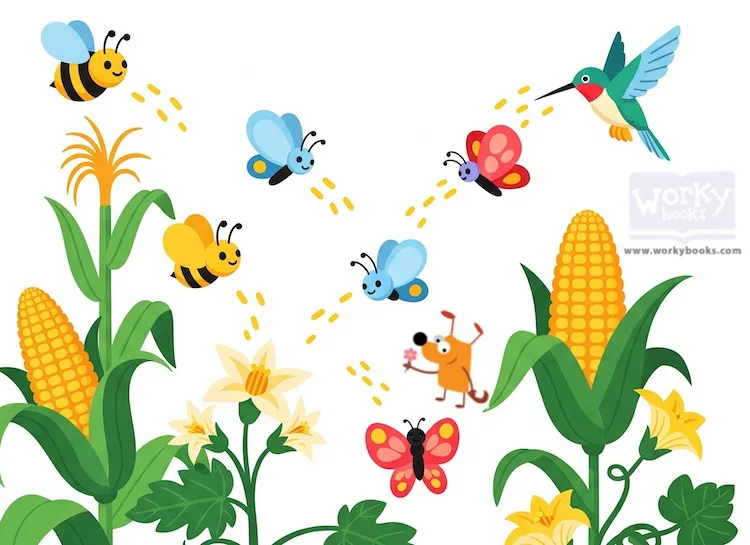
Pollination is not just about flowers multiplying; it's the lifeblood of our ecosystems. Over 75% of the world's food crops depend on insect pollination, providing us with fruits, vegetables, nuts, and even chocolate! Pollination is much more than just a process for plants to reproduce. It is a crucial ecosystem service that provides us with many benefits, including:
Food security: Many of the fruits, vegetables, and nuts that we eat rely on pollinators for their production. In fact,over 75% of the world's food crops require insect pollination.
Biodiversity: Pollination helps to maintain the diversity of plant life. As different pollinators visit different types of flowers, they promote cross-pollination, which leads to the genetic diversity of plants.
Healthy ecosystems: Pollinators play a vital role in maintaining healthy ecosystems by ensuring the reproduction of flowering plants. These plants provide food and habitat for many other organisms, including birds, mammals,and insects.
What is the benefit of pollination for plants?
It helps them to grow taller. It protects them from disease. c) It allows them to reproduce. d) It helps them to attract more sunlight.
How does pollination contribute to food security?
It helps to control the population of insects.It helps to produce more food crops. It helps to improve the taste of food.It helps to protect food from spoilage.
Why is pollination important for healthy ecosystems?
It helps to reduce pollution.It helps to control the climate.It helps to maintain biodiversity.It helps to prevent soil erosion.
Perfect For:
👩🏫 Teachers
• Reading comprehension practice
• Auto-graded assessments
• Literacy skill development
👨👩👧👦 Parents
• Reading practice at home
• Comprehension improvement
• Educational reading time
🏠 Homeschoolers
• Reading curriculum support
• Independent reading practice
• Progress monitoring
Reading Features:
📖
Reading Passage
Engaging fiction or nonfiction text
❓
Comprehension Quiz
Auto-graded questions
📊
Instant Feedback
Immediate results and scoring
📄
Printable Version
Download for offline reading
🔊
Read Aloud
Voice-over with word highlighting
Reviews & Ratings
No reviews yet. Be the first to share your experience!
Related Content
Identify Main Idea Graphic Organizer
This graphic organizer on main idea includes space to write the main idea and three supporting details.
RI.1.2RI.2.2RI.3.2RI.4.2
Main Idea and Suporting Details Graphic Organizer
This graphic organizer on main idea includes space to write the main idea and three supporting details.
RI.1.2RI.2.2RI.3.2RI.4.2
Snorkeling & Scuba Diving
RI.2.2RI.2.6RI.2.10RF.2.4.A
Main Idea and Details Graphic Organizer
This graphic organizer on main idea includes space to write the main idea and three supporting details.
RI.1.2RI.2.2RI.3.2RI.4.2
Informational Text —Healthy Teeth and Gums
RI.4.10RI.4.3RF.4.4RF.4.4.A
Natural Disasters and Urban flooding
This reading comprehension worksheet focuses on the topic of natural disasters, specifically urban flooding. Following t...
RI.4.44-ESS3ESS3.B4-ESS3-1
The Formation of Fossils
L.4.2.DL.4.6RI.4.4
Climate and Water Cycle
W.4.2.ARI.4.4RI.4.1
Ocean Acidification
Download this reading comprehension worksheet about ocean acidification. The worksheet includes an informational text ab...
RI.4.4
Informational Text —The History of Toothpaste
RI.4.4RI.4.4
Informational Text —Migratory Birds
Engage young minds with this worksheet that delves into the wonders of migratory birds. Learn about their extraordinary ...
RI.4.10RI.4.3RF.4.4RF.4.4.A
Informational Text —All About Dentists
Students read an informational text explaining what dentists do and how they are trained. Aligned to RI.4.3-2
RI.4.10RI.4.3RF.4.4RF.4.4.A
The Space Needle
Students read a passage about the history and features of Seattle's Space Needle, then answer comprehension questions to...
RI.4.2
The Rubik's Cube
RI.2.2RI.2.6RI.2.10RF.2.4.A
Understanding Climate Action Context Clues
Understanding Climate Action" worksheet, aligned with CCS L.4.4.A and NGSS. This resource introduces key concepts such a...
L.4.4.ARI.4.1RI.4.4
The Life and Legacy of Mahatma Gandhi
RF.5.4.ARF.5.4.BW.5.2L.5.6
Pandas—Informational Text
This informational text on pandas is a great way to practice reading comprehension. Students will read the text then ans...
RI.5.1RI.5.10
Types of Maps—Contextual Clues
Explore the world of maps with this worksheet. After reading the passage, students are presented with a series of questi...
RI.5.4
Mesopotamia—Informatonal Text
This informational text on Mesopotamia is a great way to practice reading comprehension. Students will read the text the...
RI.5.3RI.5.10
Vegetarian Diet—Words and Phrases in a Text
Fifth-grade students will explore the world of vegetarian diets through this engaging worksheet aligned with CCS.RI.5.4....