

Satellites Track Melting Glaciers
Interactive passage with audio narration, comprehension questions, and printable PDF.
By completing this purchase you agree to our Terms of Use and Privacy Policy. Your subscription renews automatically until you cancel. You can cancel anytime from your account settings. All sales are final and non-refundable. Digital content is available for download in your account immediately upon purchase.
What's included
Satellites Track Melting Glaciers preview and details
About this printable Satellites Track Melting Glaciers science reading passage, NGSS-aligned (Grades 5-8)
Sample passage and quiz from Satellites Track Melting Glaciers
Reading passage and comprehension quiz preview
Satellites Track Melting Glaciers
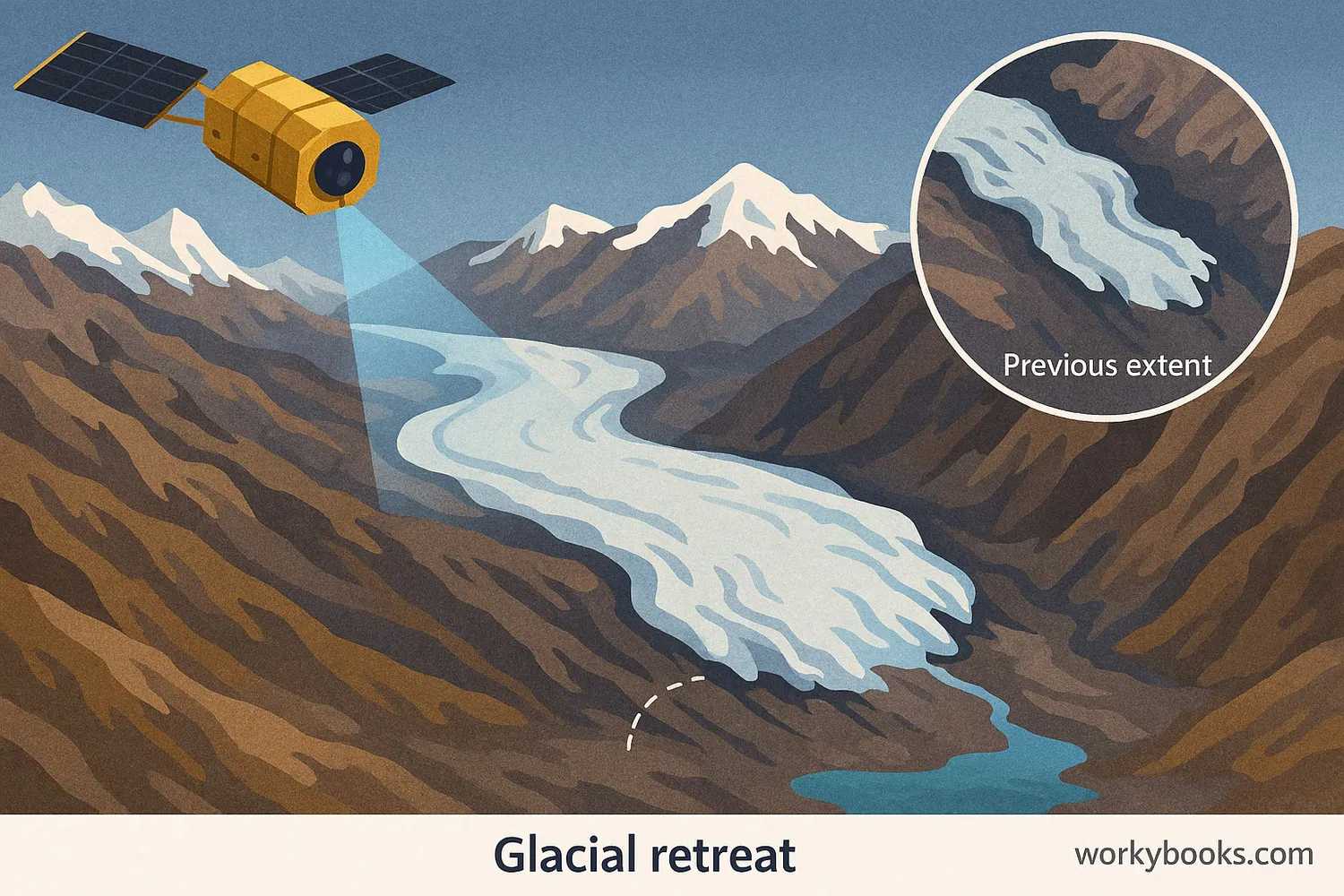
From hundreds of miles above Earth, satellites give scientists a powerful tool to study climate change. These orbiting instruments photograph and measure the same glaciers, ice sheets, and sea ice over and over. Scientists compare images taken years apart to watch ice shrinking across the planet. This steady observation provides clear evidence of global warming.
Satellites use remote sensing technology to collect data without touching the ice. Cameras capture visible light images showing glacier boundaries and surface features. Other instruments measure ice thickness using radar waves that penetrate the surface. Scientists track glaciers retreating up mountain valleys and Arctic sea ice covering less area each summer. Large ice sheets in Greenland and Antarctica show thinning in satellite measurements. The power of satellites lies in consistency and coverage. The same instruments watch the whole Earth steadily over decades.
Satellite data reveals important patterns in ice loss. Evidence shows that glacier retreat has accelerated over the past century. In Alaska, glaciers have lost billions of tons of ice since satellites began monitoring in the 1970s. Satellites also measure rising sea levels as melting ice adds water to oceans. Ocean temperature sensors on satellites detect warming waters that melt ice from below. These multiple measurements help scientists understand the factors driving climate change.
The connection between ice loss and warming creates a feedback loop. As bright ice disappears, darker surfaces underneath absorb more heat. This process involves albedo, which measures how much sunlight a surface reflects. Ice has high albedo and reflects most sunlight back to space. Dark ocean water or rock has low albedo and absorbs heat. When ice melts, Earth's overall albedo decreases. The planet absorbs more solar radiation, causing additional warming and more ice melt.
Understanding ice loss matters for predicting future climate changes. Melting glaciers and ice sheets contribute to sea level rise that can affect coastal communities. Satellite observations provide the long-term data scientists need to track these changes. This evidence helps researchers ask better questions about what factors have caused rising global temperatures. Satellites give us eyes in the sky to monitor our changing planet.
Interesting Fact: Some satellites can detect ice thickness changes as small as one centimeter from space. This precision helps scientists measure even gradual melting over time.
Comprehension quiz (10 questions)
1. What do satellites use to collect data about glaciers without touching them?
2. According to the passage, what has happened to glaciers in Alaska since the 1970s?
3. What does albedo measure?
4. Why is the consistency of satellite observations important for studying climate change?
5. How does the melting of ice create a feedback loop that causes more warming?
6. Based on the passage, which statement best describes how satellites help scientists study climate change?
7. What can scientists detect by comparing satellite images taken years apart?
8. Ice has a high albedo, which means it reflects most sunlight back to space.
9. Satellites can only measure ice thickness but cannot take photographs of glaciers.
10. According to the passage, melting glaciers and ice sheets contribute to sea level rise.
Perfect for the way you teach
- Build comprehension skills
- Auto-graded quiz
- Differentiated reading
- Read together at home
- Improve fluency
- Quiet reading time
- Reading curriculum support
- Independent practice
- Track Lexile growth