Reading Passage
The Hottest Planet in the Solar System
Interactive passage with audio narration, comprehension questions, and printable PDF.
|
18
Grades 3–7ReadingElaScienceEnglish · SpanishInteractive · Printable
Aligned toMS-ESS1-3
What's included
Reading passage
Audio narration
Comprehension quiz
Writing activity
Glossary & flashcards
Differentiated version
Spanish translation
The Hottest Planet in the Solar System preview and details
About this printable The Hottest Planet in the Solar System science reading passage, NGSS-aligned (Grades 3-7)
This NGSS-aligned middle school reading passage explains why Venus is the hottest planet in our solar system. Students learn that although Mercury is closer to the Sun, Venus has a thick carbon dioxide atmosphere that traps heat through the greenhouse effect. The passage explores how sulfuric acid clouds and a slow rotation also contribute to Venus's extreme temperature. With key vocabulary and real-world connections, this text builds science comprehension while supporting NGSS Earth and Space Science standards focused on planetary systems and climate impacts.
Written by Workybooks TeamPublished by Workybooks
Preview
Sample passage and quiz from The Hottest Planet in the Solar System
Reading passage and comprehension quiz preview
The Hottest Planet in the Solar System
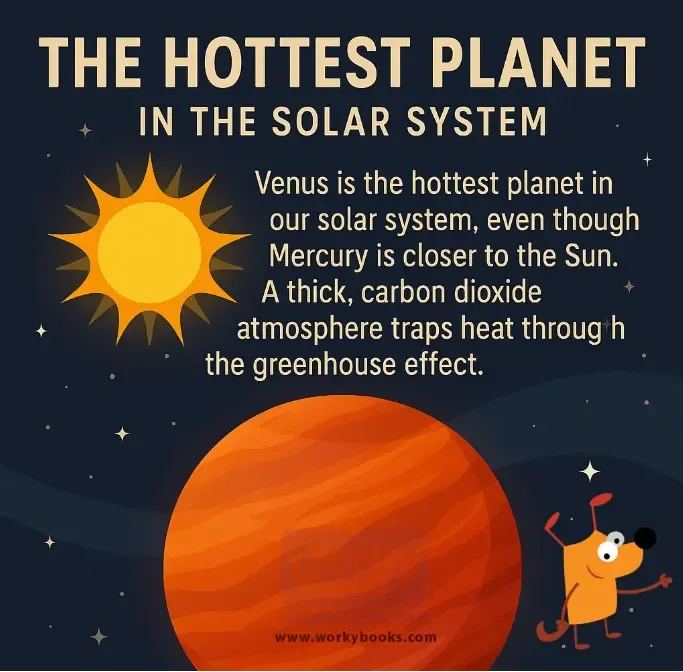
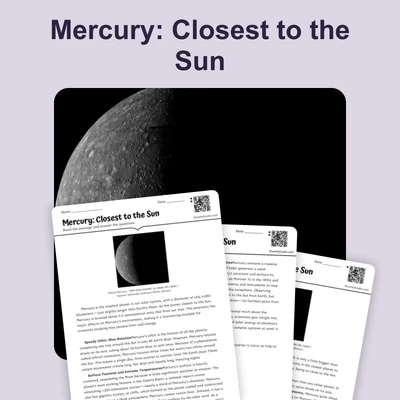
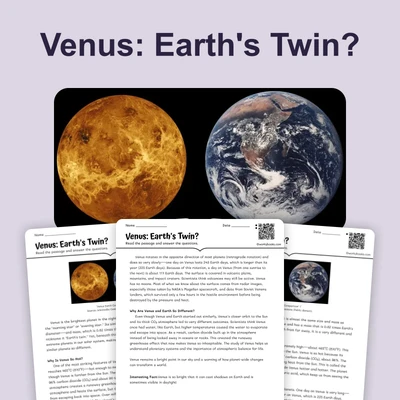
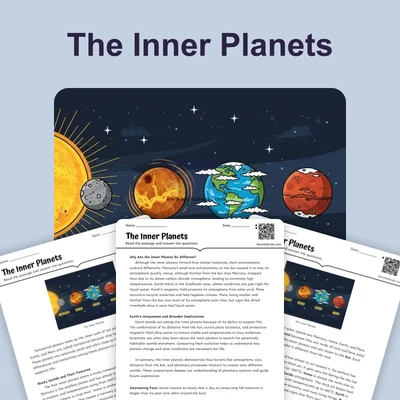
The hottest planet in our solar system is Venus. Even though Mercury is the closest planet to the Sun, Venus is hotter because of its thick atmosphere. Venus is the second planet from the Sun and has a surface temperature of around 465°C (869°F)—hot enough to melt lead!
Venus has a thick layer of carbon dioxide (CO₂) gas in its atmosphere. This gas traps heat from the Sun in a process called the greenhouse effect. Sunlight passes through the atmosphere, but the heat gets trapped and can’t escape. This makes Venus much hotter than it would be based only on its distance from the Sun.
The clouds on Venus are also made of sulfuric acid, which reflects sunlight and keeps the planet extremely bright. But these clouds do not cool the planet. Instead, they add to the trapping of heat, making Venus the hottest world in the solar system—even hotter than Mercury, which has no atmosphere to hold in heat.
Scientists study Venus to understand how greenhouse gases affect planets. Learning about Venus helps us understand how climate change could affect Earth in the future.
Fun Fact: A day on Venus is longer than its year—it takes Venus more time to rotate once than to orbit the Sun!
Comprehension quiz (8 questions)
1. Which planet is the hottest in the solar system?
Mercury
Earth
Mars
Venus
2. What makes Venus hotter than Mercury?
Its closer distance to the Sun
Its thick atmosphere traps heat
Its surface is made of lava
It rotates faster
3. What gas is most responsible for the greenhouse effect on Venus?
Oxygen
Nitrogen
Carbon dioxide
Helium
4. What is the surface temperature on Venus?
100°C
250°C
465°C
900°C
5. What are Venus’s clouds made of?
Water vapor
Sulfuric acid
Methane gas
Dust and ice
6. Why is Mercury not as hot as Venus?
Mercury is farther from the Sun
Mercury has water
Mercury has no atmosphere to trap heat
Mercury rotates faster
7. What is the main idea of the passage?
Venus and Earth are the same
Venus has water and oxygen
Venus is the hottest planet due to its thick atmosphere
Mercury is the most dangerous planet
8. How can studying Venus help scientists?
It shows how to live on other planets
It helps predict solar flares
It teaches about the greenhouse effect and climate change
It explains how the Moon formed
Who it's for
Perfect for the way you teach
Teachers
- Build comprehension skills
- Auto-graded quiz
- Differentiated reading
Parents
- Read together at home
- Improve fluency
- Quiet reading time
Homeschoolers
- Reading curriculum support
- Independent practice
- Track Lexile growth
Topics