The Solar System-Short Story
Interactive passage with audio narration, comprehension questions, and printable PDF.
What's included
The Solar System-Short Story preview and details
About this printable The Solar System-Short Story science reading passage, NGSS-aligned (Grades 4-5)
Sample passage and quiz from The Solar System-Short Story
Reading passage and comprehension quiz preview
The Solar System
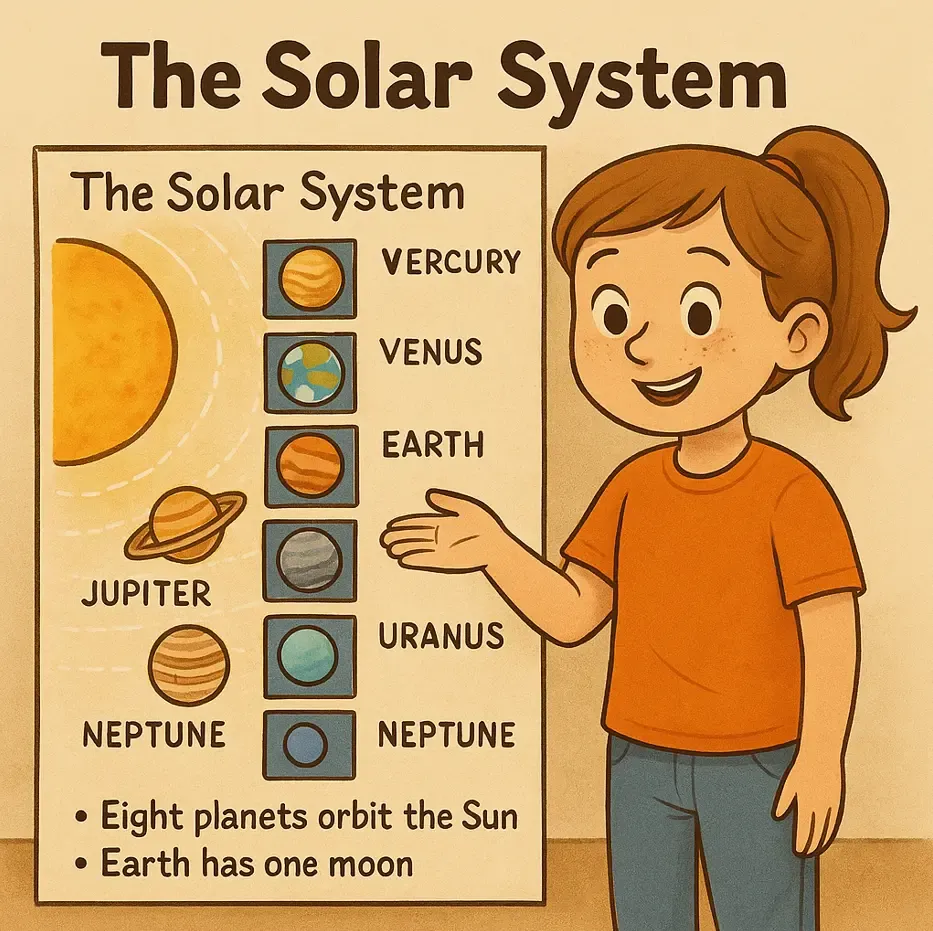
Jo is doing a science project on the planets in our solar system. She learned that there are eight planets orbiting the Sun. The planets closest to the Sun are Mercury, Venus, Earth and Mars. These planets are made of rock and metal. The outer planets - Jupiter, Saturn, Uranus and Neptune - are large gas planets.
Earth is the only planet known to have life. Earth takes 365 days to orbit the Sun. It rotates every 24 hours on its axis, which creates day and night. Earth has one moon, which orbits around it. Jo made a poster board showing the order of the planets and some facts about each one. She included photos of each planet too. On Science Night, Jo proudly presented her project about our amazing solar system!
Comprehension quiz (4 questions)
1. What is Jo creating a science project on?
2. How many planets orbit the Sun?
3. What are the four inner planets made of?
4. What causes day and night on Earth?
Common Core standards for The Solar System-Short Story
By the end of the year, read and comprehend informational texts, including history/social studies, science, and technical texts, at the high end of the grades 2–3 text complexity band independently and proficiently.
By the end of the year, read and comprehend literature, including stories and poetry, in the grades 2–3 text complexity band proficiently, with scaffolding as needed at the high end of the range.
Recount stories, including fables and folktales from diverse cultures, and determine their central message, lesson, or moral.
Ask and answer questions to demonstrate understanding of a text, referring explicitly to the text as the basis for the answers.
By the end of the year, read and comprehend literature, including stories, dramas, and poetry, at the high end of the grades 2–3 text complexity band independently and proficiently.
Recount stories, including fables, folktales, and myths from diverse cultures; determine the central message, lesson, or moral and explain how it is conveyed through key details in the text.
Describe characters in a story (e.g., their traits, motivations, or feelings) and explain how their actions contribute to the sequence of events.
Perfect for the way you teach
- Build comprehension skills
- Auto-graded quiz
- Differentiated reading
- Read together at home
- Improve fluency
- Quiet reading time
- Reading curriculum support
- Independent practice
- Track Lexile growth