The States of Matter: Solid
Interactive passage with audio narration, comprehension questions, and printable PDF.
What's included
The States of Matter: Solid preview and details
About this printable The States of Matter: Solid science reading passage, NGSS-aligned (Grades 4-5)
Sample passage and quiz from The States of Matter: Solid
Reading passage and comprehension quiz preview
States of Matter
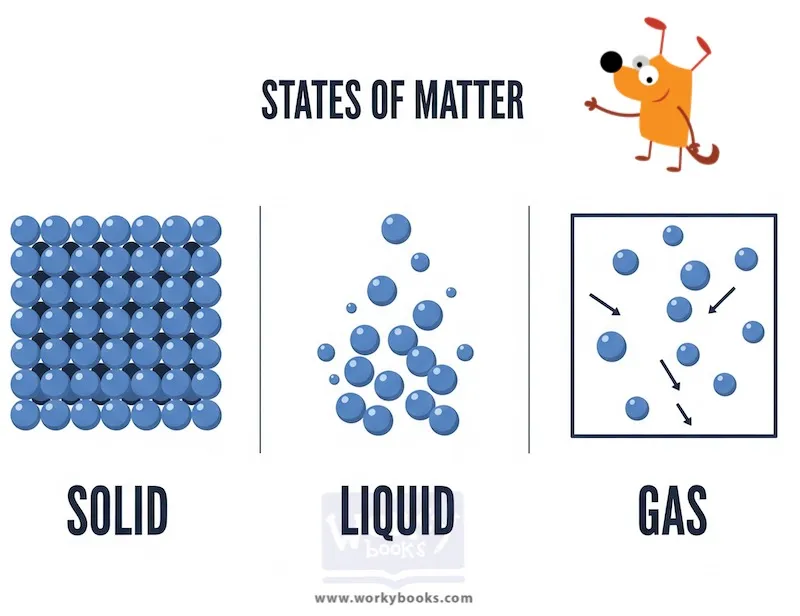
Matter is anything that takes up space and mass. All matter exists in one of three main physical states: solid, liquid or gas. In a solid, particles are packed tightly together so they can only vibrate in place, keeping a definite shape and volume. Solids also cannot be easily compressed. Particles in a liquid flow freely past each other and have a definite volume but change shape based on their container. Liquids can be poured easily. Gas particles move very rapidly and spread out, changing both shape and volume to fit their container. Adding or removing heat energy causes physical changes between the states of matter.
Comprehension quiz (4 questions)
1. What is the main idea of the passage?
2. What makes up all matter?
3. How are solid particles arranged compared to liquids?
4. What allows liquids to change shape?
Common Core standards for The States of Matter: Solid
Determine the main idea of a text and explain how it is supported by key details; summarize the text.
Explain events, procedures, ideas, or concepts in a historical, scientific, or technical text, including what happened and why, based on specific information in the text.
Determine the meaning of general academic and domain-specific words or phrases in a text relevant to a grade 4 topic or subject area.
Quote accurately from a text when explaining what the text says explicitly and when drawing inferences from the text.
Explain the relationships or interactions between two or more individuals, events, ideas, or concepts in a historical, scientific, or technical text based on specific information in the text.
Determine the meaning of general academic and domain-specific words and phrases in a text relevant to a grade 5 topic or subject area.
Perfect for the way you teach
- Build comprehension skills
- Auto-graded quiz
- Differentiated reading
- Read together at home
- Improve fluency
- Quiet reading time
- Reading curriculum support
- Independent practice
- Track Lexile growth