Finding Volume of 3D Shapes
Interactive worksheet with auto-grading, instant feedback, and printable PDF.
What's included
Finding Volume of 3D Shapes preview and details
About this worksheet
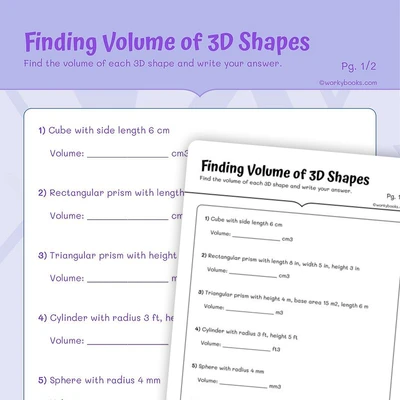
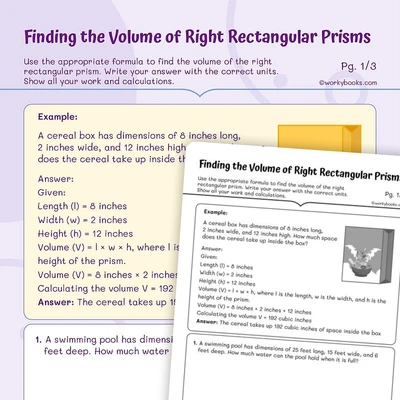
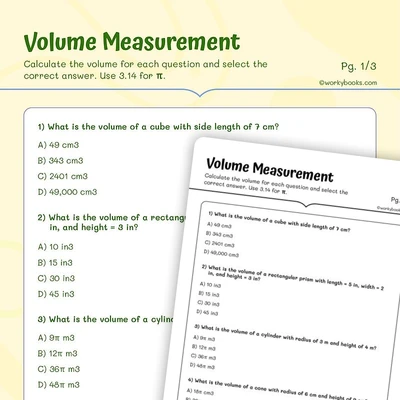
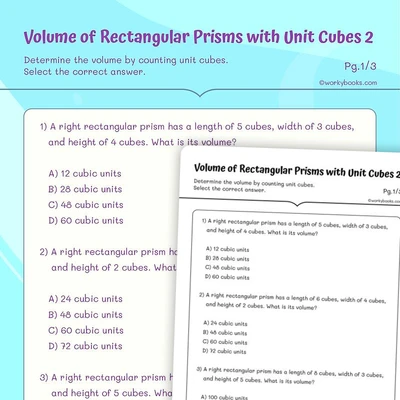
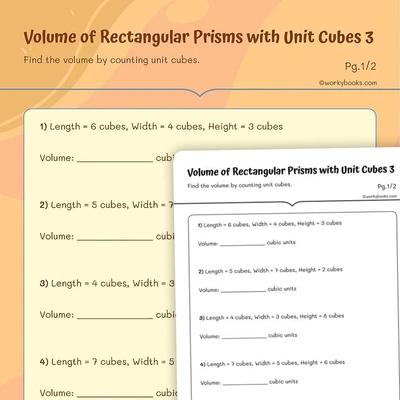
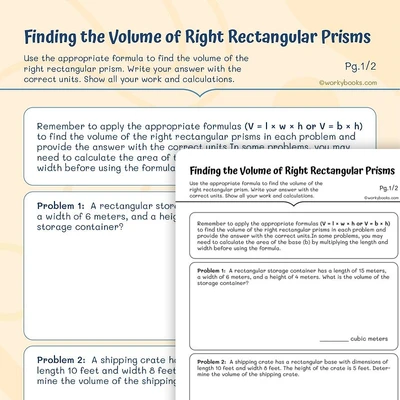
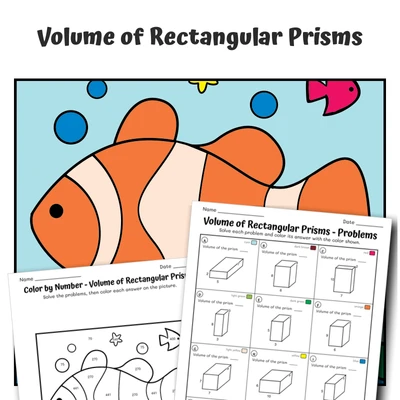
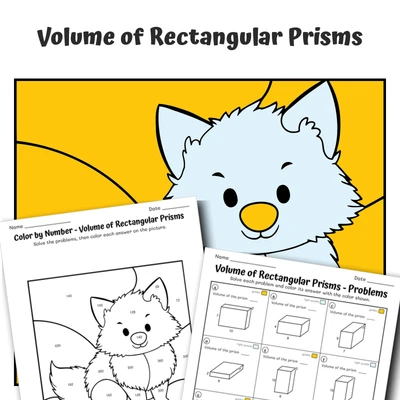
Finding Volume of 3D Shapes explores comprehensive volume calculations across various three-dimensional geometrical figures. The material progresses through different shapes including cubes, rectangular prisms, triangular prisms, cylinders, spheres, and cones, requiring students to apply appropriate formulas for each shape type. The problems incorporate whole numbers, decimals, and fractional measurements, building a thorough understanding of volume calculation in different contexts.
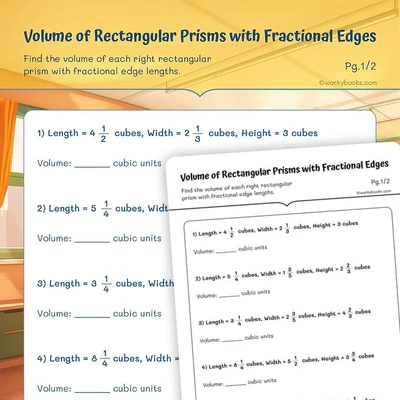
This interactive and printable worksheet, that aligns with the Common Core State Standards, Finding Volume of 3D Shapes, culminates with advanced problems involving fractional edge lengths and composite shapes like L-shaped prisms. Students are challenged to demonstrate their comprehension through a final explanatory question about volume calculation methods. The progression from basic to complex shapes helps students develop confidence in applying volume formulas while understanding the relationship between a shape's dimensions and its volume.
What will your child learn through this worksheet?
- Application of different volume formulas for various 3D shapes
- Understanding of the relationship between dimensions and volume
- Calculation strategies for shapes with fractional measurements
- Problem-solving with composite shapes
Learning Outcomes
- Calculate volumes using appropriate formulas with 90% accuracy
- Differentiate between volume formulas for different 3D shapes
- Solve problems involving fractional and decimal measurements
- Explain volume calculation methods using mathematical reasoning
Cognitive
- Through this interactive worksheet, students develop formula selection and application skills
- Practice mathematical reasoning with various geometric shapes
Psychomotor
- This worksheet enhances spatial visualization abilities
- Improves precision in mathematical calculations and notation
Affective
- Develops confidence in handling complex geometric calculations through this interactive learning experience
- Builds appreciation for systematic problem-solving approaches
Reinforce
- This worksheet strengthens understanding of volume concepts through varied applications
- Encourages clear mathematical communication and explanation
Tags
3D shapes, volume calculation, geometric formulas, spatial reasoning, mathematical computation, cubic units, geometric measurement, problem-solving, composite shapes, fractional measurements, three-dimensional geometry, mathematical reasoning, volume formulas, geometric concepts, spatial visualization
Common Core standards covered
Relate volume to the operations of multiplication and addition and solve real world and mathematical problems involving volume.
Find the volume of a right rectangular prism with whole-number side lengths by packing it with unit cubes, and show that the volume is the same as would be found by multiplying the edge lengths, equivalently by multiplying the height by the area of the base. Represent threefold whole-number products as volumes, e.g., to represent the associative property of multiplication.
Apply the formulas V = l × w × h and V = b × h for rectangular prisms to find volumes of right rectangular prisms with whole-number edge lengths in the context of solving real world and mathematical problems.
Recognize volume as additive. Find volumes of solid figures composed of two non-overlapping right rectangular prisms by adding the volumes of the non-overlapping parts, applying this technique to solve real world problems.
Perfect for the way you teach
- Assign in one click
- Track progress per student
- Auto-graded results
- Practice at home
- Print or do on-screen
- Build skill mastery
- Standards-aligned
- Self-paced
- Ready-to-use today