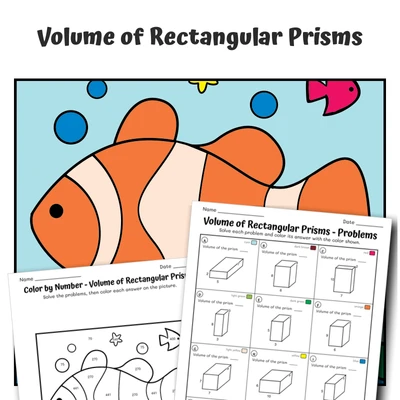
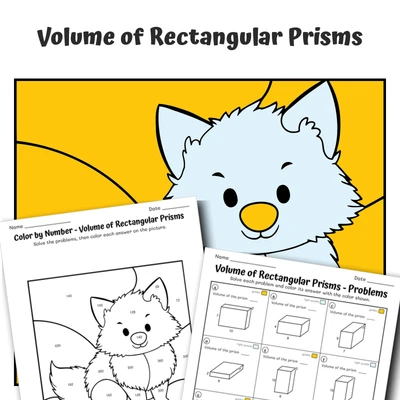
Volume of 3D Shapes
Interactive worksheet with auto-grading, instant feedback, and printable PDF.
By completing this purchase you agree to our Terms of Use and Privacy Policy. Your subscription renews automatically until you cancel. You can cancel anytime from your account settings. All sales are final and non-refundable. Digital content is available for download in your account immediately upon purchase.
What's included
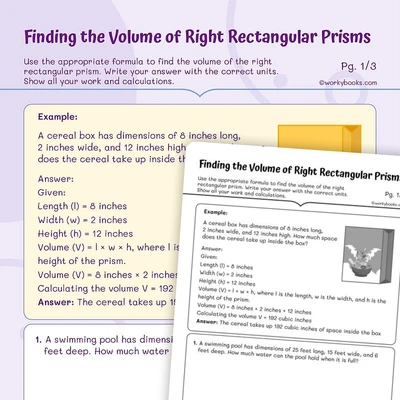
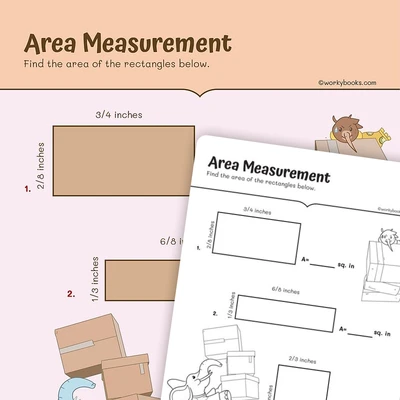
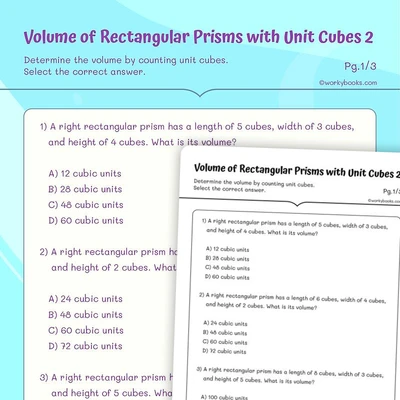
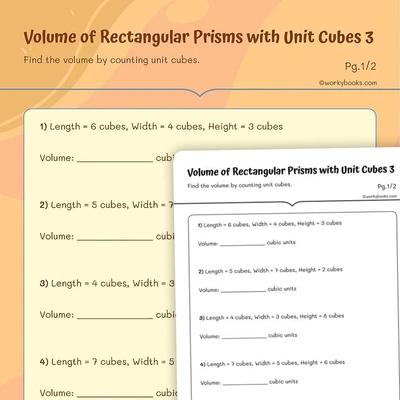
Volume of 3D Shapes preview and details
About this worksheet
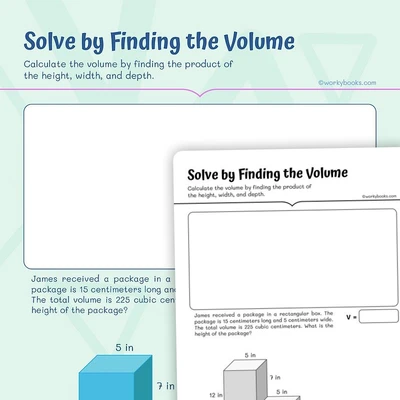
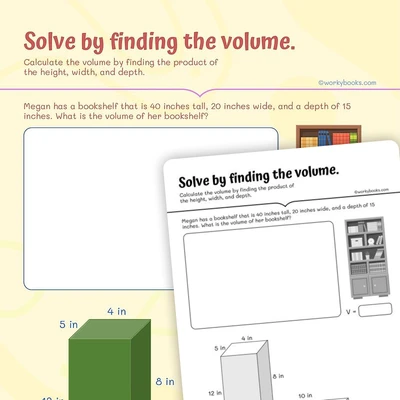
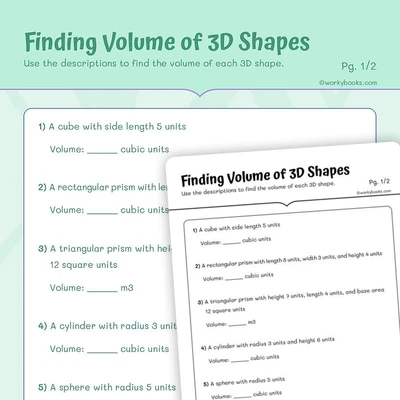
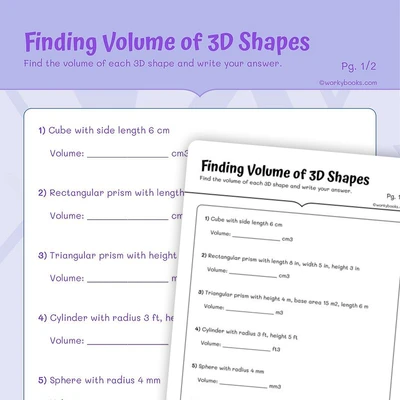
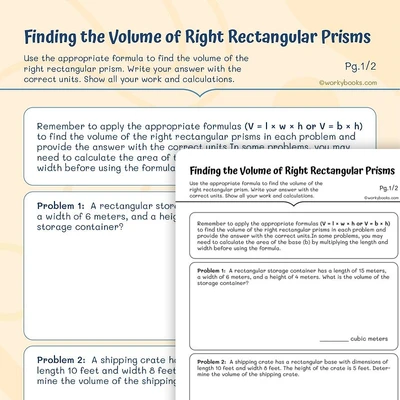
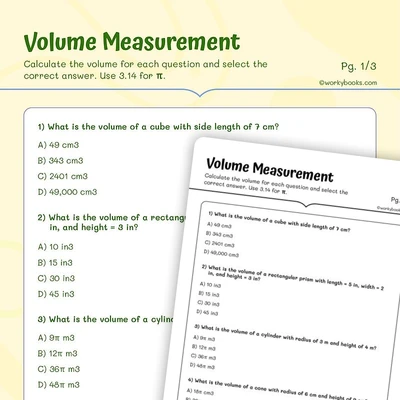
Finding the Volume of 3D Shapes 2 advances students' understanding of volume calculation through diverse three-dimensional geometric figures. The material presents a comprehensive set of problems involving regular prisms, cylinders, spheres, and cones with varying dimensions and units of measurement. Students work with different measurement units (inches, centimeters, meters, yards) while applying appropriate volume formulas for each shape type.
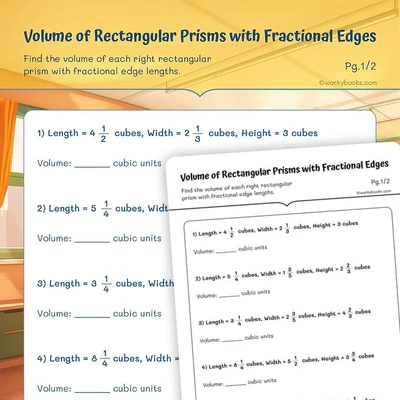
This interactive and printable worksheet, that aligns with the Common Core State Standards, Finding the Volume of 3D Shapes 2, progresses from basic rectangular prisms to more complex shapes including composite figures like L-shaped prisms and shapes with fractional dimensions. The worksheet culminates with a reflective question that encourages students to articulate their understanding of volume calculation methods. Each problem requires careful attention to units and proper application of volume formulas, helping students develop strong geometric reasoning skills.
What will your child learn through this worksheet?
- Volume calculation methods for various 3D shapes
- Unit conversion and consistency in measurements
- Application of different volume formulas
- Problem-solving with mixed units and fractional measurements
Learning Outcomes
- Apply appropriate volume formulas to different 3D shapes with 90% accuracy
- Convert between different units of measurement correctly
- Calculate volumes involving fractional and decimal measurements
- Demonstrate understanding of composite shape volume calculations
Cognitive
- Through this interactive worksheet, students develop strategic problem-solving approaches
- Practice applying appropriate formulas for different geometric shapes
Psychomotor
- This worksheet enhances precision in mathematical calculations
- Improves ability to visualize three-dimensional shapes
Affective
- Develops confidence in handling complex geometric problems through this interactive learning experience
- Builds appreciation for systematic problem-solving methods
Reinforce
- This worksheet strengthens understanding of volume relationships across different shapes
- Encourages clear mathematical communication and reasoning
Tags
3D shapes, volume calculation, geometric measurement, spatial reasoning, mathematical formulas, unit conversion, composite shapes, fractional dimensions, problem-solving, geometric visualization, cubic units, mathematical computation, geometric reasoning, dimensional analysis, mathematical communication
Common Core standards covered
Relate volume to the operations of multiplication and addition and solve real world and mathematical problems involving volume.
Find the volume of a right rectangular prism with whole-number side lengths by packing it with unit cubes, and show that the volume is the same as would be found by multiplying the edge lengths, equivalently by multiplying the height by the area of the base. Represent threefold whole-number products as volumes, e.g., to represent the associative property of multiplication.
Apply the formulas V = l × w × h and V = b × h for rectangular prisms to find volumes of right rectangular prisms with whole-number edge lengths in the context of solving real world and mathematical problems.
Recognize volume as additive. Find volumes of solid figures composed of two non-overlapping right rectangular prisms by adding the volumes of the non-overlapping parts, applying this technique to solve real world problems.
Perfect for the way you teach
- Assign in one click
- Track progress per student
- Auto-graded results
- Practice at home
- Print or do on-screen
- Build skill mastery
- Standards-aligned
- Self-paced
- Ready-to-use today