
Where Do Animals Get Energy?
Interactive worksheet with auto-grading, instant feedback, and printable PDF.
By completing this purchase you agree to our Terms of Use and Privacy Policy. Your subscription renews automatically until you cancel. You can cancel anytime from your account settings. All sales are final and non-refundable. Digital content is available for download in your account immediately upon purchase.
What's included
Where Do Animals Get Energy? preview and details
About this worksheet
Where Do Animals Get Energy?: Grade 4 Science Worksheet
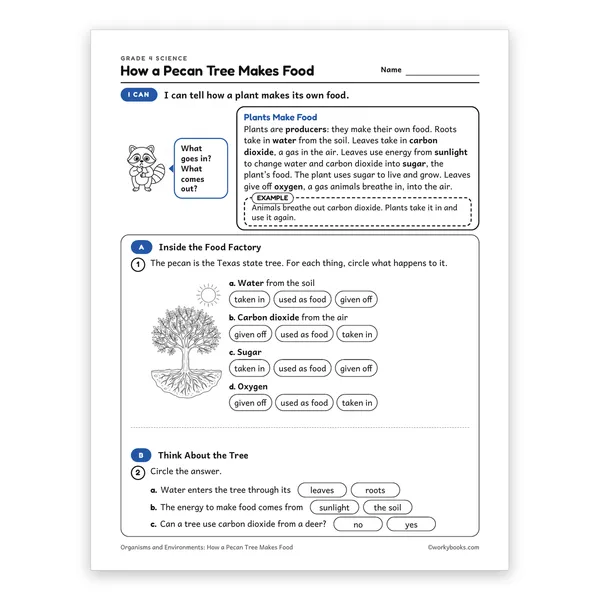
Can an alligator make its own food? Students learn that plants make their own food using sunlight, while animals, including people, must eat plants or other animals. They sort an orange tree, an alligator, a heron, and sawgrass as food makers or food eaters, then follow the energy as a heron eats a fish and as they eat an orange themselves.
Key Science Vocabulary
- energy: what living things need to move, grow, and stay alive
- producer: a plant that makes its own food using sunlight
- consumer: an animal that eats to get energy
- food source: the plant or animal that is eaten
- sunlight: the energy plants use to make food
What Students Do
- Read a short teach box on why animals must eat and how energy passes in food
- Part A: four big picture cards; circle makes food or eats food
- Part B: two is-eaten-by picture pairs; circle where the energy goes
- Answer key with a red reason line
Standards
Florida SC.4.L.17.2: Explain that animals, including humans, cannot make their own food and that when animals eat plants or other animals, the energy stored in the food source is passed to them. Builds toward NGSS 5-PS3-1 (energy in animals’ food was once energy from the Sun).
Where It Fits in Grades 3 to 8
Earlier grades learn what plants and animals need. Grade 4 shows that energy passes from food to the eater. Next comes the full food chain, and in grade 5 and middle school, food webs, photosynthesis, and energy flow in ecosystems.
Teaching Tip
Ask students what they ate for breakfast and trace each food back to a plant. Every chain ends at a plant, and that sets up the next sheet on food chains. Prints clearly in black and white and takes 8 to 10 minutes.
Perfect for the way you teach
- Assign in one click
- Track progress per student
- Auto-graded results
- Practice at home
- Print or do on-screen
- Build skill mastery
- Standards-aligned
- Self-paced
- Ready-to-use today