How Baby Animals Grow Up
Interactive worksheet with auto-grading, instant feedback, and printable PDF.
By completing this purchase you agree to our Terms of Use and Privacy Policy. Your subscription renews automatically until you cancel. You can cancel anytime from your account settings. All sales are final and non-refundable. Digital content is available for download in your account immediately upon purchase.
What's included
How Baby Animals Grow Up preview and details
About this worksheet
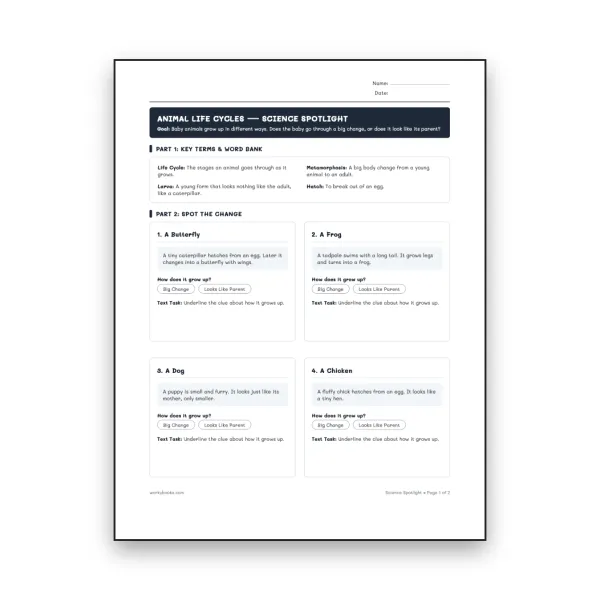
Give students fresh practice with animal life cycles in this quick Science Spotlight. Using four brand-new animals — a bee, a beetle, a cat, and a duck — children name the young animal from each story, then decide whether it goes through a big change (metamorphosis) or simply looks like its parent from the start.
The sort keeps working on the same big idea: not every baby looks like a small copy of its parents. A grub becomes a striped bee and a wormy mealworm becomes a hard, shiny beetle — big changes — while a kitten and a duckling already look like the adults they will become. A careful detail sharpens the reasoning: the duckling hatches from an egg yet still looks like a little duck, so students learn that hatching is not the same as metamorphosis.
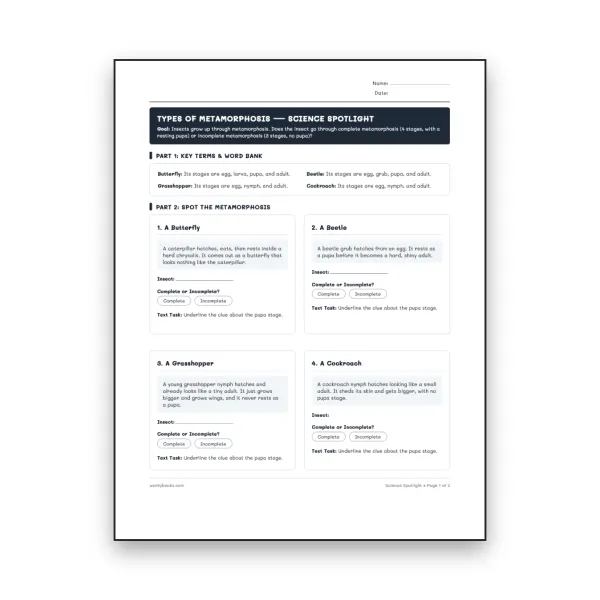
A four-word word bank gives the young-animal names students will write in — grub, mealworm, kitten, duckling — with the science tucked into each definition, and a built-in underline task builds close reading. The clean answer key shows the young animal, the correct choice, and the clue in red.
Built for grades 2–3 and aligned to NGSS 3-LS1-1, this makes an easy warm-up, review, or second practice sheet in a life-cycles set. Just print and teach.
Perfect for the way you teach
- Assign in one click
- Track progress per student
- Auto-graded results
- Practice at home
- Print or do on-screen
- Build skill mastery
- Standards-aligned
- Self-paced
- Ready-to-use today