Will It Rain?
Interactive worksheet with auto-grading, instant feedback, and printable PDF.
By completing this purchase you agree to our Terms of Use and Privacy Policy. Your subscription renews automatically until you cancel. You can cancel anytime from your account settings. All sales are final and non-refundable. Digital content is available for download in your account immediately upon purchase.
What's included
Will It Rain? preview and details
About this worksheet
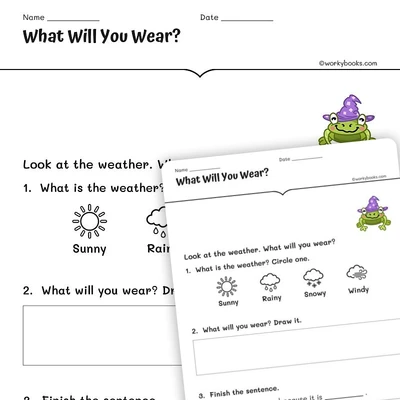
Teach your youngest scientists to predict the weather with this big-print claim-and-evidence worksheet for Kindergarten through Grade 2. In three simple steps, children read the sky (clear or stormy), predict whether it will rain, then finish the sentence frame I think it will ____ because I see ____.
This is a true forecasting move - claiming what is coming next and backing it with evidence they can see, like dark clouds or a clear sky. That little word because brings claim-evidence-reasoning to a level your youngest learners can handle, building science talk and opinion writing together. Two labeled word banks help early writers complete both blanks on their own.
Aligned to NGSS K-ESS2-1 and K-ESS3-2 (observe weather and forecast to prepare) and grade-banded ELA standards for speaking, listening, and opinion writing (SL.K.5-SL.2.5, W.K.1-W.2.1), it extends the reasoning beyond describing the weather to predicting it. Just print and go.
- One clean page, large kid-friendly print
- Read the sky, predict, and a because sentence frame
- Two word banks for independent work
- Print-ready PDF, no prep
Common Core standards covered
Add drawings or other visual displays to descriptions when appropriate to clarify ideas, thoughts, and feelings.
Create audio recordings of stories or poems; add drawings or other visual displays to stories or recounts of experiences when appropriate to clarify ideas, thoughts, and feelings.
Write opinion pieces in which they introduce the topic or name the book they are writing about, state an opinion, supply a reason for the opinion, and provide some sense of closure.
Write opinion pieces in which they introduce the topic or book they are writing about, state an opinion, supply reasons that support the opinion, use linking words (e.g., because, and, also) to connect opinion and reasons, and provide a concluding statement or section.
Use a combination of drawing, dictating, and writing to compose opinion pieces in which they tell a reader the topic or the name of the book they are writing about and state an opinion or preference about the topic or book (e.g., My favorite book is...).
Perfect for the way you teach
- Assign in one click
- Track progress per student
- Auto-graded results
- Practice at home
- Print or do on-screen
- Build skill mastery
- Standards-aligned
- Self-paced
- Ready-to-use today