5th Grade Fraction Word Problems: A Simple Guide from a Teacher
Let me be honest. Fractions are hard. Fraction word problems are harder. This post is my best attempt to explain 5th grade fraction word problems, the way I explain them to my class. No jargon. Lots of pictures. And real practice problems at the end, with answers.
I’ve taught 5th grade for a long time, and every year I see the same thing. A student can add 3/4 + 2/3 on a worksheet with no trouble. Then they read a short story problem about a girl running two days in a row, and they freeze.
That’s not because they’re bad at math. It’s because word problems ask for something different. They ask kids to figure out what to do before they do it. That’s a skill, and it can be taught.
What 5th graders need to know about fractions
Fifth grade is the big fraction year. By the end of the year, students should be able to:
- Add and subtract fractions with different bottom numbers (like 1/2 + 1/3)
- Understand that dividing can make a fraction (3 ÷ 4 = 3/4)
- Multiply fractions (2/3 of 24, or 1/2 × 3/4)
- Divide with unit fractions (3 ÷ 1/4, or 1/2 ÷ 4)
One quick note about that last one. In 5th grade, students only divide with unit fractions. Those are fractions with a 1 on top, like 1/4 or 1/3. Dividing any fraction by any fraction, like 3/4 ÷ 2/3, is a 6th grade skill. So if a “5th grade” worksheet has that, it’s really a 6th grade worksheet.
The 4 kinds of fraction word problems
Almost every fraction word problem in 5th grade is one of these four. Once students can spot which kind they’re looking at, the hard part is done.
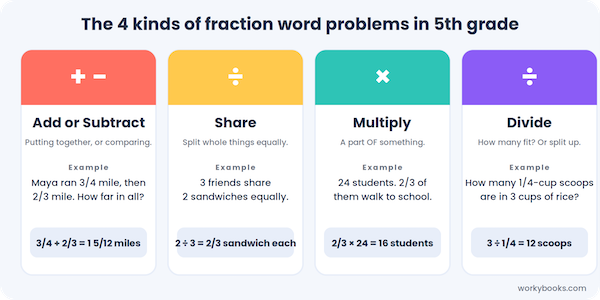
Let’s go through each one.
1. Add or subtract
Something is being put together, or two amounts are being compared.
Example: Maya ran 3/4 of a mile on Monday. She ran 2/3 of a mile on Tuesday. How far did she run in all?
Two amounts, put together. That’s adding.
The tricky part is that 3/4 and 2/3 have different bottom numbers. You can’t add them until the pieces are the same size. Here’s the picture I draw on the board every single year:
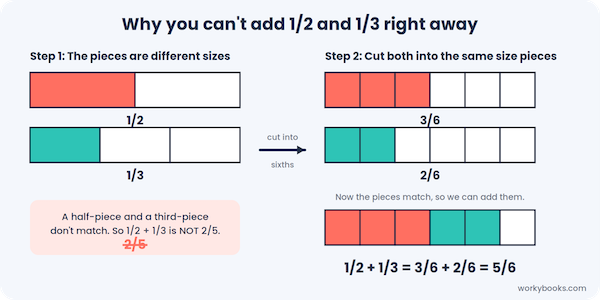
For Maya’s problem, we cut both fractions into twelfths. 3/4 becomes 9/12. 2/3 becomes 8/12. Then 9/12 + 8/12 = 17/12, which is 1 5/12 miles.
Before we solve, I always ask for a guess. “Three-fourths is almost a mile. Two-thirds is more than half. So the answer should be a bit less than 1 1/2 miles.” Then when a student writes 5/7, they see right away that it can’t be right.
A subtraction example: A recipe needs 2 1/2 cups of flour. Jamal has 1 3/4 cups. How much more does he need?
“How much more” means compare. Compare means subtract. 2 1/2 − 1 3/4 = 3/4 cup.
2. Share
A few whole things get split evenly between people. There’s no fraction in the problem, but the answer is a fraction.
Example: Three friends share 2 sandwiches equally. How much does each friend get?
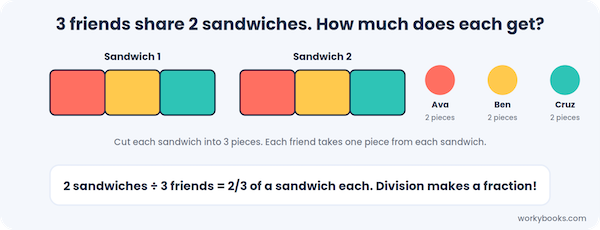
2 ÷ 3 = 2/3 of a sandwich each. Cut each sandwich into 3 pieces. Each friend takes one piece from each sandwich. That’s two pieces, or two-thirds.
This is a big idea that many people skip. Dividing makes a fraction. Once kids trust that, a whole group of problems becomes easy.
3. Multiply
You want a part of something. The word “of” is your clue.
Example: There are 24 students in a class. 2/3 of them walk to school. How many students walk?
“Two-thirds of 24″ means 2/3 × 24. Split 24 into 3 groups of 8. Take 2 of those groups. 16 students walk.
Here’s where it gets confusing for kids. Since 2nd grade, they’ve learned that multiplying makes things bigger. But when you multiply by a fraction, the answer gets smaller. Here’s the picture that fixes that:
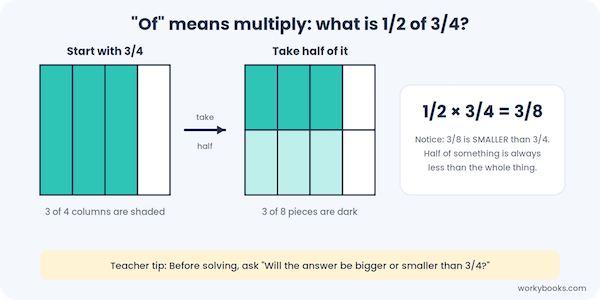
1/2 × 3/4 = 3/8. And 3/8 is less than 3/4, because half of something is always less than the whole thing.
If a student can explain why the answer got smaller, they understand fraction multiplication. If they can only multiply across, they don’t yet.
4. Divide
There are two kinds of division problems in 5th grade, and they feel completely different to kids.
Kind one: “How many fit?” A bag has 3 cups of rice. A serving is 1/4 cup. How many servings are in the bag?
That’s 3 ÷ 1/4. How many quarter-cups fit inside 3 cups? Four in every cup, times 3 cups. 12 servings.
Kind two: “Split it up.” Half a pound of clay is shared by 4 kids. How much does each kid get?
That’s 1/2 ÷ 4. Take the half and cut it into 4 shares. Each share is 1/8 of a pound.
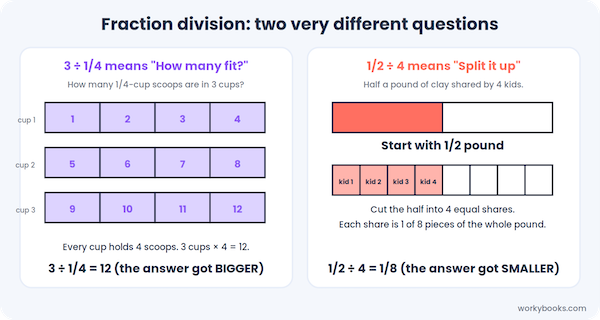
Notice one answer got bigger and one got smaller. Both make sense once you picture what’s happening.
The most common mix-up I see: students confuse “1/4 of 12” (which is 3) with “12 ÷ 1/4” (which is 48). Saying the story out loud is the fix. Are we taking a piece, or asking how many pieces fit?
A 4-step routine that works every time
I put this on the wall in September. We use it all year.
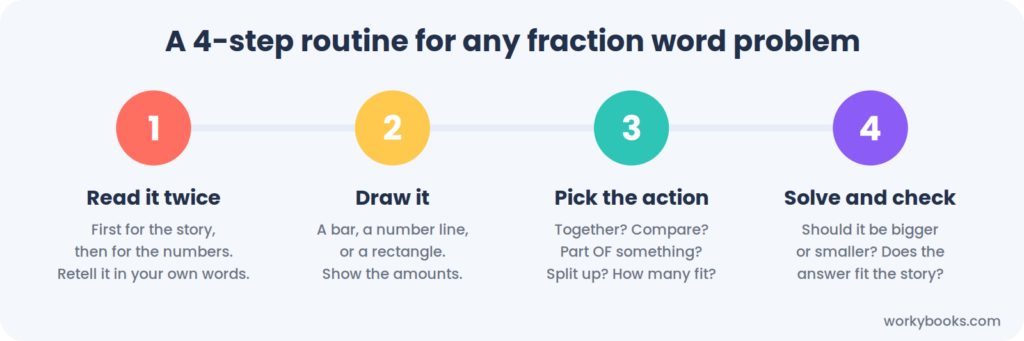
Step 1: Read it twice. The first time, read for the story. The second time, read for the numbers. Then retell it in your own words with no math talk. “Maya ran two days and we want the total.”
Step 2: Draw it. A bar, a number line, or a rectangle. If a student can draw the problem, they almost always know what to do.
Step 3: Pick the action. Are we putting together? Comparing? Taking a part of something? Splitting up? Asking how many fit?
Step 4: Solve and check. Should the answer be bigger or smaller than what we started with? Does the unit make sense? Did we answer the question that was actually asked?
One warning about keywords. Please don’t teach “of always means multiply” or “more always means add.” Those are hints, not rules. “How much more” is subtraction. Steps 1 and 2 exist so students think about the story instead of guessing from a word.
Mistakes I see every year
Adding the bottom numbers. 1/2 + 1/3 = 2/5. The fix is the picture above. Pieces have to be the same size before you can add them.
Thinking multiplying always makes bigger. Have students guess “bigger or smaller?” before they solve. Guess first, math second.
Mixing up the two kinds of division. Put “1/4 of 12” and “12 ÷ 1/4” side by side and have students draw both. The drawings look nothing alike.
Leaving the answer as 17/12. It’s correct, but nobody says “17/12 miles.” In word problems, I ask for mixed numbers with units: 1 5/12 miles.
Answering the wrong question. The problem asks how much flour Jamal still needs. The student tells me how much he has. This is why we retell the story first.
Skipping the check. Almost every wrong answer I see would have been caught by one question: “Does this make sense?”
Fractions are everywhere at home
Kids do better with problems about things they’ve actually done. Here’s where fractions show up in real life:
- Cooking. Doubling a recipe. Cutting one in half. Counting how many 1/3-cup scoops fill 2 cups. Measuring cups are the best fraction tool ever made.
- Measuring. A tape measure is a number line marked in eighths and sixteenths.
- Time. Three-quarters of an hour. A half-hour show.
- Sharing food. Splitting pizzas, sandwiches, and granola bars.
- Sports. Running 3/4 of a mile every day for a week.
If you write your own problems, pull from this list.
Practice: 5th grade fraction word problems with answers
Eight problems, two of each type. Answers are right below each one.
1. (Add) Liam read 1/3 of his book on Saturday and 2/5 of it on Sunday. What fraction of the book has he read? Answer: 5/15 + 6/15 = 11/15 of the book
2. (Subtract) A ribbon is 5/6 of a yard long. Ana cuts off 1/4 of a yard. How much is left? Answer: 10/12 − 3/12 = 7/12 of a yard
3. (Share) Four friends share 3 granola bars equally. How much does each friend get? Answer: 3 ÷ 4 = 3/4 of a granola bar
4. (Share) A teacher splits 5 pounds of clay equally among 4 students. How much does each get? Answer: 5 ÷ 4 = 1 1/4 pounds
5. (Multiply) Sofia has 36 stickers. She gives 5/9 of them to her brother. How many did she give away? Answer: 36 ÷ 9 = 4, then 4 × 5 = 20 stickers
6. (Multiply) A poster is 2/3 covered with drawings. 3/4 of the drawings are animals. What fraction of the poster is animal drawings? Answer: 3/4 × 2/3 = 6/12 = 1/2 of the poster
7. (Divide: how many fit?) A 5-yard rope is cut into pieces that are each 1/3 of a yard. How many pieces? Answer: 5 ÷ 1/3 = 15 pieces
8. (Divide: split it up) Half a pound of trail mix is split evenly into 5 bags. How much is in each bag? Answer: 1/2 ÷ 5 = 1/10 of a pound
Bonus (two steps): Marcus had 2 1/2 cups of juice. He drank 3/4 of a cup. Then he poured half of what was left into a glass for his sister. How much did his sister get? Answer: 2 1/2 − 3/4 = 1 3/4 cups left. Half of 1 3/4 = 7/8 of a cup.
5th grade fraction word problem worksheets (PDF)
Want ready-to-print practice? Workybooks has a full set of 5th grade fraction word problem worksheets, sorted by type:
- Adding and subtracting fractions
- Fraction multiplication word problems
- Fraction division word problems
- Mixed review
Each one is a printable PDF with an answer key.
Questions parents and teachers ask me
What’s the difference between 5th and 6th grade fraction word problems?
Fifth grade covers adding, subtracting, multiplying, and dividing with unit fractions. Sixth grade adds dividing any fraction by any fraction, like 3/4 ÷ 2/3, and starts connecting fractions to ratios and percents.
Stop the arithmetic practice for a bit. Focus on Steps 1 and 2: retell the story, draw it. Ask “what would you do, and why?” before any calculating.
Fewer 5th grade fraction word problems than you’d think. Three or four, done slowly with drawings, beat twenty done fast.
Not for these. The fraction math is part of what 5th grade is building, and the thinking is the real goal. A calculator skips both.
No answer until there’s a drawing. It feels slow for a week or two. Then the drawing becomes the thinking, and the guessing stops.
Fraction word problems are hard because they make kids think, not just compute. That’s exactly why they’re worth it.
Teach the four types. Use the four steps. Draw everything. Guess before you solve.
By the end of the year, the Common Core fraction standards for grade 5 say students should be able to:, “Oh, this is a sharing one.” That’s the moment it clicks.
You can also find our fraction word problem bundles and other 5th grade math resources in the Workybooks store on Teachers Pay Teachers.
Related Posts
10 Animal Symmetry Worksheets for Grade 4
Teaching Metric System Conversions to 4th Graders