3rd Grade Science Curriculum Map Aligned to TEKS
This 3rd grade science curriculum map gives you a full year of 3rd grade science, planned week by week. It follows the 3rd grade science standards (TEKS), and every lesson has a ready-to-print 3rd grade science worksheet with an answer key. It works in the classroom and for 3rd grade homeschool science.
What do the 3rd grade science standards cover?
The 3rd grade science standards have 13 parts. Parts 3.1 to 3.5 are science skills. Parts 3.6 to 3.13 are the content kids learn.
| Topic | TEKS | What kids learn |
|---|---|---|
| Science skills | 3.1 to 3.5 | Ask questions, use tools, collect data, explain with evidence, find patterns |
| Matter | 3.6 | Measure properties, solids, liquids, gases, melting and freezing |
| Forces and motion | 3.7 | Pushes, pulls, gravity, magnets |
| Energy | 3.8 | Light, sound, heat, and motion energy |
| Earth and space | 3.9, 3.10 | Orbits, planets, weather, soil, landforms |
| Natural resources | 3.11 | How we use resources, reduce, reuse, recycle |
| Living things | 3.12, 3.13 | Food chains, seasons, fossils, body parts, life cycles |
Skills are not a separate chapter in this plan. After weeks 1 to 3, skill worksheets are mixed into every unit. Each unit has a data sheet with the same three questions: What changed? What pattern do I see? What is my evidence?
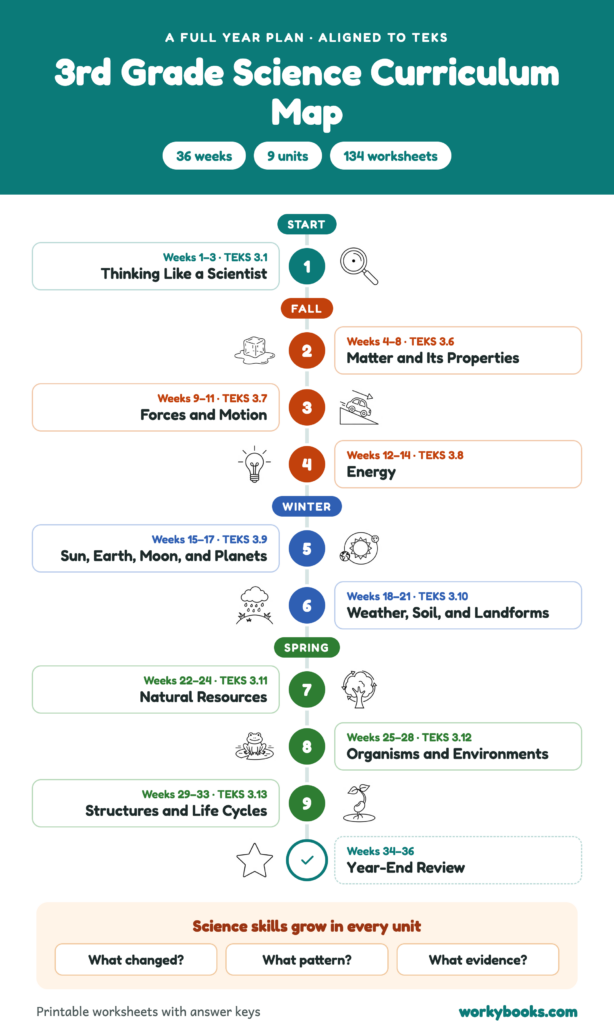
3rd grade science curriculum map at a glance
| Weeks | Unit | TEKS |
|---|---|---|
| 1 to 3 | Thinking Like a Scientist | 3.1A to 3.1E |
| 4 to 8 | Matter and Its Properties | 3.6 |
| 9 to 11 | Forces and Motion | 3.7 |
| 12 to 14 | Energy | 3.8 |
| 15 to 17 | Sun, Earth, Moon, and Planets | 3.9 |
| 18 to 21 | Weather, Soil, and Landforms | 3.10 |
| 22 to 24 | Natural Resources | 3.11 |
| 25 to 28 | Organisms and Environments | 3.12 |
| 29 to 33 | Structures and Life Cycles | 3.13 |
| 34 to 36 | Year-end review | All |
Week-by-week 3rd grade science plan with worksheets
Each week uses 3 to 6 short worksheets, about 5 to 10 minutes each. Teach the topic sheets early in the week and the skill sheets later.
Unit 1. Thinking Like a Scientist (weeks 1 to 3)
TEKS: 3.1A to 3.1E. Big question: How do scientists find out about the world?
- Week 1 (notice and ask): Scientists Notice; I Notice or I Think?; I Notice, I Wonder; What Is a Science Question?; Turn It into a Question; Questions from What I Read
- Week 2 (safety and tools): Think Like a Scientist; Safe Practices in the Classroom; Safe Practices on a Field Trip; Tools to Observe and Measure; Weather Tools; Observation of Habitats
- Week 3 (investigate and share): Observations and Measurements as Evidence; Plan and Conduct an Investigation; Simple Experiments: A Fair Test; Communicating Science Findings; Science Words
Unit 2. Matter and Its Properties (weeks 4 to 8)
TEKS: 3.6A to 3.6D. Big question: How can we describe matter, and how does it change?
- Week 4 (properties): Physical Properties of Matter; Reading a Thermometer in Celsius; Measuring Mass in Grams; Sources of Error in Measurement
- Week 5 (testing): Magnetic or Nonmagnetic Materials; Sink or Float Investigation; Using Evidence from an Investigation
- Week 6 (states): Classifying States of Matter; Shape of Solids and Liquids; Tree Maps: States of Matter
- Week 7 (changes): Melting and Freezing; Evaporation and Condensation; Claims and Evidence in Science; How Refrigerators Changed Our Lives
- Week 8 (using materials): Choosing Materials by Their Properties; Combining Materials to Make Objects; Evaluating a Design Using Criteria; Matter and Its Changes Review
Unit 3. Forces and Motion (weeks 9 to 11)
TEKS: 3.7A, 3.7B. Big question: What makes things move, stop, or change direction?
- Week 9 (forces): Pushes and Pulls; Forces Change Motion; Contact and Noncontact Forces; Cause and Effect in Science
- Week 10 (gravity and magnets): Gravity Pulls on All Objects; Magnets Attract and Repel; When a Force Does Not Move an Object; Listening for Evidence in a Science Talk
- Week 11 (investigate motion): Planning a Push and Pull Investigation; Soft Push or Hard Push?; Changing Position and Motion; Cause and Effect: Ramp Test; Explaining Results with Data
Unit 4. Energy (weeks 12 to 14)
TEKS: 3.8A, 3.8B. Big question: Where do we see energy, and what can it do?
- Week 12 (forms): Forms of Energy Around Us; Light Energy; Sound Energy; How Electricity Changed Our Lives
- Week 13 (heat and motion): Thermal Energy; Mechanical Energy; How Science Changed Communication
- Week 14 (speed): Planning a Speed Investigation; Faster Car, More Energy; Speed and Mechanical Energy; Investigating Cause and Effect
Unit 5. Sun, Earth, Moon, and Planets (weeks 15 to 17)
TEKS: 3.9A, 3.9B. Big question: How do the Sun, Earth, Moon, and planets move in space?
- Week 15 (orbits): The Sun, Earth, and Moon; Earth Orbits the Sun; The Moon Orbits Earth; Patterns in Nature; Writing Science Explanations
- Week 16 (models): Making a Sun, Earth, and Moon Model; Advantages and Limitations of Models; Model Limits in Size and Materials; Scale and Quantity in Models
- Week 17 (planets): Meet the Eight Planets; Planets in Order from the Sun; Missing Planet Positions; Fix the Solar System; STEM Careers Meet an Astronomer
Unit 6. Weather, Soil, and Landforms (weeks 18 to 21)
TEKS: 3.10A to 3.10C. Big question: How do Earth’s surface and sky change?
- Week 18 (weather): What Is Weather?; Reading a Weather Report; Bar Graphs: Weather Data; STEM Careers Meet a Meteorologist
- Week 19 (weather data): Comparing Weather in Two Places; Line Graphs: Daily Temperature; Finding Patterns in a Bar Graph; Comparing Data with Subtraction
- Week 20 (soil): What Is Soil Made Of?; Weathering Makes Soil; Decomposition Makes Soil; STEM Careers Meet a Geologist
- Week 21 (fast changes): Earth’s Surface and Landforms; Volcanoes, Earthquakes, and Landslides; Modeling Fast Changes
Unit 7. Natural Resources (weeks 22 to 24)
TEKS: 3.11A to 3.11C. Big question: Where do the things we use come from, and how can we save them?
- Week 22 (resources): What Are Natural Resources?; Where Do Products Come From?; Natural Resources for Building; STEM Careers Meet a Civil Engineer
- Week 23 (uses): Natural Resources for Farming; Natural Resources for Transportation; How Science Helps Texas Farmers; Using Patterns to Design Solutions
- Week 24 (conservation): Why Save Natural Resources?; Ways to Conserve Natural Resources; Reduce, Reuse, or Recycle?; Saving Resources at School
Unit 8. Organisms and Environments (weeks 25 to 28)
TEKS: 3.12A to 3.12D. Big question: How do living things depend on their environment and on each other?
- Week 25 (seasons): Temperature and Precipitation; Animal Migration and Hibernation; Plant Dormancy; Data Tables: Garden Animals
- Week 26 (food chains): Producers and Consumers; Energy Flow in a Food Chain; Flow of Energy and Cycling of Matter; Parts of a System
- Week 27 (changes): What If the Frogs Disappear?; What If the Bees Disappear?; Floods and Droughts; Floods, Droughts, and Organisms; Stability and Change in Systems; Finding Unusual Data in a Table
- Week 28 (fossils): Fossils: Clues to Past Life; What Do Texas Fossils Tell Us?; STEM Careers Meet a Wildlife Biologist
Unit 9. Structures and Life Cycles (weeks 29 to 33)
TEKS: 3.13A, 3.13B. Big question: How do body parts help living things survive, and how do they grow and change?
- Week 29 (structures): Animal Structures and Functions; Animal Body Coverings; Structure and Function
- Week 30 (adaptations): Bird Beaks and Feet; How Texas Animals Survive; Venn Diagrams: Fish and Frogs
- Week 31 (plant life cycles): What Is a Life Cycle?; Life Cycle of a Lima Bean; Life Cycle of a Radish; Finding Relationships in Plant Data; Proposing Solutions with Data
- Week 32 (insect life cycles): Beetle Metamorphosis; Cricket Metamorphosis; Flow Charts: Butterfly Life Cycle
- Week 33 (compare): Comparing Life Cycles; How Vaccines Help Protect People
Year-end review (weeks 34 to 36)
Big question: What patterns and causes did we see all year?
- Recurring Themes in Science
- One data sheet from each unit as a quick check
- Science Words and Matter and Its Changes Review
Using this plan for 3rd grade homeschool science
- Teach 2 or 3 science days a week and follow the units in order.
- Pair each worksheet with a quick test at home: melt ice in sun and shade, roll a toy car down a ramp, or try magnets on kitchen objects.
- Plant lima beans and radishes in week 29 so they are ready to observe in week 31.
- Every sheet has an answer key and prints well in black and white.
3rd grade science FAQ
Third graders learn matter, forces and motion, energy, the Sun, Earth, Moon, and planets, weather and soil, natural resources, and living things. They also build skills like asking questions, measuring, and reading graphs.
In Texas, the 3rd grade science standards are the TEKS, parts 3.1 to 3.13. The table at the top of this page shows what each part covers.
About 30 to 45 minutes. A 5 to 10 minute worksheet plus a short demo or hands-on activity fits well.
Yes. The week-by-week order, short worksheets, and answer keys make it easy to teach 3rd grade science at home.
Explore more science by topic
Want extra practice beyond this plan? Browse all our science worksheets by topic:
- Physical Science: matter, forces, motion, and energy (Units 2 to 4)
- Earth and Space Science: Sun, Moon, planets, soil, and landforms (Units 5 and 6)
- Weather and Climate: weather tools, data, and patterns (Unit 6)
- Life Science: plants, animals, food chains, and life cycles (Units 8 and 9)
Get the 3rd grade science worksheets
All 134 worksheets in this plan are ready to print or use online at Workybooks. Start with week 1 and your 3rd grade science year is ready to go.
Related Posts

Types of Clouds: A Complete Cloud Unit for Grades 3-8

Cesar Chavez Day: Teaching Resources