California Gold Rush: Teaching Resources and Activities
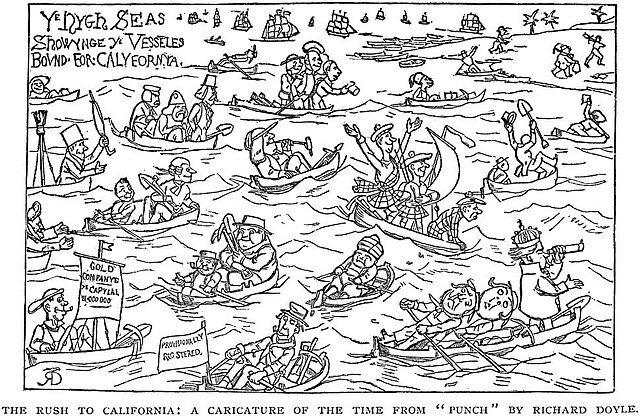
The California Gold Rush remains one of the most captivating chapters in American history. When James Marshall spotted gold flakes glittering in the American River in 1848, he set off a chain of events that would transform California, reshape the nation, and create stories of adventure, hardship, and ambition that still resonate with students today.
For teachers, the Gold Rush offers a treasure trove of learning opportunities—from geography and economics to social studies and critical thinking. This comprehensive blog provides an overview of the California Gold Rush to use in your classroom.
California Gold Rush Facts: What Students Need to Know
On January 24, 1848, James W. Marshall was building a sawmill for John Sutter along the American River in Coloma, California. When he noticed something shining in the water, which turned out to e gold.
Marshall tried to keep the discovery secret, but word spread quickly. Sam Brannan, a merchant, famously ran through the streets of San Francisco shouting “Gold! Gold! Gold from the American River!” He had already stocked his store with mining supplies and became one of California’s first millionaires—not from mining, but from selling pickaxes and pans.
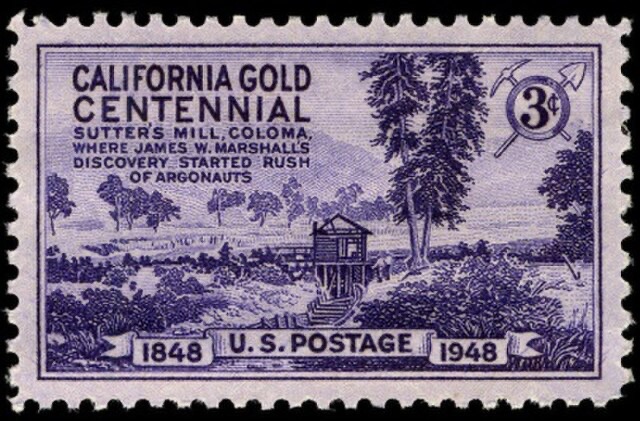
Source: A 3-cent stamp issued on January 24, 1948 commemorated the centennial of the discovery of gold in California. The stamp pictures Sutter’s Mill where the discovery started “the rush of Argonauts”, Bureau of Engraving and Printing
By 1849, the news had spread worldwide. Ships arrived from China, Chile, Australia, and Europe. Wagon trains crossed the treacherous plains and mountains. The Gold Rush had begun.
The Forty-Niners and Mass Migration
The prospectors who arrived in 1849 became known as the “Forty-niners” or simply “49ers.” Before the Gold Rush, California had approximately 14,000 non-Native American residents. By 1852, that number had exploded to over 250,000.
People traveled to California by three main routes. The overland trail took four to six months by covered wagon across prairies, deserts, and mountains. The sea route around Cape Horn at the tip of South America took five to eight months. The Panama shortcut involved sailing to Panama, crossing the jungle by land, and catching another ship—faster but dangerous due to tropical diseases.
Key Locations on the California Gold Rush Map
Understanding the geography helps students visualize this historical moment. Sutter’s Mill in Coloma marks the discovery site and is now a state historic park. Sacramento grew from Sutter’s Fort into a major supply hub and eventually the state capital. San Francisco transformed from a small settlement called Yerba Buena into a booming port city. The Mother Lode region stretched 120 miles through the Sierra Nevada foothills, encompassing the richest gold deposits.
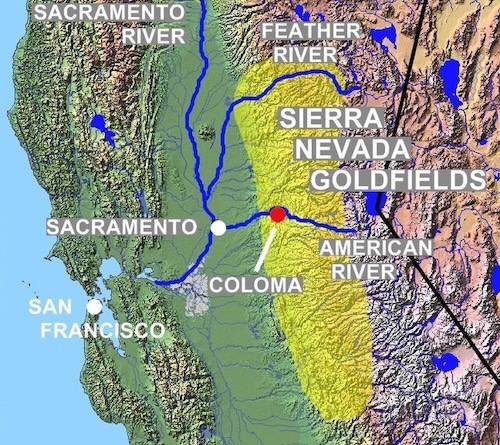
Map of the Sierra Nevada gold fields during the California Gold Rush, Wikimedia commons.
Mining Life and Methods
Early miners used simple gold panning—swirling water and sediment in a shallow pan to separate heavy gold flakes. As easy pickings disappeared, miners developed more complex techniques. Placer mining used sluice boxes and rockers to process more gravel. Hydraulic mining, introduced in the 1850s, used powerful water cannons to blast away entire hillsides—effective but environmentally devastating.
Life in the mining camps was rough. Men lived in canvas tents, ate beans and salt pork, and worked long hours in freezing streams. Boomtowns sprang up overnight wherever gold was found, complete with saloons, general stores, and gambling halls. When the gold ran out, these towns often became ghost towns—some of which still dot the California landscape today.
Historical Impact of California Gold Rush
Political Changes
Just two years after the discovery, California entered the Union as a free state in 1850 through the Compromise of 1850. This had major implications for the national debate over slavery and the balance of power between North and South.
The Gold Rush also embodied the spirit of Manifest Destiny—the belief that American expansion across the continent was both justified and inevitable. California’s rapid development seemed to confirm this vision of American progress and growth.
Economic Transformation
Here’s a fact that often surprises students: most miners didn’t get rich. The real fortunes went to merchants and entrepreneurs who sold supplies to the miners. Levi Strauss made his fortune selling durable denim pants. Sam Brannan became California’s first millionaire through his stores. Bankers, hotelkeepers, and laundry operators (many of them Chinese immigrants) built successful businesses serving the mining population.
California was established as an economic powerhouse. It accelerated the development of banking, agriculture, and transportation networks. The need to connect California to the rest of the nation helped drive the construction of the transcontinental railroad, completed in 1869.
Social and Cultural Effects
Miners from six continents created one of the most diverse populations in America. Miners came from Mexico, China, Chile, France, Germany, Ireland, and dozens of other countries. Free African Americans came seeking opportunity. This diversity created both cultural richness and significant conflict.
Chinese immigrants faced particular discrimination, including the Foreign Miners Tax of 1850, which specifically targeted non-citizens. Native Americans suffered devastating losses as miners invaded their lands, destroyed their food sources, and brought diseases. Some were killed outright in violent conflicts. The Native American population in California declined from approximately 150,000 in 1848 to fewer than 30,000 by 1870.
Women were rare in early Gold Rush California—in 1850, men outnumbered women almost 12 to 1. Those women who came often found economic opportunities running boarding houses, doing laundry, or working as entertainers. A few even worked as miners themselves.

Three men and one woman panning for gold during the California Gold Rush July 9,1850, Wikimedia commons
Environmental Consequences
The rush for gold left lasting scars on California’s landscape. Hydraulic mining washed away entire mountains and clogged rivers with sediment, causing devastating floods in farming areas downstream. Mercury used to extract gold from ore contaminated waterways—pollution that persists today.
View of gold miners excavating an eroded bluff with jets of water at a placer mine in Dutch Flat, California, between 1857 and 1870.Original uploaded by Lordkinbote(Transfered by Nis Hoff), Wikimedia Common
This environmental destruction eventually led to some of America’s first environmental regulations. In 1884, a federal court banned hydraulic mining in the landmark Woodruff v. North Bloomfield case. The Gold Rush thus offers valuable lessons about the environmental costs of resource extraction.
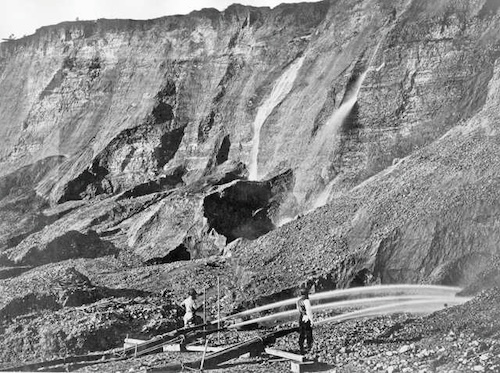
View of gold miners excavating an eroded bluff with jets of water at a placer mine in Dutch Flat, California, between 1857 and 1870. Original uploaded by Lordkinbote(Transfered by Nis Hoff), Wikimedia Common.
Teaching the California Gold Rush: Grade-Level Approaches
Elementary (Grades 3-5)
For younger students, focus on storytelling and daily life. What did miners eat? Where did they sleep? What tools did they use? Hands-on activities like gold panning simulations capture their imagination and make history tangible.
Key concepts for this age group include the basic narrative of discovery and migration, daily life in mining camps, simple cause and effect (discovery led to migration led to statehood), map skills and California geography, and vocabulary building with terms like prospector, nugget, and claim.
Consider using picture books and historical fiction to bring the era to life. Students can write diary entries as imaginary forty-niners or create illustrations of mining camp scenes.
Standards Alignment
The California Gold Rush connects to multiple educational standards. For Common Core ELA, it supports informational text reading and analysis, writing from sources, and vocabulary development. For Social Studies standards, it addresses westward expansion, California history, economic concepts, and geographic thinking. It also supports historical thinking skills including analyzing cause and effect, evaluating multiple perspectives, using primary sources, and making evidence-based arguments.
Classroom Resources and Activities
Reading Resources
Building background knowledge through reading is essential. Look for reading passages at multiple levels to differentiate instruction. Primary sources help students engage directly with historical evidence—try excerpts from miners’ letters or newspaper accounts of the discovery.
For fiction, titles like “By the Great Horn Spoon!” by Sid Fleischman offer engaging narratives for upper elementary students. “The Ballad of Lucy Whipple” by Karen Cushman provides a female perspective on Gold Rush life.
Interactive Activities
Gold Rush Simulation: Divide students into groups representing different miners. Give each group a set of gold tokens hidden in a pan of sand. The group that finds the most tokens gets to “buy” supplies from your classroom store—but prices keep rising! This teaches basic economics while being genuinely fun.
Role-Play Activities: Assign students different personas—a forty-niner from Ohio, a Chinese immigrant, a Native American, a woman running a boarding house, a merchant. Have them write diary entries or participate in a “town meeting” from their character’s perspective.
Gold Panning Experiment: Fill shallow pans with sand, gravel, and small metal objects (painted rocks work well as “gold”). Teach students the swirling technique real miners used. This kinesthetic activity helps students understand why mining was such hard work.
Map Skills Activities: Have students trace the different routes to California on a map. Calculate distances and discuss the challenges of each route. Compare travel times in 1849 to today.
Worksheets and Printables
Effective worksheet activities include vocabulary matching with key Gold Rush terms, timeline activities sequencing major events, compare and contrast organizers examining miner expectations versus reality, cause and effect charts exploring the rush’s impacts, reading comprehension activities with primary and secondary sources, and character analysis worksheets for studying historical figures like James Marshall and Sam Brannan.
Multimedia Resources
Virtual Field Trips: Marshall Gold Discovery State Historic Park offers virtual resources. Many California historical societies provide online exhibits and primary source collections.
Videos and Documentaries: PBS and the History Channel have produced accessible documentaries suitable for classroom use. Preview carefully to ensure grade-appropriate content.
Interactive Timelines: Create digital timelines using tools like Knova or TimelineJS, or have students build physical timelines on classroom walls.
Assessment Ideas
Discussion Questions: Why did people risk everything to come to California? Who were the real winners and losers of the Gold Rush? How did the Gold Rush change California forever?
Writing Prompts: Write a letter home as a forty-niner describing your first month in California. Argue whether the Gold Rush was worth its costs. Compare the California Gold Rush to a modern “gold rush” like the tech boom.
Project-Based Learning: Students research and present on specific aspects of Gold Rush life, create museum exhibits, produce podcasts as historical radio shows, or design board games that teach Gold Rush concepts.
Sample 5-Day Unit Plan
Day 1: Discovery and the Rush Begins
- Hook activity: Show a small gold nugget or image and ask what students would do if they found gold
- Read-aloud or video about the discovery at Sutter’s Mill
- Map activity tracing routes to California
- Exit ticket: Why did news of gold spread so quickly?
Day 2: Life in the Mining Camps
- Primary source analysis: Photographs or drawings of mining camps
- Gold panning simulation activity
- Reading passage on daily life
- Vocabulary work: prospector, claim, placer mining, sluice box
Day 3: Diverse Perspectives and Immigration
- Jigsaw activity: Groups research different groups (Chinese immigrants, Mexican miners, Native Americans, women)
- Group presentations sharing findings
- Discussion: Whose story is usually told? Whose is left out?
Day 4: Impact on California
- Cause and effect graphic organizer
- Reading on California statehood and the Compromise of 1850
- Environmental impact discussion
- Economics lesson: Who got rich and why?
Day 5: Assessment and Reflection
- Student presentations or projects
- Written assessment
- Reflection: What lessons can we learn from the Gold Rush?
- Connection to modern issues
Essential Questions for Student Inquiry
Great teaching starts with great questions. Use these essential questions to drive student thinking throughout your unit:
- Why did thousands of people risk everything for the chance to find gold?
- Who were the real winners and losers of the California Gold Rush?
- How did the Gold Rush shape California and the United States?
- What can we learn from the Gold Rush about immigration, opportunity, and diversity?
- How do we weigh economic opportunity against environmental and human costs?
- Whose stories get told in history, and whose get left out?
These questions have no simple answers, which makes them perfect for developing critical thinking skills.
Bringing It All Together
The California Gold Rush offers everything a great history unit needs: drama, adventure, diverse perspectives, and meaningful connections to broader themes that still matter today. Whether your students are panning for gold in a classroom simulation or analyzing the environmental impact of hydraulic mining, they’re e
These classroom resources students help students engage with history in ways that build both knowledge and thinking skillsi. It is about understanding human choices and their consequences. The forty-niners made decisions based on hope, risk, and opportunity. So did the merchants who supplied them, the immigrants who faced discrimination, and the Native Americans who lost their lands. By exploring these different experiences, students develop empathy and critical thinking that extends far beyond the history classroom.
Download Teaching Resources
Ready to strike gold in your classroom? Explore our collection of California Gold Rush teaching resources:
- Reading Passages: Grade-leveled informational texts covering all aspects of Gold Rush history
- Comprehension Worksheets: Ready-to-use activities with answer keys
- Vocabulary Resources: Word walls and matching activities
- Assessment Materials: Quizzes aligned to standards
Visit Workybooks to access our complete California Gold Rush teaching collection and hundreds of other standards-aligned resources for K-8 educators.
Looking for more history teaching resources? Subscribe to our newsletter for monthly teaching tips, free resources, and the latest additions to our educational library.
Related Posts
Egyptian Pharaohs
Author’s Purpose Worksheets: Grade 1