This learning resource is available in interactive and printable formats. The interactive worksheet can be played online and assigned to students. The Printable PDF version can be downloaded and printed for completion by hand.
This NGSS-aligned passage teaches students about bar-built estuaries, unique coastal ecosystems formed by sandbars or barrier islands. Using the Outer Banks of North Carolina as an example, students discover how barrier islands protect shallow lagoons such as Albemarle Sound and Pamlico Sound. The passage explains key characteristics, including shallow waters, weaker tides, marsh grasses, and habitats for fish and birds. It also highlights how storms and human development can threaten these fragile ecosystems. With fun facts, engaging examples, and audio integration for accessibility, this resource connects NGSS Life Science: Structure and Function to real-world geography and ecosystems. Ideal for middle school science learners.
CONTENT PREVIEW
Expand content preview
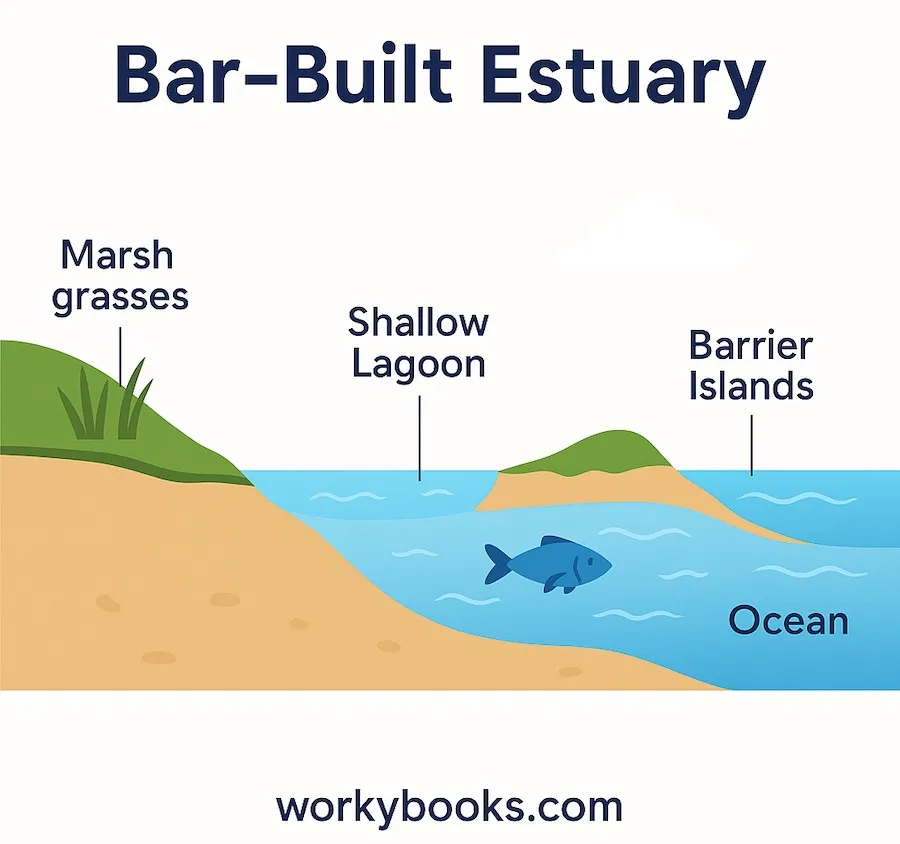
Bar-built estuaries are special places along the coast where the land meets the ocean. A bar-built estuary forms when ocean waves push sand into long walls called barrier islands or sand bars. These sandy walls build up over time and block off part of the ocean, trapping water behind them. This trapped water is called a lagoon.
Step by step, this is how it happens. First, strong waves pick up sand from the beach and carry it along the shore. Over time, the sand piles up in long, narrow shapes. These become barrier islands or sand bars. The barrier acts like a wall, and the ocean water behind it can’t flow out as easily. The area behind the barrier fills up with a mix of salt water from the ocean and fresh water from rivers or rain. It’s almost like nature is building a giant sand wall at the beach and making a huge puddle behind it!
Bar-built estuaries are important homes for many animals. In places like the Outer Banks in North Carolina and Laguna Madre in Texas, you can find shrimp, flounder, pelicans, and even sea turtles that nest on the sandy beaches. The calm, shallow waters of the lagoon are safe places for young fish and other creatures to grow.
Barrier islands also help protect the mainland. When big storms or hurricanes come from the ocean, the sandy barrier acts like a shield. It takes the force of the waves and wind, so the land behind it stays safer. But bar-built estuaries can be in danger, too. Strong hurricanes can sometimes wash away the sand bars or change their shape, which can harm the animals living there.
Interesting Fact: Some barrier islands are always changing—they can move, grow, or shrink over time as waves and storms move the sand!
What forms a bar-built estuary?
Waves pile up sandMountains block riversTrees grow by waterSnow melts on land
What is trapped behind the sand bar?
Lagoon waterDesert sandFresh airIce
Which animal nests on barrier island beaches?
Sea turtlePolar bearCamelMonkey
What is one danger to bar-built estuaries?
HurricanesSmall fishCold weatherSunshine
Why do barrier islands matter to the mainland?
They protect from stormsThey make it rainThey grow tall treesThey create volcanoes
What happens if a hurricane washes away a sand bar?
Animals lose their homesMore beaches appearMountains growFish stop swimming
Barrier islands are always the same size. True or false?
TrueFalse
What is a lagoon?
Trapped water behind sand barTall mountain peakFrozen riverBig forest
Perfect For:
👩🏫 Teachers
• Reading comprehension practice
• Auto-graded assessments
• Literacy skill development
👨👩👧👦 Parents
• Reading practice at home
• Comprehension improvement
• Educational reading time
🏠 Homeschoolers
• Reading curriculum support
• Independent reading practice
• Progress monitoring
Reading Features:
📖
Reading Passage
Engaging fiction or nonfiction text
❓
Comprehension Quiz
Auto-graded questions
📊
Instant Feedback
Immediate results and scoring
📄
Printable Version
Download for offline reading
🔊
Read Aloud
Voice-over with word highlighting
Reviews & Ratings
No reviews yet. Be the first to share your experience!
Related Content
What's The Main Idea?
These short science texts are a great way to practice main idea. Students will read the paragraphs and then choose the m...
RI.2.6
Reading for Main Details—Birds
This informational text on birds is a great way to practice main idea. Students will read the passage, then give the mai...
RI.2.6RI.2.8
Koi Fish—What’s the Main Idea?
This informational text on koi fish is a great introduction to teaching main idea. Students will be asked, in multiple c...
RI.3.2RF.3.4RI.3.1
Spider—Main Idea
This informational text on spiders is a great introduction to teaching main idea. Students will be asked, in multiple ch...
RI.3.2RF.3.4RI.3.1RI.2.6
Reading for Main Details—Beavers Teeth
This informational text on beavers is a great way to practice main idea. Students will read the passage, then give the m...
RI.2.6RI.2.10
Reading for Main Details—Veternarians
Practie summarizing paragraphs with this fun informational text on veternarians! Students will give the main idea of eac...
RI.2.2RI.2.10
Penguins— Main Purpose
This informational text on penguins with comprehension questions is a great way to practice reading fluency and main ide...
RI.1.2RI.1.10RF.1.4.ARF.1.4.B
Reading for Main Details—Orcas
Practie summarizing paragraphs with this fun science informational text on orcas! Students will give the main idea of ea...
RI.2.2RI.2.10
Informational Text —Learn About Dinosaurs
This informational text on dinosaurs with comprehension questions to follow is perfect for teaching main idea. Students ...
RF.3.4RF.3.4.ARF.3.4.CRI.3.2
Informational Text — Habitats
This short informational text on habitats will teach your students what a habitat is, as well as provide some examples o...
RF.3.4.A
Informational Text —Elephants Facts
This informational text on elephants with comprehension questions to follow is perfect for teaching main idea. Students ...
RF.2.4.ARI.2.1RI.2.2RI.2.6
Main Idea and Supporting Details in Informational Text
RI.3.1RI.3.2RI.3.8
Informational Text — Astronauts
Practice this second grade context clues worksheet with this informational text on astronauts. Students will read the te...
RI.2.4RI.2.10RI.3.4RI.3.10
Informational Text —Importance of Sound
This Reading Informational Text Common Core standards calls for 4th graders to be able to effectively describe and analy...
RI.4.5
Informational Text — Penguins
This informational text on penguins is a great way to practice reading comprehension. Students will read the short passa...
RI.2.1RI.2.10
Informational Text — Armadillos
This informational text on armadillos is a great way to practice reading comprehension. Students will read the short pas...
RI.2.1RI.2.10
What Is the Main Source of Carbon in an Ecosystem?
This NGSS-aligned science reading passage helps middle school students explore the main source of carbon in ecosystems: ...
MS-LS2-3
Informational Text —Sea Stars
Use this second grade worksheet on context clues with this informational text on sea stars. Students will read the text ...
RI.2.4RI.2.10RI.3.4RI.3.10
Informational Text —Bioluminescence
This informational text on bioluminescence will teach your students about this phenomenon. Examples in nature are provid...
RI.3.10RF.3.4RF.3.4.ARI.3.1
Informational Text —Snowflakes
This informational text on snowflakes will teach your students how snowflakes are formed. Images of several different fl...