Baxter and the Missing Diary Caper-Short Story
Interactive passage with audio narration, comprehension questions, and printable PDF.
What's included
Baxter and the Missing Diary Caper-Short Story preview and details
About this printable Baxter and the Missing Diary Caper-Short Story reading passage (Grades 2-4)
Sample passage and quiz from Baxter and the Missing Diary Caper-Short Story
Reading passage and comprehension quiz preview
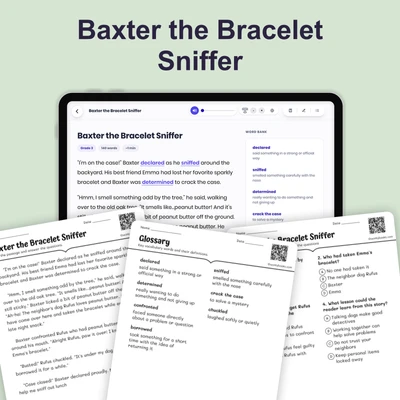
Baxter and the Missing Diary Caper
"We've got another mystery on our paws!" Baxter exclaimed, rushing over to Emma. Her friend Zoe was sobbing because her diary had gone missing.
"Hmm, last time Zoe saw it was in her room after school," Baxter said, sniffing around for clues. "Aha! These smell like crocodile tears!"
Baxter confronted his crocodile stuffed animal, Snappy. "Alright Snappy, fess up! I smell your cotton stuffing on Zoe's pillow."
"Rats, you got me detective doggie!" Snappy said. "I borrowed the diary to read about the yummy meals Zoe's mom makes. It's under my bed."
"Case solved!" Baxter declared. "Snappy was just curious, no harm done."
Zoe hugged her diary happily. "Thank you Baxter! Want to join me and Emma for story time and treats?"
"Sure," Baxter said, wagging his tail with glee. Solving mysteries makes me hungry after all!"
Comprehension quiz (4 questions)
1. What was missing that Baxter had to find?
2. How did Baxter know to question Snappy the stuffed animal?
3. Why did Snappy take Zoe's diary?
4. How does Zoe reward Baxter for solving the mystery?
Common Core standards for Baxter and the Missing Diary Caper-Short Story
Use sentence-level context as a clue to the meaning of a word or phrase.
Use context to confirm or self-correct word recognition and understanding, rereading as necessary.
By the end of the year, read and comprehend literature, including stories and poetry, in the grades 2–3 text complexity band proficiently, with scaffolding as needed at the high end of the range.
Recount stories, including fables and folktales from diverse cultures, and determine their central message, lesson, or moral.
Ask and answer questions to demonstrate understanding of a text, referring explicitly to the text as the basis for the answers.
By the end of the year, read and comprehend literature, including stories, dramas, and poetry, at the high end of the grades 2–3 text complexity band independently and proficiently.
Recount stories, including fables, folktales, and myths from diverse cultures; determine the central message, lesson, or moral and explain how it is conveyed through key details in the text.
Describe characters in a story (e.g., their traits, motivations, or feelings) and explain how their actions contribute to the sequence of events.
Refer to parts of stories, dramas, and poems when writing or speaking about a text, using terms such as chapter, scene, and stanza; describe how each successive part builds on earlier sections.
Perfect for the way you teach
- Build comprehension skills
- Auto-graded quiz
- Differentiated reading
- Read together at home
- Improve fluency
- Quiet reading time
- Reading curriculum support
- Independent practice
- Track Lexile growth