This learning resource is available in interactive and printable formats. The interactive worksheet can be played online and assigned to students. The Printable PDF version can be downloaded and printed for completion by hand.
This NGSS-aligned passage introduces students to delta estuaries, formed when rivers deposit sediments as they meet the sea. The passage highlights the Mississippi River Delta in Louisiana, where sediments create wetlands, marshes, and distributaries that provide rich habitats. Students learn about delta estuary characteristics such as fan-shaped land, nutrient-rich soils, and protection from storm surges. It also explains the importance of deltas for shrimp, oysters, fish, and migratory birds, as well as for human industries like fishing and shipping. Challenges such as human alteration of sediment flow and rising sea levels are also discussed. With a fun fact about its size, plus integrated audio for accessibility, this passage connects NGSS Life Science: Structure and Function to real-world examples.
CONTENT PREVIEW
Expand content preview
Delta Estuaries: How Rivers Build New Land
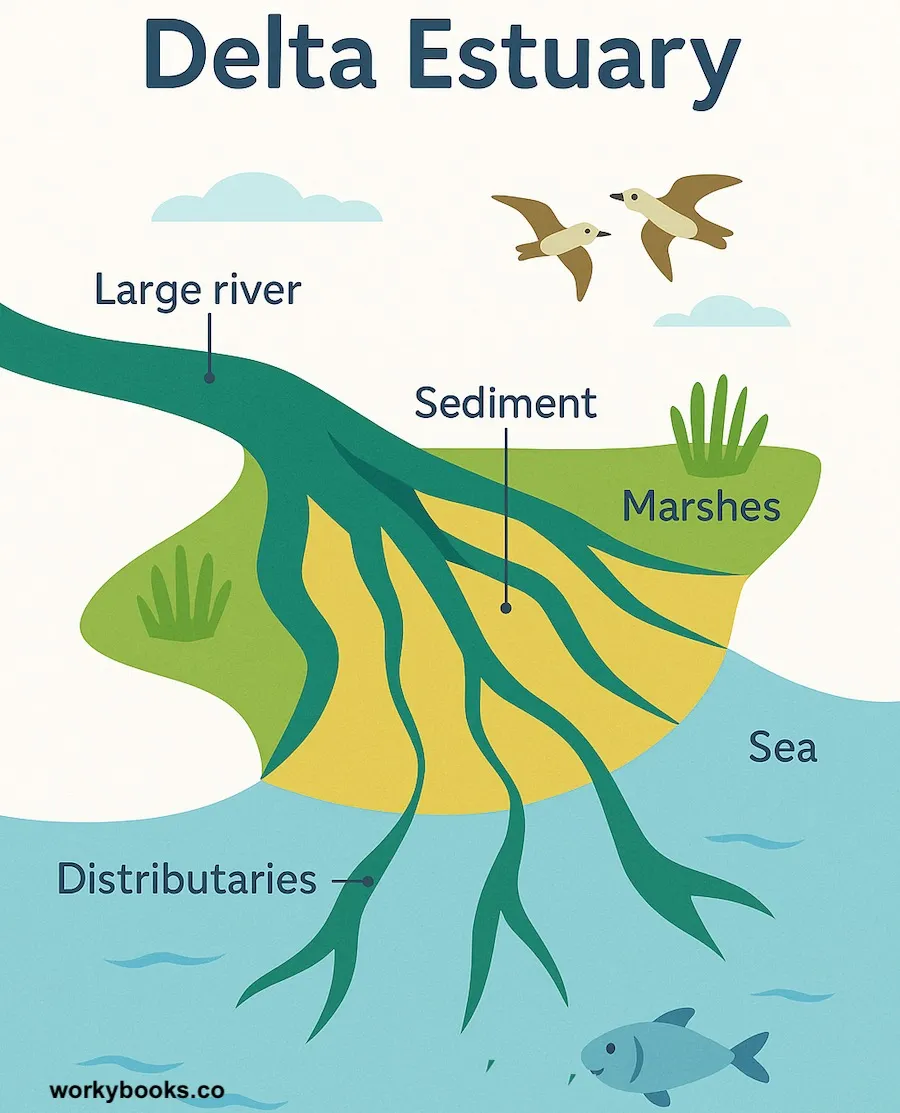
A delta estuary forms where a river meets the ocean or a large lake. When a river flows quickly, it carries a lot of sediment—tiny pieces of mud, sand, and dirt. Near the end of the river, called the river mouth, the water slows down. Because the river is moving slowly, it can’t carry as much sediment. The mud and sand begin to settle, just like how chocolate settles at the bottom of a glass if you pour chocolate milk slowly!
Over many years, these piles of mud and sand get bigger. They build new land at the river mouth. This land often looks like a fan or a triangle. That’s why it’s called a delta, named after the Greek letter delta, which looks like a triangle: Δ.
One of the most famous deltas is the Mississippi River Delta in Louisiana. Much of Louisiana was built from river mud! This delta is home to many animals. You can find alligators, pelicans, shrimp, and crawfish living in the wetlands. The land is great for farming because the soil is very rich. It’s also important for fishing and gives birds a place to live and rest.
Deltas are important, but they also face problems. Sometimes, deltas start to sink or wash away. People work to protect deltas so animals and people can continue to live there.
Interesting Fact: The Mississippi River moves so much mud each year that it could fill over 700,000 trucks!
What is a delta made of?
Mud and sandIce and snowRocks and gravelSalt and water
Where does a delta form?
Where river meets oceanIn the desertOn a mountainIn deep ocean
What shape is a delta?
Triangle or fanCircleSquareRectangle
Why does sediment drop at the river mouth?
Water slows downWater freezesIt gets windySun shines
What animal lives in deltas?
AlligatorCamelPenguinBear
Why are deltas important?
Good soil and habitatsMake desertsCreate mountainsGrow icebergs
Deltas can sink or wash away.
TrueFalse
What does 'sediment' mean?
Tiny mud or sand piecesBig rocksFast waterFresh air
Perfect For:
👩🏫 Teachers
• Reading comprehension practice
• Auto-graded assessments
• Literacy skill development
👨👩👧👦 Parents
• Reading practice at home
• Comprehension improvement
• Educational reading time
🏠 Homeschoolers
• Reading curriculum support
• Independent reading practice
• Progress monitoring
Reading Features:
📖
Reading Passage
Engaging fiction or nonfiction text
❓
Comprehension Quiz
Auto-graded questions
📊
Instant Feedback
Immediate results and scoring
📄
Printable Version
Download for offline reading
🔊
Read Aloud
Voice-over with word highlighting
Reviews & Ratings
No reviews yet. Be the first to share your experience!
Related Content
What's The Main Idea?
These short science texts are a great way to practice main idea. Students will read the paragraphs and then choose the m...
RI.2.6
Reading for Main Details—Birds
This informational text on birds is a great way to practice main idea. Students will read the passage, then give the mai...
RI.2.6RI.2.8
Koi Fish—What’s the Main Idea?
This informational text on koi fish is a great introduction to teaching main idea. Students will be asked, in multiple c...
RI.3.2RF.3.4RI.3.1
Reading for Main Details—Beavers Teeth
This informational text on beavers is a great way to practice main idea. Students will read the passage, then give the m...
RI.2.6RI.2.10
Spider—Main Idea
This informational text on spiders is a great introduction to teaching main idea. Students will be asked, in multiple ch...
RI.3.2RF.3.4RI.3.1RI.2.6
Reading for Main Details—Veternarians
Practie summarizing paragraphs with this fun informational text on veternarians! Students will give the main idea of eac...
RI.2.2RI.2.10
Penguins— Main Purpose
This informational text on penguins with comprehension questions is a great way to practice reading fluency and main ide...
RI.1.2RI.1.10RF.1.4.ARF.1.4.B
Informational Text —Learn About Dinosaurs
This informational text on dinosaurs with comprehension questions to follow is perfect for teaching main idea. Students ...
RF.3.4RF.3.4.ARF.3.4.CRI.3.2
Reading for Main Details—Orcas
Practie summarizing paragraphs with this fun science informational text on orcas! Students will give the main idea of ea...
RI.2.2RI.2.10
Informational Text — Habitats
This short informational text on habitats will teach your students what a habitat is, as well as provide some examples o...
RF.3.4.A
Informational Text —Elephants Facts
This informational text on elephants with comprehension questions to follow is perfect for teaching main idea. Students ...
RF.2.4.ARI.2.1RI.2.2RI.2.6
Main Idea and Supporting Details in Informational Text
RI.3.1RI.3.2RI.3.8
Informational Text — Astronauts
Practice this second grade context clues worksheet with this informational text on astronauts. Students will read the te...
RI.2.4RI.2.10RI.3.4RI.3.10
What Is the Main Source of Carbon in an Ecosystem?
This NGSS-aligned science reading passage helps middle school students explore the main source of carbon in ecosystems: ...
MS-LS2-3
Informational Text —Importance of Sound
This Reading Informational Text Common Core standards calls for 4th graders to be able to effectively describe and analy...
RI.4.5
Informational Text — Penguins
This informational text on penguins is a great way to practice reading comprehension. Students will read the short passa...
RI.2.1RI.2.10
Informational Text — Armadillos
This informational text on armadillos is a great way to practice reading comprehension. Students will read the short pas...
RI.2.1RI.2.10
Informational Text —Sea Stars
Use this second grade worksheet on context clues with this informational text on sea stars. Students will read the text ...
RI.2.4RI.2.10RI.3.4RI.3.10
Informational Text —Bioluminescence
This informational text on bioluminescence will teach your students about this phenomenon. Examples in nature are provid...
RI.3.10RF.3.4RF.3.4.ARI.3.1
Informational Text —Snowflakes
This informational text on snowflakes will teach your students how snowflakes are formed. Images of several different fl...