Eva's Aquarium Visit-Short Story
Interactive passage with audio narration, comprehension questions, and printable PDF.
What's included
Eva's Aquarium Visit-Short Story preview and details
About this printable Eva's Aquarium Visit-Short Story reading passage (Grades 3-5)
Sample passage and quiz from Eva's Aquarium Visit-Short Story
Reading passage and comprehension quiz preview
Going to the Aquarium
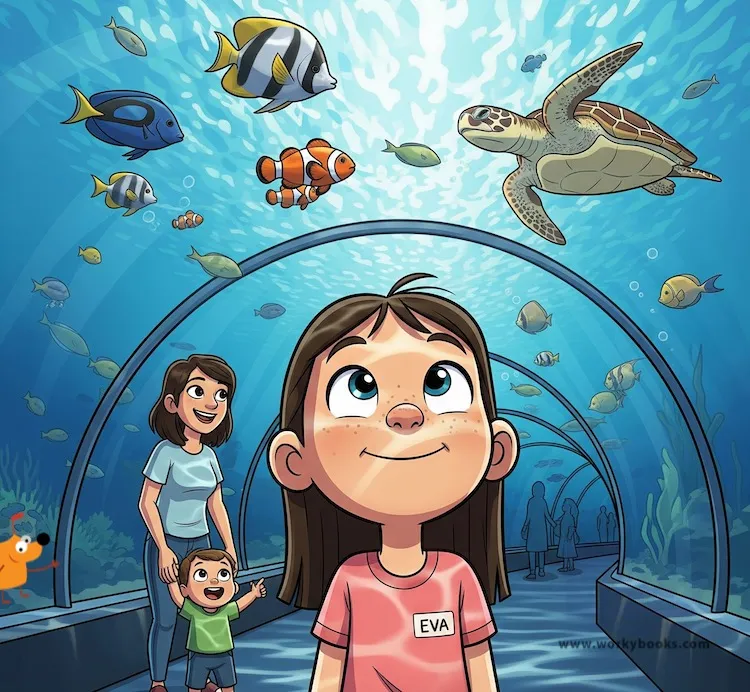
Eva is going to the aquarium with her mom and little brother. She has been excited for this trip all week! When they arrive, Eva presses her face
against the glass tunnels and says, “Wow, look at all the fish and sea turtles swimming above us!”
“Clownfish! My favorite,” says her brother Marco, pointing at some orange and white striped fish.
“Should we head over to the touch pools next?” asks Mom.
Eva replies, “Oh yes! I want to touch a starfish. Let's go!”
On their way out, Eva exclaims, “That shark tunnel was awesome! Can we get a snack now?” Marco says, “I'm hungry too. Can we please have ice cream?”
“Sure,” says Mom. “Ice cream sounds perfect.”
Comprehension quiz (4 questions)
1. Where is Eva going with her family?
2. What does Marco get excited about seeing?
3. What does Eva want to do at the touch pool?
4. What snack do they decide to get?
Common Core standards for Eva's Aquarium Visit-Short Story
By the end of the year, read and comprehend informational texts, including history/social studies, science, and technical texts, at the high end of the grades 2–3 text complexity band independently and proficiently.
By the end of the year, read and comprehend literature, including stories and poetry, in the grades 2–3 text complexity band proficiently, with scaffolding as needed at the high end of the range.
Recount stories, including fables and folktales from diverse cultures, and determine their central message, lesson, or moral.
Ask and answer questions to demonstrate understanding of a text, referring explicitly to the text as the basis for the answers.
By the end of the year, read and comprehend literature, including stories, dramas, and poetry, at the high end of the grades 2–3 text complexity band independently and proficiently.
Recount stories, including fables, folktales, and myths from diverse cultures; determine the central message, lesson, or moral and explain how it is conveyed through key details in the text.
Describe characters in a story (e.g., their traits, motivations, or feelings) and explain how their actions contribute to the sequence of events.
Perfect for the way you teach
- Build comprehension skills
- Auto-graded quiz
- Differentiated reading
- Read together at home
- Improve fluency
- Quiet reading time
- Reading curriculum support
- Independent practice
- Track Lexile growth