Neanderthals and Denisovans
Interactive passage with audio narration, comprehension questions, and printable PDF.
By completing this purchase you agree to our Terms of Use and Privacy Policy. Your subscription renews automatically until you cancel. You can cancel anytime from your account settings. All sales are final and non-refundable. Digital content is available for download in your account immediately upon purchase.
What's included
Part of this bundle

Neanderthals and Denisovans preview and details
About this printable Neanderthals and Denisovans reading passage (Grades 6-8)
Sample passage and quiz from Neanderthals and Denisovans
Reading passage and comprehension quiz preview
Neanderthals, Denisovans, and Other Humans
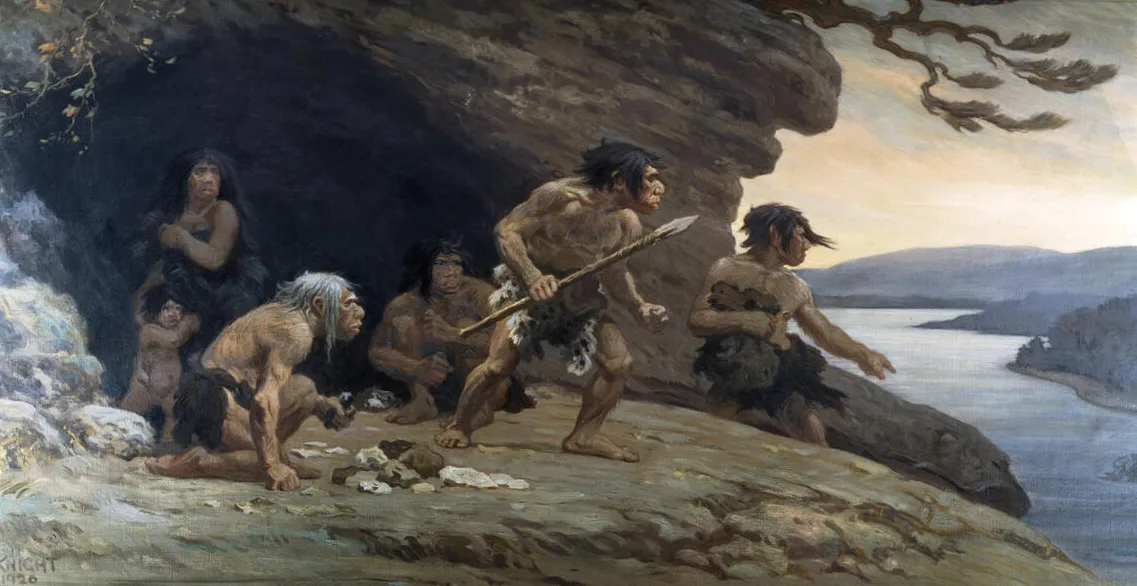
"Neanderthal Flintworkers (Knight, 1920)" by Charles Robert Knight / Wikimedia Commons (Public domain).
Multiple groups of ancient humans, or hominins, once lived across Europe and Asia during the last Ice Age. Among the most well-known are the Neanderthals, the Denisovans, and early Homo sapiens, our own species. These groups shared a common ancestor but developed unique features, cultures, and ways of life shaped by their environments.
Neanderthals first appeared about 400,000 years ago and became especially common in Europe and western Asia. Archaeologists have uncovered evidence of their complex social lives, such as burial sites in Shanidar Cave in Iraq, where pollen suggests they may have placed flowers with their dead. Neanderthals used stone tools like scrapers and spear points, and lived in small groups that hunted large Ice Age animals. Their bodies were adapted to cold climates, with sturdy bones and short limbs to conserve heat.
In 2010, scientists discovered a new group of ancient humans in the Denisova Cave in Siberia—now called Denisovans—by analyzing a single finger bone and tooth. Genetic studies revealed Denisovans were distinct from both Neanderthals and Homo sapiens, though all three could interbreed. DNA evidence shows Denisovans contributed genes to modern populations in Asia and Oceania, affecting traits like immunity to certain diseases and adaptation to high altitudes, as seen in present-day Tibetans.
Meanwhile, Homo sapiens emerged in Africa around 300,000 years ago and slowly spread across the globe. When they reached Europe and Asia, they encountered Neanderthals and Denisovans. Archaeological sites, like the cave at Grotte du Renne in France, provide clues about possible contact, such as shared ornaments and tools. Over thousands of years, Neanderthals and Denisovans disappeared—possibly due to climate change, competition for resources, and interbreeding with Homo sapiens.
The study of Neanderthals, Denisovans, and other humans helps us understand human diversity and adaptation. It shows how geography, environment, and migration shaped our ancestors’ lives. The discovery of ancient DNA and new fossils continues to change what we know about our shared past.
By learning about these early humans, historians and scientists can connect patterns of migration, adaptation, and survival to broader themes in ancient history, such as the development of societies and the impact of environment on human life.
Interesting Fact: Some modern humans still carry small amounts of Neanderthal or Denisovan DNA, showing that these ancient groups are part of our genetic story.
Comprehension quiz (8 questions)
1. Where did Denisovans get their name?
2. When did Neanderthals appear?
3. What was found in Shanidar Cave?
4. How were Neanderthals adapted to cold?
5. Why did Neanderthals and Denisovans disappear?
6. What does DNA evidence show?
7. Neanderthals and Denisovans were extinct by 2010.
8. What is a hominin?
Perfect for the way you teach
- Build comprehension skills
- Auto-graded quiz
- Differentiated reading
- Read together at home
- Improve fluency
- Quiet reading time
- Reading curriculum support
- Independent practice
- Track Lexile growth