Ocean Life
Interactive passage with audio narration, comprehension questions, and printable PDF.
What's included
Ocean Life preview and details
About this printable Ocean Life science reading passage, NGSS-aligned (Grades 3-5)
Sample passage and quiz from Ocean Life
Reading passage and comprehension quiz preview
Ocean Life
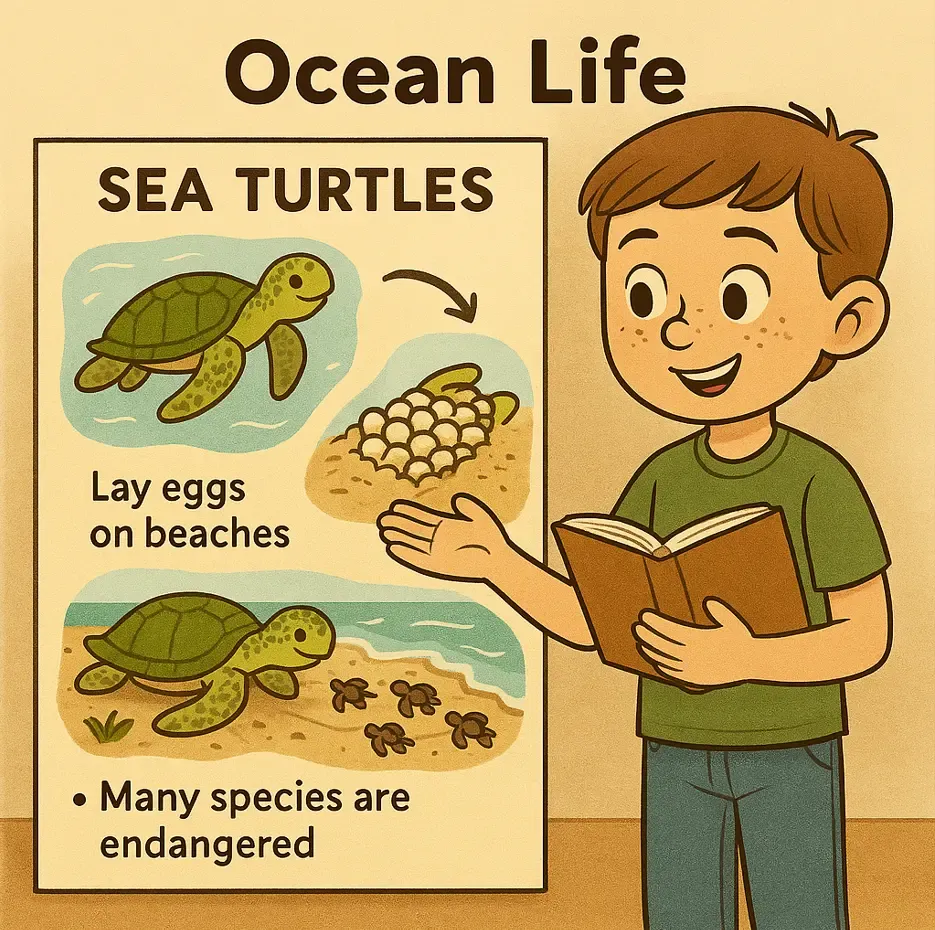
For science class, Evan is doing a report on sea turtles. He learned that sea turtles spend most of their lives swimming in the ocean, but they lay eggs on sandy beaches. Female turtles come ashore, dig nests, and bury over 100 eggs in each nest! The eggs hatch into little turtles who make their way down the beach and into the ocean just 2 months later.
Sea turtles face many threats from humans like plastic pollution, getting caught in fishing gear, and having their nesting beaches disturbed. Many species of sea turtles are endangered. Evan was sad to learn how human activities harm sea turtles. For his report, Evan explained the life cycle of sea turtles and how people can help protect them. He asked his family to use less plastic and got excited when he saw a sea turtle swimming on his vacat
ion to the beach.
Comprehension quiz (4 questions)
1. What is Evan doing a school report on?
2. Where do sea turtles lay eggs?
3. What threatens sea turtles?
4. How did learning about sea turtles make Evan feel?
Common Core standards for Ocean Life
By the end of the year, read and comprehend informational texts, including history/social studies, science, and technical texts, at the high end of the grades 2–3 text complexity band independently and proficiently.
By the end of the year, read and comprehend literature, including stories and poetry, in the grades 2–3 text complexity band proficiently, with scaffolding as needed at the high end of the range.
Recount stories, including fables and folktales from diverse cultures, and determine their central message, lesson, or moral.
Ask and answer questions to demonstrate understanding of a text, referring explicitly to the text as the basis for the answers.
By the end of the year, read and comprehend literature, including stories, dramas, and poetry, at the high end of the grades 2–3 text complexity band independently and proficiently.
Recount stories, including fables, folktales, and myths from diverse cultures; determine the central message, lesson, or moral and explain how it is conveyed through key details in the text.
Describe characters in a story (e.g., their traits, motivations, or feelings) and explain how their actions contribute to the sequence of events.
Perfect for the way you teach
- Build comprehension skills
- Auto-graded quiz
- Differentiated reading
- Read together at home
- Improve fluency
- Quiet reading time
- Reading curriculum support
- Independent practice
- Track Lexile growth