Patterns in Coded Messages — Reading Comprehension
Rate this
Premium Resource
Present
Present in classroom. No work saved
Assign
Classroom with student accounts, Track progress
Quick Play
No student accounts, assign with a link
Grades
3
4
5
Standards
NGSS 4-PS4-3
PRINT+DIGITAL RESOURCE
This learning resource is available in interactive and printable formats. The interactive worksheet can be played online and assigned to students. The Printable PDF version can be downloaded and printed for completion by hand.
This engaging Grade 4-5 science passage explores how codes are systems of patterns that represent information, allowing messages to be sent and understood by others. Students learn how different codes use different patterns of sounds, lights, or symbols to represent letters, words, or data. The passage connects to Morse code, demonstrating how patterns of dots and dashes represent letters, allowing messages to be sent by sound or light. Aligned with NGSS standard 4-PS4-3, this audio-integrated resource includes a simplified differentiated version, Spanish translations, glossary, multiple-choice quiz, writing activities, and graphic organizers. Students discover how patterns make communication possible across distances and situations. The passage uses concrete examples like flashlights and telegraphs to make abstract concepts tangible. Audio integration supports diverse learners, while differentiated materials ensure accessibility for all students. Keywords include codes, patterns, Morse code, coded messages, communication systems, information patterns, and message systems.
CONTENT PREVIEW
Expand content preview
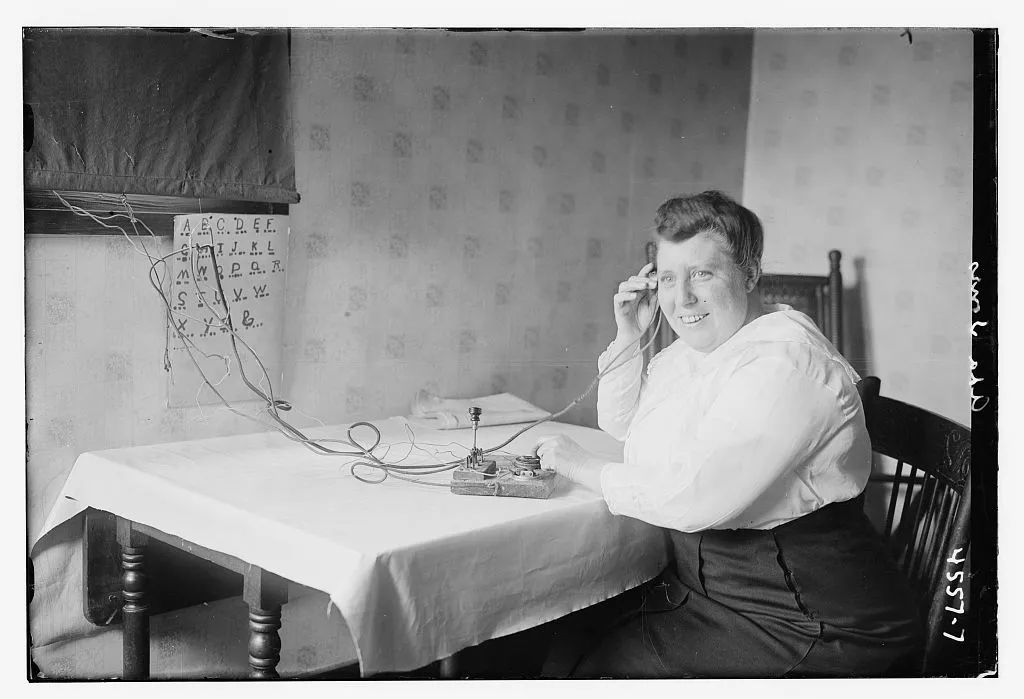
Ada Jones sending morse code in 1918 by Bain / Wikimedia Commons
A code is a system of patterns that represents information so that messages can be sent and understood. Codes allow people to communicate over distances or in special situations where regular talking or writing might not work. Without codes, we would have trouble sharing important information quickly and clearly.
All codes work by using patterns, which are things that repeat in an organized way. Different codes use different kinds of patterns to stand for letters, words, or data. Some codes use patterns of sounds, like beeps. Other codes use patterns of lights, like flashes. Still other codes use patterns of symbols, like special marks or pictures. Each pattern in a code has a specific meaning that both the sender and receiver must know.
Morse code is a famous code system invented in the 1830s. It uses patterns of dots and dashes to represent each letter of the alphabet. A dot is a short signal, and a dash is a longer signal. For example, the letter A is represented by one dot followed by one dash. The letter S is three dots in a row. When you know what each pattern means, you can spell out entire words and sentences.
Morse code can be sent in different ways because it only uses two basic signals. People can tap out the patterns as sounds, like tapping on a table or using a telegraph machine that makes clicking noises. They can also flash the patterns with light, like using a flashlight or signal lamp. If you flash a light three times quickly, pause, then flash three times slowly, then flash three times quickly again, you've sent the emergency signal SOS.
The reason codes work is that everyone agrees on what each pattern means. Just like how we all agree that the letter B makes a certain sound, people using Morse code agree that dot-dash means the letter A. This shared understanding of patterns is what makes communication, or the sharing of information, possible. If you send a message in code but the other person doesn't know the pattern system, they won't understand what you're trying to say.
Patterns in coded messages remain important today, even though we have phones and computers. Computers use codes made of patterns of 1s and 0s to store and send all kinds of information. Pilots and sailors still learn signal codes using lights and flags. Understanding how codes use patterns to represent information helps us see that communication is really about creating and recognizing patterns that carry meaning from one person to another.
What is a code?
A system of patterns representing informationA type of computer programA secret language only spies useA way to write faster
What does Morse code use?
Letters and numbers onlyDots and dashesColors and shapesMusical notes
When was Morse code invented?
In the 1930sIn the 1730sIn the 1830sIn the 2000s
Why do codes work?
They are easy to learnEveryone agrees on pattern meaningsThey use simple wordsThey are written down
How can Morse code be sent?
Only with telegraph machinesOnly with computersWith sounds or light signalsOnly by writing
What emergency signal uses three patterns?
ABCSOSHELP911
Codes are still used in computers today.
TrueFalse
What are patterns in codes?
Random signals with no meaningThings that repeat in organized waysOnly visual designsMistakes in messages
Perfect For:
👩🏫 Teachers
• Reading comprehension practice
• Auto-graded assessments
• Literacy skill development
👨👩👧👦 Parents
• Reading practice at home
• Comprehension improvement
• Educational reading time
🏠 Homeschoolers
• Reading curriculum support
• Independent reading practice
• Progress monitoring
Reading Features:
📖
Reading Passage
Engaging fiction or nonfiction text
❓
Comprehension Quiz
Auto-graded questions
📊
Instant Feedback
Immediate results and scoring
📄
Printable Version
Download for offline reading
🔊
Read Aloud
Voice-over with word highlighting
Reviews & Ratings
No reviews yet. Be the first to share your experience!
Related Content
How Antennas Work
This engaging 350-word science passage introduces elementary students to the fascinating world of antennas and signal tr...
NGSS 4-PS4-3
How Transmitters Work
This 350-word informational science passage explores how transmitters are devices that create and send wave signals carr...
NGSS 4-PS4-3
What Is Morse Code
This engaging 250-word science passage introduces Grade 4-5 students to Morse code, a fascinating communication system t...