

Radioactive Decay
Interactive passage with audio narration, comprehension questions, and printable PDF.
What's included
Radioactive Decay preview and details
About this printable Radioactive Decay science reading passage, NGSS-aligned (Grades 5-8)
Sample passage and quiz from Radioactive Decay
Reading passage and comprehension quiz preview
Radioactive Decay
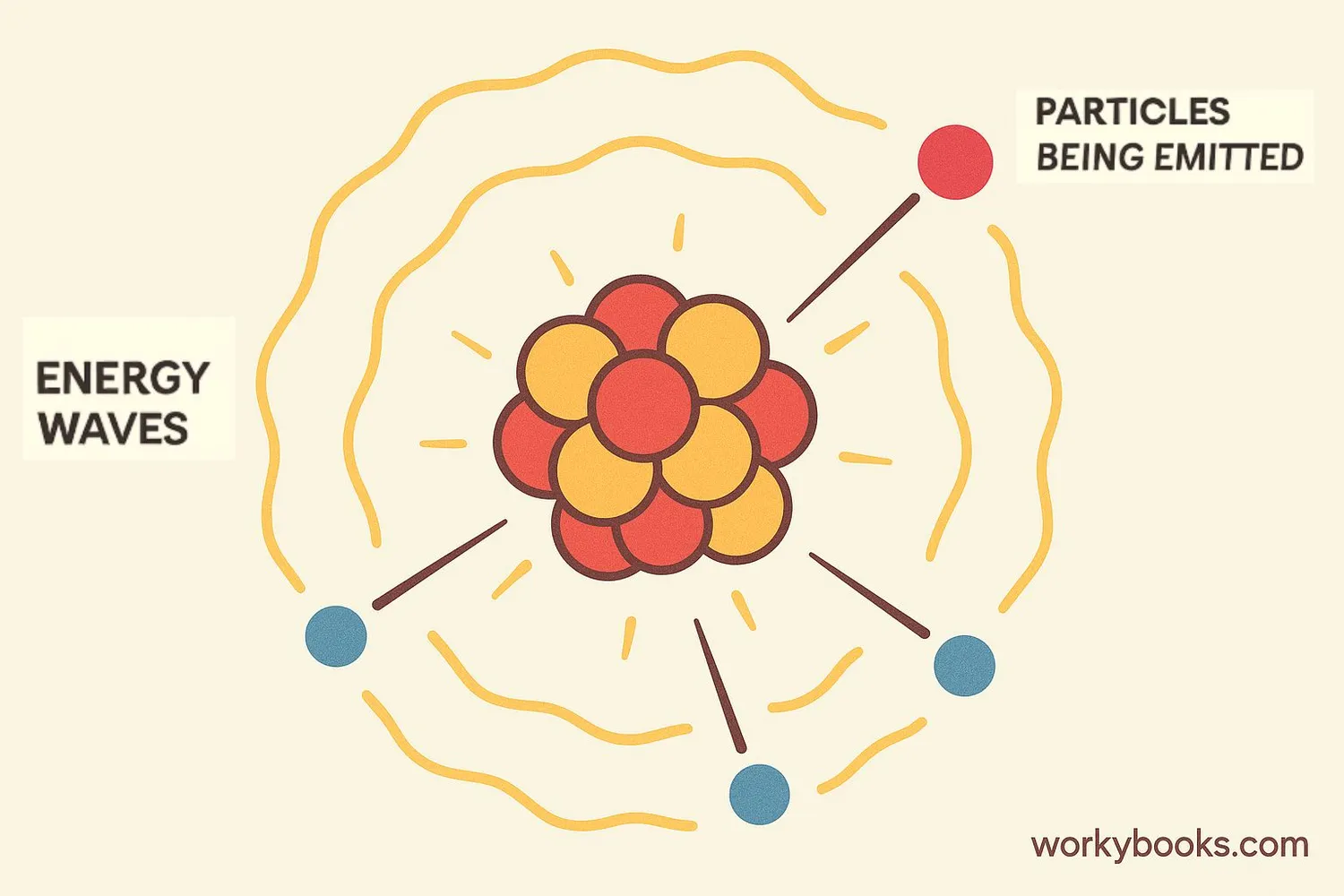
Radioactive decay is a natural process that changes the identity of elements over time. It is responsible for the way uranium in rocks can eventually turn into lead, and for how scientists use carbon-14 to date ancient bones and artifacts. Understanding radioactive decay helps explain the age of the Earth, the origin of some elements, and even how smoke detectors work. This passage explores how and why radioactive decay happens, and why it is important for science and society.
The Mechanism of Radioactive Decay
Atoms are made of protons and neutrons in a central nucleus, surrounded by electrons. Some nuclei are unstable because they have too many or too few neutrons compared to protons. These unstable nuclei are called radioisotopes or radioactive isotopes. To reach a more stable state, they release radiation—energy or particles that escape from the nucleus. During this process, the parent isotope changes into a different element called the daughter isotope. For example, a uranium-238 nucleus (the parent) emits particles and becomes lead-206 (the daughter) after a series of decays. This series is known as a decay chain. Each step in the chain involves the nucleus losing particles or energy, gradually transforming into a more stable element.
Decay Chains and Predictable Patterns
While the decay of a single atom is random, scientists can predict how a large group of atoms will behave. The half-life of a radioisotope is the time it takes for half of the atoms in a sample to decay. For uranium-238, the half-life is about 4.5 billion years. This means that after 4.5 billion years, only half of the original uranium remains, and the rest has become other elements through decay. Carbon-14, which is used to date ancient organic materials, decays into nitrogen-14 with a half-life of 5,730 years. By measuring the ratio of parent to daughter isotopes, scientists can calculate the age of rocks, fossils, and artifacts with remarkable accuracy. Decay chains can involve several steps and different elements before reaching a stable isotope.
Applications and Broader Implications
Radioactive decay has many uses beyond dating ancient objects. In medicine, radioisotopes are used to diagnose and treat diseases. Environmental scientists use the decay of certain isotopes to track pollution and study climate change. The energy released during radioactive decay can be harnessed in nuclear power plants to generate electricity. However, the radiation produced can also be harmful, so safe handling and disposal of radioactive materials is important for health and the environment. The study of radioactive decay connects to larger scientific principles, like the conservation of mass and energy, and helps us understand the dynamic and ever-changing nature of matter in the universe.
Interesting Fact:
A single gram of radium releases about 0.0001 calories of energy per second through radioactive decay—enough to glow in the dark!
Comprehension quiz (10 questions)
1. What is radioactive decay?
2. Which part of the atom is involved in radioactive decay?
3. What is a parent isotope?
4. What does the term 'half-life' mean in the passage?
5. Which of these is an example of a decay chain described in the passage?
6. What is the main reason scientists use the ratio of parent to daughter isotopes?
7. In what way is radioactive decay useful in medicine?
8. What is the role of radiation in radioactive decay?
9. True or False: The half-life of carbon-14 is 5,730 years.
10. True or False: The decay of a single atom is predictable and always happens at the same time.
Perfect for the way you teach
- Build comprehension skills
- Auto-graded quiz
- Differentiated reading
- Read together at home
- Improve fluency
- Quiet reading time
- Reading curriculum support
- Independent practice
- Track Lexile growth