What Is Earth Science?
Interactive passage with audio narration, comprehension questions, and printable PDF.
By completing this purchase you agree to our Terms of Use and Privacy Policy. Your subscription renews automatically until you cancel. You can cancel anytime from your account settings. All sales are final and non-refundable. Digital content is available for download in your account immediately upon purchase.
What's included
What Is Earth Science? preview and details
About this printable What Is Earth Science? science reading passage, NGSS-aligned (Grades 5-8)
Sample passage and quiz from What Is Earth Science?
Reading passage and comprehension quiz preview
What Is Earth Science?
Earth science is the field that investigates our home planet and its position in space. Scientists in this field seek to answer questions such as: How did Earth form? What causes earthquakes and storms? How do oceans and the atmosphere interact? Earth science matters because it helps us understand natural events, find vital resources, and protect people from hazards.
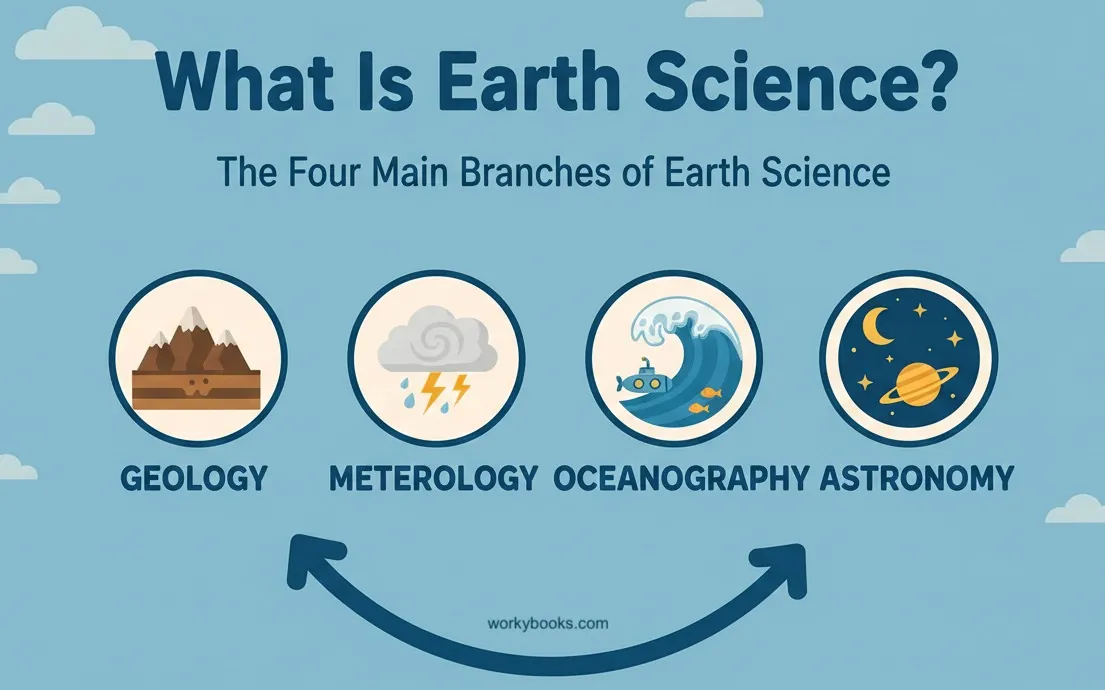
The Four Main Branches of Earth Science
Earth science is divided into four main branches, each with its own focus. Geology is the study of rocks, minerals, and Earth’s interior. Geologists examine processes like plate tectonics, which move continents and cause earthquakes. Meteorology investigates the atmosphere and weather patterns. Meteorologists use instruments and satellites to measure temperature, humidity, and pressure, helping to forecast storms and predict climate trends. Oceanography explores the oceans—covering about 71% of Earth’s surface. Oceanographers study currents, marine life, and how the oceans affect weather and climate. Astronomy focuses on Earth’s place in the universe, including the Sun, Moon, planets, and stars. Astronomers use telescopes to observe distant objects and analyze how cosmic events influence Earth.
Studying Earth’s Past, Present, and Future
Earth scientists use data collected from rocks, ice cores, weather balloons, and satellites to investigate both past and current conditions. For example, by analyzing layers of rock, geologists learn about ancient environments and past extinctions. Meteorologists track weather changes to improve forecasts and issue warnings for severe storms like hurricanes. Oceanographers monitor rising sea levels and changes in ocean temperature, which can signal global climate shifts. These scientists also use computer models to predict future events, such as volcanic eruptions, earthquakes, or climate change impacts. Scientific thinking relies on observation, measurement, and testing hypotheses to uncover how Earth’s systems interact over time.
Why Earth Science Matters: Real-World Applications
Earth science is essential because it helps society prepare for and respond to natural hazards. For instance, understanding plate tectonics allows geologists to identify earthquake-prone zones and improve building safety. Meteorologists’ weather predictions can save lives during tornadoes or floods. Oceanographers help manage fisheries and protect coastlines from erosion. Astronomers track asteroids and solar activity that could affect satellites and power grids. Earth science is also vital for finding resources like water, minerals, and energy, and for addressing major challenges such as climate change. Careers in Earth science include geologist, meteorologist, oceanographer, environmental scientist, and astronaut.
Earth science connects physical, chemical, and biological systems. By understanding these connections, scientists can find solutions to environmental problems and help build a safer, more sustainable future.
Interesting Fact:
About 90% of all earthquakes occur along the Pacific “Ring of Fire,” showing how plate tectonics shape our planet’s surface.
Comprehension quiz (10 questions)
1. Which of the following is NOT one of the four main branches of Earth science?
2. What do meteorologists study?
3. Which tool do meteorologists often use to help predict the weather?
4. What is the main focus of geology?
5. What does the term 'natural hazards' refer to in the passage?
6. According to the passage, how do oceanographers help protect society?
7. Which career would most likely track asteroids and solar activity?
8. True or False: Earth scientists use computers and models to predict future events.
9. True or False: The majority of earthquakes occur in the Atlantic Ocean.
10. What is one reason Earth science is important for society?
Perfect for the way you teach
- Build comprehension skills
- Auto-graded quiz
- Differentiated reading
- Read together at home
- Improve fluency
- Quiet reading time
- Reading curriculum support
- Independent practice
- Track Lexile growth