Scientific Inquiry in Earth Science
Interactive passage with audio narration, comprehension questions, and printable PDF.
By completing this purchase you agree to our Terms of Use and Privacy Policy. Your subscription renews automatically until you cancel. You can cancel anytime from your account settings. All sales are final and non-refundable. Digital content is available for download in your account immediately upon purchase.
What's included
Scientific Inquiry in Earth Science preview and details
About this printable Scientific Inquiry in Earth Science science reading passage, NGSS-aligned (Grades 5-8)
Sample passage and quiz from Scientific Inquiry in Earth Science
Reading passage and comprehension quiz preview
Scientific Inquiry in Earth Science

Earth science investigates how our planet changes over time and why these changes occur. The study of Earth is important because it helps us understand natural events like earthquakes, climate change, and the formation of mountains. Earth scientists use scientific inquiry to answer questions about the planet. This process involves making observations, developing hypotheses, and testing ideas. However, Earth science faces unique challenges because scientists cannot experiment directly on the whole Earth, and many processes occur over millions of years.
Methods of Scientific Inquiry in Earth Science
Earth scientists use a variety of investigative methods. Field studies involve observing and measuring natural processes in places like rivers, volcanoes, and forests. For example, scientists may collect soil samples or record the movement of glaciers. In the laboratory, they analyze rock samples or simulate earthquakes on a small scale. Modeling is another key tool. Scientists build physical models, such as stream tables, to demonstrate how rivers shape landforms. They also use mathematical models and computer simulations to understand complex systems like Earth’s climate. These models use data, equations, and algorithms to predict how systems behave. Because scientists cannot directly observe all Earth processes, they also analyze historical data like ice cores or tree rings to learn about the past.
Making Observations and Testing Hypotheses
Earth scientists collect data over long periods—sometimes decades or even centuries. For example, climate scientists track temperature and carbon dioxide levels year after year to find trends. By comparing observations with model predictions, they test their hypotheses. If the data matches the model, the hypothesis is supported. If not, scientists revise their ideas and test again. This process allows scientists to make inferences about events that happened thousands or millions of years ago, such as volcanic eruptions or the movement of tectonic plates.
Challenges and Importance of Long-Term Data
Earth science has special challenges because many variables affect natural systems, and processes often occur over long timescales. For instance, understanding climate change requires data from many sources—satellites, weather stations, and ocean buoys—collected over decades. By combining different types of investigations, scientists are better able to explain and predict changes in Earth’s systems. The information they gather helps society prepare for natural hazards, manage resources, and protect the environment.
Scientific inquiry in Earth science shows how careful observation, data analysis, and modeling can reveal the hidden processes shaping our planet. These methods connect to broader scientific principles about systems, change, and evidence. As technology advances, Earth scientists will continue to develop new ways to investigate our ever-changing world.
Interesting Fact:
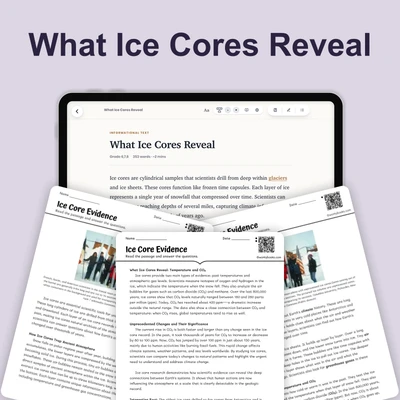
Earth scientists use ice cores from Antarctica that are over 800,000 years old to study ancient climates and atmospheric changes.
Comprehension quiz (10 questions)
1. What is one reason why Earth science is challenging for scientists?
2. Which of the following is NOT an example of a field study?
3. What do Earth scientists use to make inferences about past events?
4. What is modeling in Earth science?
5. According to the passage, what is a hypothesis?
6. In the passage, what does 'data' mean?
7. Why do scientists use long-term data collection in Earth science?
8. How do models help Earth scientists?
9. True or False: Earth scientists can always directly observe every process they study.
10. True or False: Ice cores from Antarctica help scientists study climates from hundreds of thousands of years ago.
Perfect for the way you teach
- Build comprehension skills
- Auto-graded quiz
- Differentiated reading
- Read together at home
- Improve fluency
- Quiet reading time
- Reading curriculum support
- Independent practice
- Track Lexile growth