
Passage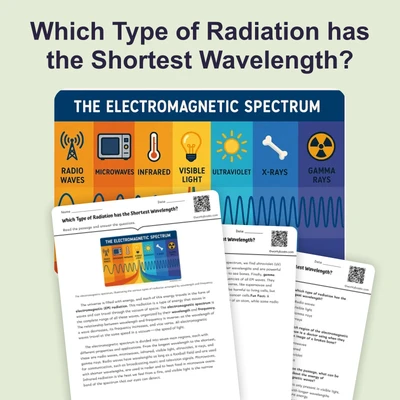
Grades 3–8
Which Type of Radiation has the Shortest Wavelength?
Reading Passage
$1.50

Explore our collection of Electromagnetic Waves curriculum resources for grades K-8. This hub offers printable and digital worksheets, games, reading passages, and activities that build understanding from basic light and sound concepts to more advanced wave properties. Some resources are free, while most are available with a Workybooks membership.
Reading Passage
Reading Passage · MS-PS4-1
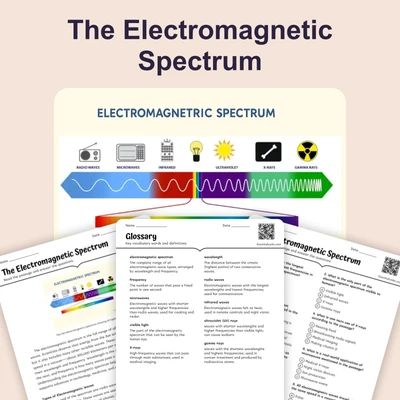
Electromagnetic Waves resources on Workybooks span the K-8 progression, starting in early grades with observable phenomena like light and heat from the sun, sound traveling through air, and how shadows form. Students learn that waves carry energy and can be described by properties such as wavelength and frequency. As they move into upper elementary, they explore the electromagnetic spectrum, including visible light, infrared, and ultraviolet, and investigate how waves interact with matter through reflection, refraction, and absorption. Related concepts such as energy transfer, vibration, and the speed of light are integrated into activities and reading passages.
In grades 3-5, students deepen their understanding by comparing mechanical and electromagnetic waves, using diagrams to model wave behavior, and conducting simple experiments with prisms and mirrors. By grade 8, the resources cover topics like radio waves, microwaves, and the relationship between energy and frequency. The scaffolded resources allow teachers to differentiate instruction, offering simpler explanations for younger students and more complex challenges for advanced learners. All materials are teacher-authored, standards-aligned, and designed for no-prep classroom use.
Teachers can use this hub to find the right level for their class by filtering resources by grade or skill. For whole-group lessons, use a reading passage or graphic organizer to introduce wave concepts. In small groups or centers, hands-on activities and games reinforce vocabulary and properties. Assign printable worksheets for independent practice or homework, and use digital activities for intervention or review. The range of difficulty allows differentiation across a mixed-ability room: struggling students can start with basic light and sound resources, while advanced learners tackle the electromagnetic spectrum. These resources also serve as formative assessments or end-of-unit review.
These resources align with grade-level Common Core standards for literacy and math, as well as Next Generation Science Standards (NGSS) for waves and their applications in technologies for information transfer. Specific standards vary by grade and activity.
Yes, many of our Electromagnetic Waves worksheets are printable. You can download and print PDF versions for classroom use. Some are free, while others require a membership. Digital versions are also available for online practice.
Absolutely. These worksheets are designed for kids in grades K-8, with age-appropriate language and visuals. Early grades focus on basic concepts like light and sound, while upper grades explore the electromagnetic spectrum and wave properties.
In addition to worksheets, this hub includes interactive games, reading passages with comprehension questions, hands-on activities, and graphic organizers. These resources support different learning styles and instructional settings.
The resources span multiple grade levels and difficulty levels. You can assign simpler activities (e.g., identifying light sources) to students who need foundational practice, and more complex ones (e.g., calculating wave speed) to advanced learners. Digital and printable options allow flexible use in centers, independent work, or homework.