Electromagnetic Spectrum
Interactive passage with audio narration, comprehension questions, and printable PDF.
By completing this purchase you agree to our Terms of Use and Privacy Policy. Your subscription renews automatically until you cancel. You can cancel anytime from your account settings. All sales are final and non-refundable. Digital content is available for download in your account immediately upon purchase.
What's included
Electromagnetic Spectrum preview and details
About this printable Electromagnetic Spectrum science reading passage, NGSS-aligned (Grades 5-8)
Sample passage and quiz from Electromagnetic Spectrum
Reading passage and comprehension quiz preview
The Electromagnetic Spectrum

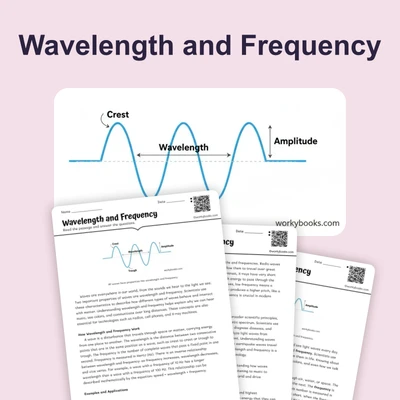
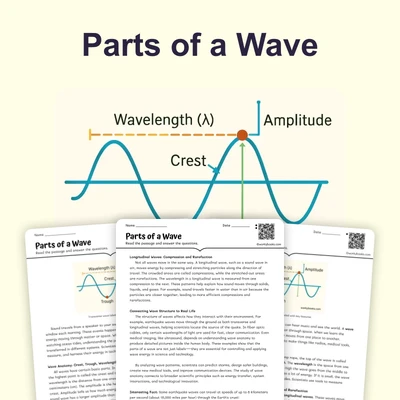
The electromagnetic spectrum is the full range of all types of electromagnetic waves. Scientists observe that energy from the Sun arrives on Earth as visible light, but it also includes many other invisible waves. These waves all travel at the same speed in a vacuum—about 300,000 kilometers per second—but they are sorted by their wavelength and frequency. Wavelength is the distance from one wave crest to the next, and frequency is how many waves pass a point in one second. Understanding the electromagnetic spectrum helps explain natural phenomena and supports advances in technology, medicine, and communication.
Types of Electromagnetic Waves
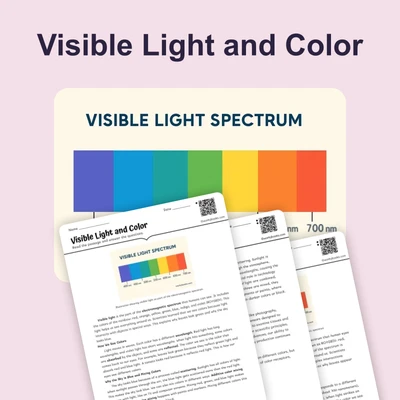
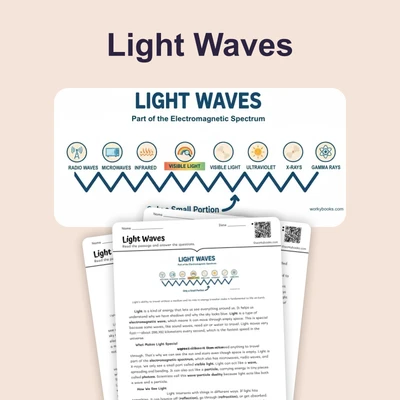
At one end of the spectrum are radio waves, with the longest wavelengths and the lowest frequencies. These waves are used for broadcasting radio and television signals, as well as for Wi-Fi and cell phones. Next are microwaves, which have shorter wavelengths and higher frequencies than radio waves. Microwaves are used in microwave ovens to heat food and in radar technology. Infrared waves come next; they are felt as heat and are used in night vision devices and remote controls. The only part of the spectrum visible to humans is visible light, which allows us to see colors from red to violet. Ultraviolet (UV) rays have even shorter wavelengths and higher frequencies. They can cause sunburn but also help our bodies produce vitamin D. X-rays penetrate most materials and are used in medical imaging to view inside the body. At the highest frequencies and shortest wavelengths are gamma rays, which are produced by radioactive atoms and certain cosmic events. Gamma rays can destroy cancer cells but are dangerous in high doses.
Interactions and Applications
The characteristics of each type of electromagnetic wave determine how it interacts with matter and how humans use it. For example, radio waves can travel long distances and pass through buildings, making them ideal for communication. Microwaves excite water molecules, which is why they heat food quickly. Infrared is absorbed by skin and objects, providing warmth and allowing thermal cameras to detect heat. Visible light interacts with our eyes, enabling sight. Ultraviolet rays can damage living tissue, so sunscreen is used to block them. X-rays are absorbed differently by bones and soft tissue, creating images in healthcare. Gamma rays can treat cancer but require shielding to protect healthy cells. Each wave’s wavelength and frequency are measured in scientific units, allowing precise control in research and technology.
Broader Implications
Understanding the electromagnetic spectrum connects to broader scientific ideas about energy, waves, and technology. It explains why satellites can send signals across the globe, how astronomers study the universe, and why protective measures are needed against certain types of waves. As technology advances, scientists discover new ways to use and control electromagnetic waves, leading to medical breakthroughs, improved communication, and exploration of space. Knowing how the spectrum works helps society make informed decisions about health, safety, and innovation.
Interesting Fact: The human eye can detect only a tiny part of the electromagnetic spectrum—less than one trillionth of the full range!
Comprehension quiz (10 questions)
1. Which waves have the longest wavelengths and lowest frequencies in the electromagnetic spectrum?
2. What is the only part of the electromagnetic spectrum visible to humans?
3. Which of the following best describes 'frequency' as used in the passage?
4. What is one main use of X-rays according to the passage?
5. What happens to the wavelength as you move from radio waves to gamma rays on the spectrum?
6. What is a real-world application of microwaves mentioned in the passage?
7. According to the passage, why is sunscreen important?
8. All electromagnetic waves travel at the same speed in a vacuum.
9. Gamma rays have the lowest frequencies and longest wavelengths.
10. Which of the following is NOT a use of infrared waves?
Perfect for the way you teach
- Build comprehension skills
- Auto-graded quiz
- Differentiated reading
- Read together at home
- Improve fluency
- Quiet reading time
- Reading curriculum support
- Independent practice
- Track Lexile growth