Composing Composite Shapes
Interactive worksheet with auto-grading, instant feedback, and printable PDF.
What's included
Composing Composite Shapes preview and details
About this worksheet
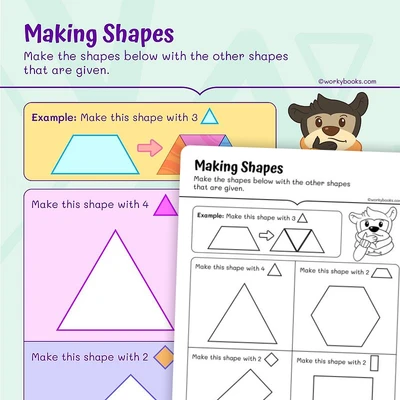
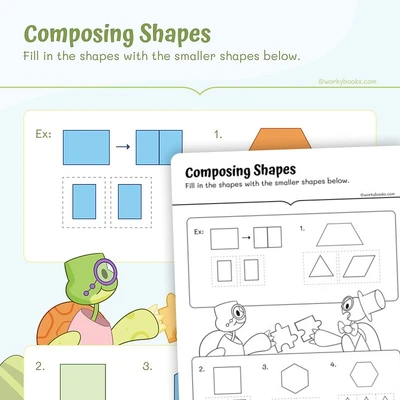
This interactive and printable worksheet, "Composing Composite Shapes" worksheet is a hands-on and engaging resource that challenges students to compose new geometric shapes by drawing lines within given figures. This activity enhances their spatial reasoning, problem-solving abilities, and geometric understanding.
What will your child learn through this worksheet?
By completing this worksheet, your child will develop the following skills:
Cognitive:
- Identify and understand the properties of various geometric shapes, such as triangles and trapezoids.
- Apply spatial reasoning and visualization to recognize how lines can be drawn to create new shapes.
- Develop problem-solving strategies to efficiently compose composite shapes.
Psychomotor:
- Enhance hand-eye coordination and fine motor skills through the act of drawing lines precisely.
- Practice accurate and controlled pencil manipulation.
Affective:
- Foster a sense of accomplishment and confidence upon successfully completing the tasks.
- Encourage perseverance and resilience when faced with challenging problems.
Interpersonal/Social:
- Collaborate with peers or seek guidance from teachers to discuss different approaches to composing shapes.
- Develop the ability to communicate spatial reasoning and problem-solving strategies effectively.
Learning Outcomes
Upon completing this worksheet, students should be able to:
- Identify and name various geometric shapes, including triangles, trapezoids, and their properties.
- Visualize and draw lines within given shapes to create new composite shapes accurately.
- Apply problem-solving strategies to efficiently compose composite shapes by drawing appropriate lines.
- Demonstrate improved hand-eye coordination and fine motor skills through precise line drawing.
- Exhibit perseverance and resilience when faced with challenging problems.
- Effectively communicate spatial reasoning and problem-solving strategies with peers or teachers.
Tags
Composing Composite Shapes, Geometric Shapes, Triangles, Trapezoids, Spatial Reasoning, Problem-Solving, Fine Motor Skills, Hand-Eye Coordination, Perseverance, Resilience, Collaboration, Communication
Common Core standards covered
Compose two-dimensional shapes (rectangles, squares, trapezoids, triangles, half-circles, and quarter-circles) or three-dimensional shapes (cubes, right rectangular prisms, right circular cones, and right circular cylinders) to create a composite shape, and compose new shapes from the composite shape.1
Perfect for the way you teach
- Assign in one click
- Track progress per student
- Auto-graded results
- Practice at home
- Print or do on-screen
- Build skill mastery
- Standards-aligned
- Self-paced
- Ready-to-use today