Partitioning Shapes
Interactive worksheet with auto-grading, instant feedback, and printable PDF.
By completing this purchase you agree to our Terms of Use and Privacy Policy. Your subscription renews automatically until you cancel. You can cancel anytime from your account settings. All sales are final and non-refundable. Digital content is available for download in your account immediately upon purchase.
What's included
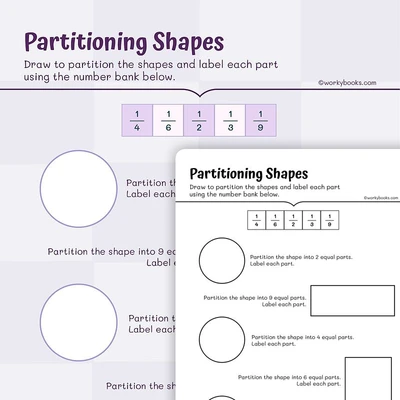
Partitioning Shapes preview and details
About this worksheet
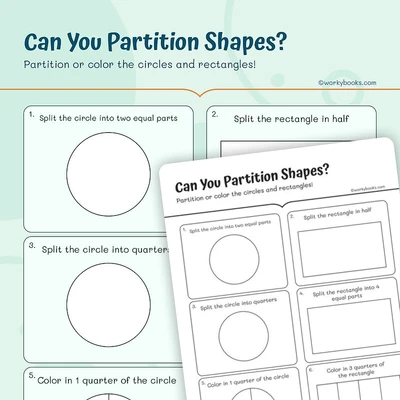
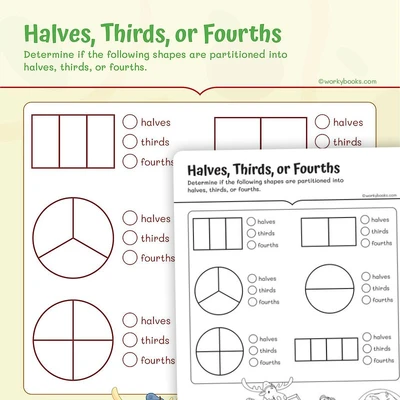
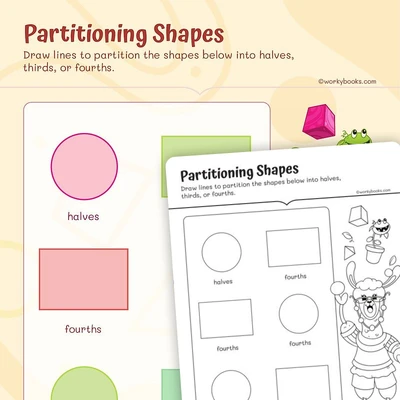
Partitioning Shapes. This interactive and printable worksheet is designed to enhance students' understanding of shape partitioning and fractions. The activity presents five different geometric shapes, including rectangles and circles, and challenges students to divide each shape into a specified number of equal parts. The worksheet progresses in complexity, starting with simpler partitions like halves and quarters, and advancing to more challenging divisions such as sixths, eighths, and twelfths.
By engaging with this worksheet, students develop critical spatial reasoning skills and deepen their comprehension of fractions and equal parts. The varied shapes and partition requirements encourage flexible thinking and problem-solving as students must devise strategies to divide each shape accurately. This hands-on approach to geometry and fractions helps solidify abstract mathematical concepts through visual representation. The activity not only reinforces geometric understanding but also lays a strong foundation for more advanced mathematical topics such as area, perimeter, and complex fractions. Through practicing these partitioning tasks, students enhance their ability to visualize and manipulate shapes, skills that are crucial in both mathematics and real-world applications.
What will your child learn through this worksheet?
- Understanding and applying the concept of equal partitioning in various shapes
- Developing strategies for dividing shapes into different numbers of equal parts
- Strengthening spatial reasoning and geometric visualization skills
- Reinforcing the connection between fractions and visual representations
Learning Outcomes
Cognitive
- Accurately partition at least 4 out of 5 shapes into the specified number of equal parts
- Explain the strategy used for partitioning each shape, demonstrating understanding of equal division
Psychomotor
- Draw precise partition lines within the shapes, showing improved fine motor control
- Complete all five shape partitions within a 20-minute timeframe, demonstrating efficient hand-eye coordination
Affective
- Express increased confidence in approaching complex shape partitioning tasks
- Show curiosity and enthusiasm for exploring more advanced geometric concepts
Interpersonal/Social
- Engage in collaborative problem-solving when discussing partitioning strategies with peers
- Clearly communicate their reasoning for chosen partitioning methods to classmates or teachers
Tags
shape partitioning, fractions, geometry, equal parts, spatial reasoning, rectangles, circles, halves, quarters, sixths, eighths, twelfths, visual math, problem-solving
Common Core standards covered
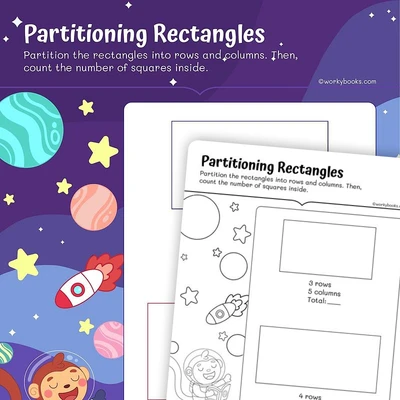
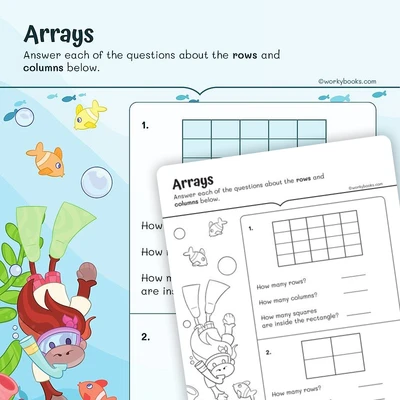
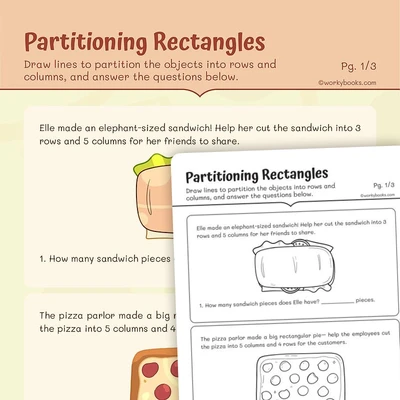
Partition a rectangle into rows and columns of same-size squares and count to find the total number of them.
Partition circles and rectangles into two, three, or four equal shares, describe the shares using the words halves, thirds, half of, a third of, etc., and describe the whole as two halves, three thirds, four fourths. Recognize that equal shares of identical wholes need not have the same shape.
Partition shapes into parts with equal areas. Express the area of each part as a unit fraction of the whole. For example, partition a shape into 4 parts with equal area, and describe the area of each part as 1/4 of the area of the shape.
Perfect for the way you teach
- Assign in one click
- Track progress per student
- Auto-graded results
- Practice at home
- Print or do on-screen
- Build skill mastery
- Standards-aligned
- Self-paced
- Ready-to-use today