Solar Eclipses
Interactive worksheet with auto-grading, instant feedback, and printable PDF.
By completing this purchase you agree to our Terms of Use and Privacy Policy. Your subscription renews automatically until you cancel. You can cancel anytime from your account settings. All sales are final and non-refundable. Digital content is available for download in your account immediately upon purchase.
What's included
Solar Eclipses preview and details
About this worksheet
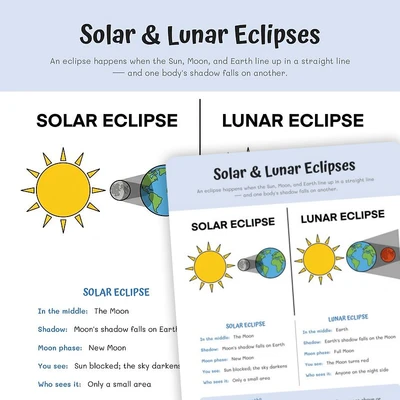
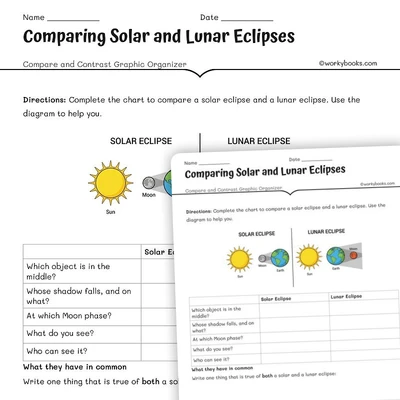
Give your students a clear, standards-precise introduction to solar eclipses with this print-ready reading passage and question set, built for NGSS MS-ESS1-1 and grades 6-8. The science note explains how a solar eclipse happens when the Moon passes between the Sun and Earth and its shadow falls on Earth, why the Sun and Moon appear nearly the same size in our sky, and how the umbra and penumbra produce total and partial eclipses.
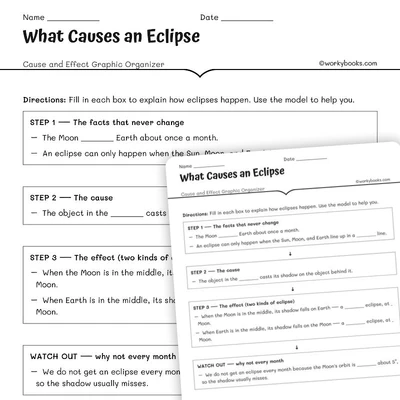
A labeled diagram supports the text, and four scaffolded questions move students from recall toward reasoning, including the keystone idea that the Moon's tilted orbit is why we do not get a solar eclipse at every New Moon. Short-answer lines give students room to explain their thinking in complete sentences.
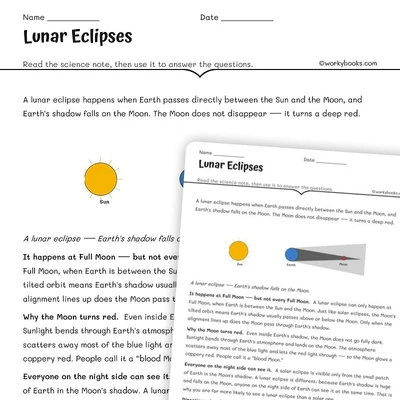
A complete answer key with sample responses is included, and everything prints cleanly in black and white. Pair it with the Lunar Eclipses reading and the rest of the eclipses unit for a full teach, practice, and assess sequence.
- Reading passage plus 4 questions with answer key
- Labeled umbra and penumbra diagram
- Aligned to NGSS MS-ESS1-1, grades 6-8
Perfect for the way you teach
- Assign in one click
- Track progress per student
- Auto-graded results
- Practice at home
- Print or do on-screen
- Build skill mastery
- Standards-aligned
- Self-paced
- Ready-to-use today