

Ice Age and Human Adaptation
A bundle of 4 resources — buy once and get every item to download and assign, individually or all together.
By completing this purchase you agree to our Terms of Use and Privacy Policy. Your subscription renews automatically until you cancel. You can cancel anytime from your account settings. All sales are final and non-refundable. Digital content is available for download in your account immediately upon purchase.
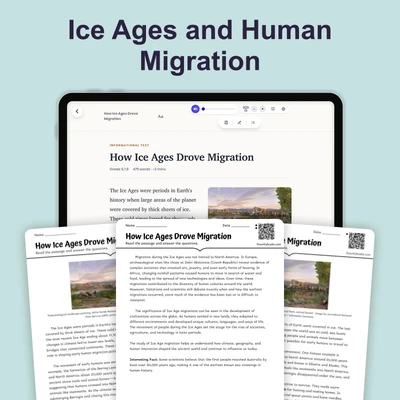
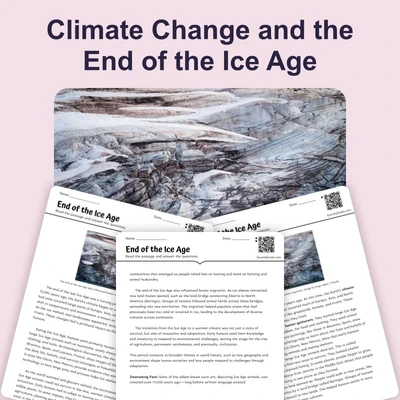
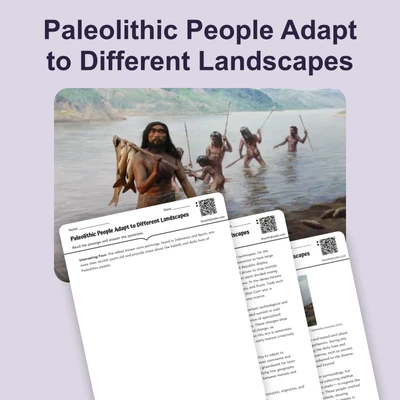
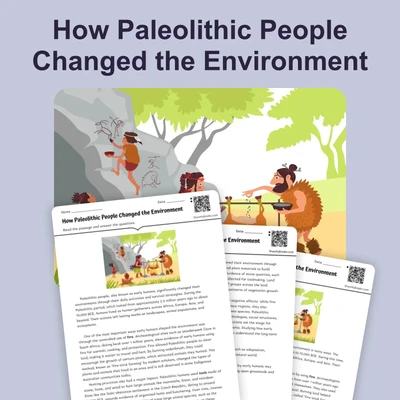
About this bundle
This comprehensive Social Studies Resource is expertly designed to help students master the complex relationship between prehistoric human activity, environmental shifts, and Earth's climate system, perfectly aligned with upper elementary and middle school standards.
Use this engaging material to clarify the critical ways early humans adapted to changing environments during the Pleistocene epoch, how climate patterns drove global migrations, and the notable impact early human innovations had on the surrounding ecosystems.
About this Resource:
The material provides a clear, conceptual framework using accessible language and detailed, historical narratives to make complex paleolithic history and climate science easy for students to understand. To support diverse classrooms, each topic in this resource features differentiated reading passages available in two distinct reading levels (Simplified and Detailed), provided in both English and Spanish.
The topics included in this resource are:
- How Ice Ages Drove Migration
- End of Ice Age
- How Early Humans Survived the Ice Age
- Human Impact on Extinctions
What's Included:
- Differentiated Reading Passages: Multiple-leveled, illustrated history and science passages explaining how global climate changes shaped ancient human lifestyles, migration paths, and survival strategies.
- Bilingual Support: Every passage and activity is fully accessible in both English and Spanish, making it ideal for mixed-ability classrooms and Dual Language/ELL programs.
- Graphic Organizers & Tables: Targeted worksheets including Cause and Effect charts and Chronological Development timelines to help students visually structure and synthesize historical data.
- Glossary: A dedicated vocabulary section defining key thematic terms such as Ice Ages, Land Bridge, Beringia, Pleistocene, Hunter-Gatherers, Extinction, and Ecosystem.
- Comprehension Quizzes: Text-dependent multiple-choice questions designed to assess student understanding of core historical and scientific facts.
- Writing Activities: Open-ended analytical prompts that challenge students to use explicit text evidence to explain how human innovation responded to environmental pressures.
- Complete Answer Keys: Thorough, suggested answers for all vocabulary, graphic organizers, quizzes, and writing activities to save you valuable grading time.
Learning Objectives:
Students will be able to:
- Explain how major climate shifts during the Ice Ages lowered sea levels and created vital land bridges like Beringia to facilitate global human migration.
- Describe the distinct ways Paleolithic hunter-gatherers modified their technologies—such as crafting specialized bone needles and hunting weapons—to survive in diverse landscapes ranging from coasts to steppes.
- Analyze the environmental impact of early human choices, specifically looking at how the controlled use of fire ("fire-stick farming") and intensive hunting strategies led to ecosystem alterations and the decline or extinction of megafauna like the woolly mammoth.
- Identify the historical significance of the transition out of the Pleistocene epoch, explaining how a warming climate set the stage for settled village life, animal domestication, and the rise of agriculture.
Perfect for the way you teach
- Assign in one click
- Track progress per student
- Auto-graded results
- Practice at home
- Print or do on-screen
- Build skill mastery
- Standards-aligned
- Self-paced
- Ready-to-use today