This learning resource is available in interactive and printable formats. The interactive worksheet can be played online and assigned to students. The Printable PDF version can be downloaded and printed for completion by hand.
This passage explores the dramatic effects of climate change at the end of the last Ice Age, focusing on how shifting environments shaped the lives, migrations, and adaptations of early humans. Students will learn about the causes and effects of the Ice Age’s end, examine archaeological evidence such as cave paintings and ancient tools, and analyze the significance of these changes in the broader context of world history. The resource includes a detailed glossary of key terms, reading comprehension questions, critical writing prompts, and graphic organizers to deepen understanding. A timeline presents the sequence of major events. The passage and activities align with standards CA HSS 6.1.1 and CCSS.RI.6.3, supporting historical thinking and ELA skills. Read aloud audio and Spanish translation are provided for accessibility, making this an ideal resource for social studies classrooms studying ancient human migration and environmental change.
CONTENT PREVIEW
Expand content preview
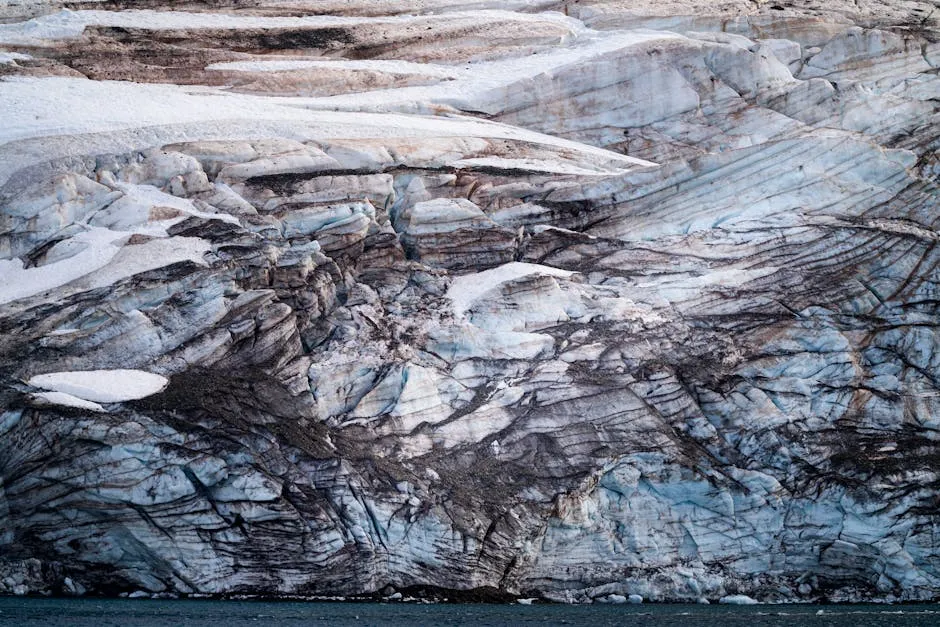
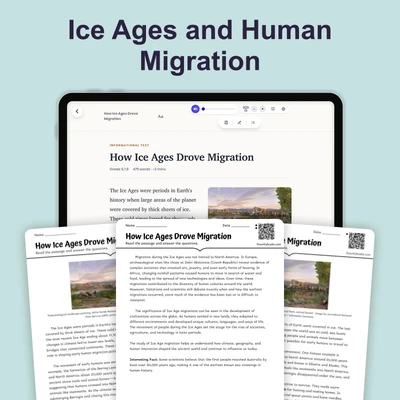
The end of the Ice Age also influenced human migration. Image by Hugo Sykes / Pexels.
The end of the last Ice Age was a turning point in ancient human history. Around 12,000 years ago, the Earth's climate began to warm, causing the vast glaciers that had once covered large parts of Europe, Asia, and North America to retreat. This shift in temperature and environment is known as the end of the Pleistocene epoch. As the ice melted, new landscapes appeared, including grasslands, forests, and rivers. These changes had a profound impact on the lives and movements of early humans.
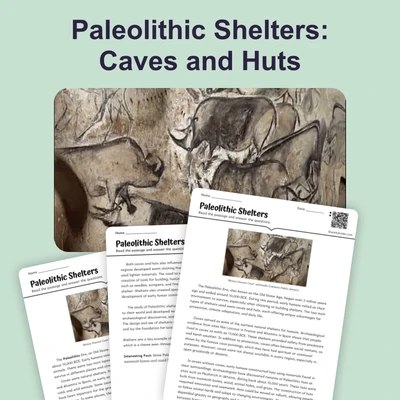
During the Ice Age, humans were primarily hunter-gatherers. They depended on large Ice Age animals such as mammoths, woolly rhinoceroses, and reindeer for food, clothing, and tools. Archaeological discoveries, like the famous cave paintings in Altamira, Spain, and Lascaux, France, show images of these animals and tell us about the daily life, beliefs, and survival strategies of Paleolithic people. Stone tools found in sites like Clovis, New Mexico, provide evidence that early humans adapted their technology to hunt large prey and process hides for shelter and clothing.
As the world warmed and glaciers melted, the environment changed rapidly. Many Ice Age animals could not survive in the new, warmer climates, leading to their extinction. Early humans had to adapt to hunting smaller game, fishing, and gathering edible plants. In some regions, they began to experiment with the first forms of agriculture, planting seeds and domesticating animals. Archaeological evidence from sites in the Fertile Crescent, such as Jericho, shows early signs of settled communities that emerged as people relied less on hunting and more on farming and animal husbandry.
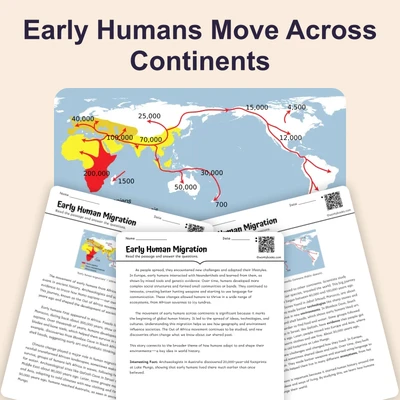
The end of the Ice Age also influenced human migration. As ice sheets retreated, new land routes opened, such as the land bridge connecting Siberia to North America (Beringia). Groups of humans followed animal herds across these bridges, spreading into new territories. This migration helped populate areas that had previously been too cold or covered in ice, leading to the development of diverse cultures across continents.
The transition from the Ice Age to a warmer climate was not just a story of survival, but also of innovation and adaptation. Early humans used their knowledge and creativity to respond to environmental challenges, setting the stage for the rise of agriculture, permanent settlements, and eventually, civilization.
This period connects to broader themes in world history, such as how geography and environment shape human societies and how people respond to challenges through adaptation.
Interesting Fact: Some of the oldest known cave art, depicting Ice Age animals, was created over 17,000 years ago—long before written language existed.
When did the last Ice Age end?
About 12,000 years agoAbout 1,000 years agoAbout 2,000 years agoAbout 100,000 years ago
What did early humans hunt during the Ice Age?
Mammoths and reindeerCows and sheepLions and tigersFish and birds
Where were famous cave paintings found?
Altamira, SpainRome, ItalyBeijing, ChinaLondon, England
Why did humans migrate after the Ice Age?
New land routes openedTo escape volcanoesTo build pyramidsTo find gold
How did humans adapt when animals went extinct?
Hunted smaller animalsStarted building castlesMoved to outer spaceIgnored the change
What was a result of warming climate?
New plants and rivers appearedGlaciers grew biggerDinosaurs returnedOceans disappeared
The Pleistocene refers to the Ice Age. True or false?
TrueFalse
What does 'migration' mean?
Moving to a new placeGrowing cropsBuilding homesHunting animals
Perfect For:
👩🏫 Teachers
• Reading comprehension practice
• Auto-graded assessments
• Literacy skill development
👨👩👧👦 Parents
• Reading practice at home
• Comprehension improvement
• Educational reading time
🏠 Homeschoolers
• Reading curriculum support
• Independent reading practice
• Progress monitoring
Reading Features:
📖
Reading Passage
Engaging fiction or nonfiction text
❓
Comprehension Quiz
Auto-graded questions
📊
Instant Feedback
Immediate results and scoring
📄
Printable Version
Download for offline reading
🔊
Read Aloud
Voice-over with word highlighting
Reviews & Ratings
No reviews yet. Be the first to share your experience!
Related Content
Early Humans Reach Australia
This reading passage explores the journey of early humans who reached Australia by crossing the ocean over 60,000 years ...
CA HSS 6.1CCSS RH.6-8.1CCSS RH.6-8.4CCSS RH.6-8.7
Early Humans in Europe and Asia
This passage explores the arrival of early humans in Europe and Asia around 40,000 BCE, highlighting their migration, ad...
CA HSS 6.1.1CCSS RH.6-8.1CCSS RH.6-8.2CCSS RH.6-8.4
Early Human Migration
This comprehensive history reading passage explores the Out of Africa movement and how early humans migrated across cont...
CA HSS 6.1.1CCSS RH.6-8.1RH.6-8.2RH.6-8.4
Ancient Humans Adapt to Different Climates
This engaging ancient history reading passage explores how early humans adapted to different climates, especially during...
First Humans
This engaging history reading passage explores the evolution of early humans, tracing the journey from the earliest homi...
CA HSS 6.1RH.6-8.1RH.6-8.2W.6.2
Origins of Human Language
This engaging history reading passage explores how early humans developed language and complex ideas, transforming their...
The Turkana Boy: A Nearly Complete Early Human Skeleton
This history reading passage explores the remarkable discovery of the Turkana Boy, a nearly complete Homo erectus skelet...
Early Stone Tools
This engaging history reading passage explores Early Paleolithic Stone Tools, focusing on how early humans crafted sharp...
Rise of Early Civilizations
This reading passage explores the critical transformation from early human hunter-gatherer societies to the development ...
CA HSS 6.1CCSS.RI.6.1CCSS.RI.6.3CCSS.RI.6.4
Neanderthals and Denisovans
This comprehensive history reading passage explores the fascinating story of Neanderthals, Denisovans, and other ancient...
CA HSS 6.1.1TEKS 6.2BCCSS.RH.6-8.1CCSS.RH.6-8.2
Paleolithic Migration by Land and Sea
This passage explores the migration of Paleolithic humans from Africa to the rest of the world, focusing on the routes t...
6.1RH.6-8.1RH.6-8.2RH.6-8.4
Introduction to the Paleolithic Age
This engaging passage explores the lives and achievements of ancient humans during the Paleolithic Age, focusing on thei...
CA HSS 6.1.1CCSS RH.6-8.1CCSS RH.6-8.2CCSS RH.6-8.4
Paleolithic Shelters
Explore how early humans in the Paleolithic Era built shelters such as caves and huts to survive harsh climates. This pa...
CA HSS 6.1CCSS.RI.6.3CCSS.RI.7.1CCSS.RI.8.2
Paleolithic Hand Axe
This engaging ancient history passage explores the development and significance of Acheulean hand axes, one of the earli...
CA HSS 6.1.1CCSS.RI.6.1CCSS.RI.6.4CCSS.W.6.2
How Paleolithic People Changed the Environment
This passage explores how Paleolithic people, or early humans, shaped their environment through the use of fire, hunting...
Discovery of Fire
This history reading passage explores the revolutionary impact of fire on early human societies. Students will learn how...
Evidence in Ancient History
This engaging history reading passage investigates how archaeologists and historians discover clues about how ancient pe...
Oldowan Tools
This engaging history reading passage explores the emergence of the first stone tools, known as Oldowan tools, around 2....
Nomads to Farmers
This engaging passage explores the two major ways of life practiced by early humans: nomadic hunter-gathering and settle...
CA HSS 6.1.1CCSS RH.6-8.2
Prehistoric Cave Art
This passage explores the significance of cave paintings and early symbolic art, examining how ancient humans used these...