How Ice Ages Drove Migration
Interactive passage with audio narration, comprehension questions, and printable PDF.
By completing this purchase you agree to our Terms of Use and Privacy Policy. Your subscription renews automatically until you cancel. You can cancel anytime from your account settings. All sales are final and non-refundable. Digital content is available for download in your account immediately upon purchase.
What's included
Part of this bundle

How Ice Ages Drove Migration preview and details
About this printable How Ice Ages Drove Migration reading passage (Grades 6-8)
Sample passage and quiz from How Ice Ages Drove Migration
Reading passage and comprehension quiz preview
How Ice Ages Drove Migration
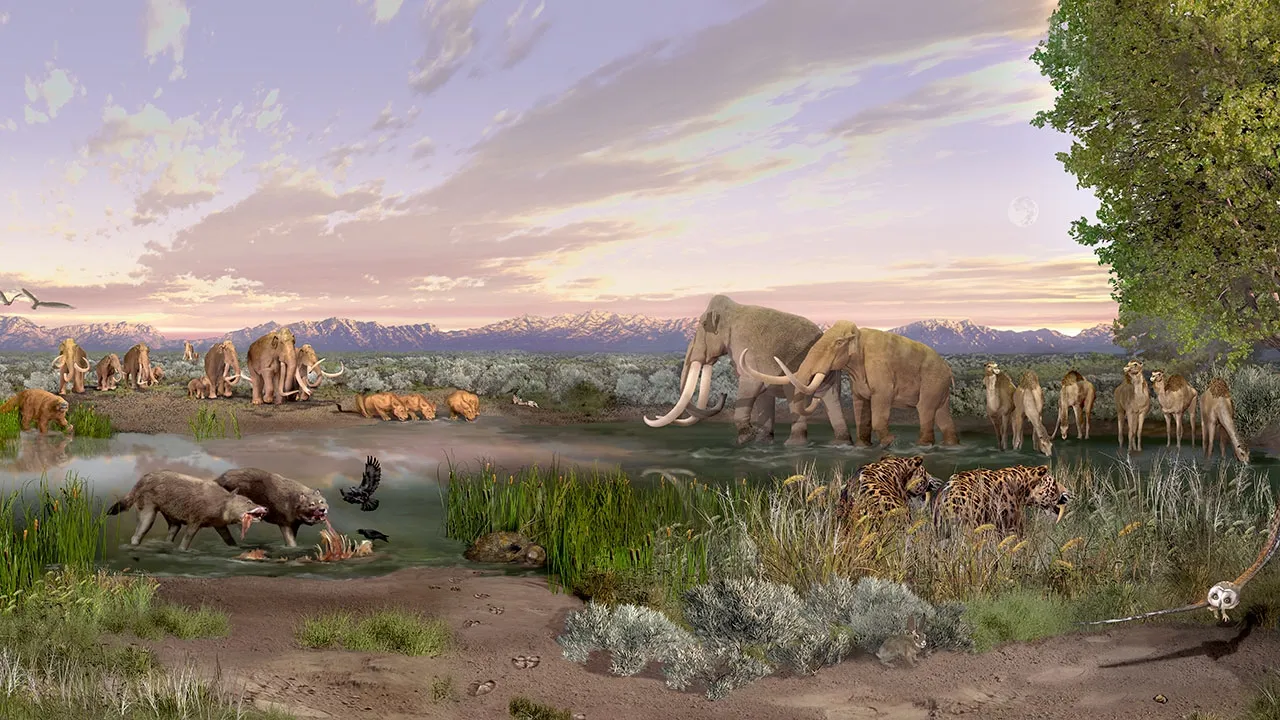
"Paleontological landscape painting, White Sands National Park, United States". Image by uncredited National Park Service (NPS) artist / Wikimedia Commons.
The Ice Ages were periods in Earth's history when large areas of the planet were covered by thick sheets of ice. These cold times lasted for thousands of years, with the most recent Ice Age ending about 11,700 years ago. During these periods, major changes in climate led to lower sea levels, exposing new land and creating land bridges that connected continents. These changing environments played a crucial role in shaping early human migration patterns and the spread of ancient cultures.
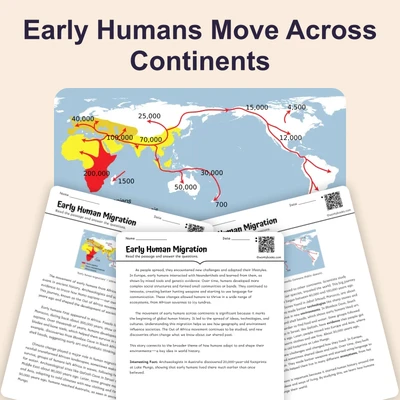
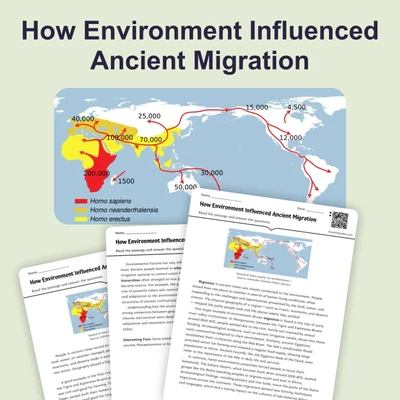
The movement of early humans was strongly influenced by the environment. For example, the formation of the Bering Land Bridge, known as Beringia, connected Asia and North America about 20,000 years ago. Archaeological evidence—such as ancient stone tools and animal bones—has been found in both Siberia and Alaska, suggesting that humans crossed into North America by following herds of large animals like mammoths. As the climate warmed and glaciers melted, sea levels rose, submerging Beringia and closing this route for future migrations.
Early humans adapted to the harsh conditions of the Ice Ages by developing new technologies. They made warm clothing from animal hides and created advanced tools for hunting and shelter-building. For example, the discovery of spear points and carved bone needles in the Clovis culture of North America provides insight into how these early people survived. Social organization also changed, with small groups cooperating to hunt large prey and share resources. These adaptations were essential for survival in cold, unpredictable climates.
Migration during the Ice Ages was not limited to North America. In Europe, archaeological sites like those at Dolní Věstonice (Czech Republic) reveal evidence of complex societies that created art, jewelry, and even early forms of housing. In Africa, changing rainfall patterns caused humans to move in search of water and food, leading to the spread of new technologies and ideas. Over time, these migrations contributed to the diversity of human cultures around the world. However, historians and scientists still debate exactly when and how the earliest migrations occurred, since much of the evidence has been lost or is difficult to interpret.
The significance of Ice Age migrations can be seen in the development of civilizations across the globe. As humans settled in new lands, they adapted to different environments and developed unique cultures, languages, and ways of life. The movement of people during the Ice Ages set the stage for the rise of societies, agriculture, and technology in later periods.
The study of Ice Age migration helps us understand how climate, geography, and human innovation shaped the ancient world and continue to influence us today.
Interesting Fact: Some scientists believe that the first people reached Australia by boat over 50,000 years ago, making it one of the earliest known sea crossings in human history.
Comprehension quiz (8 questions)
1. When did the last Ice Age end?
2. What was Beringia?
3. Which animal did early humans follow?
4. Why did sea levels drop during Ice Ages?
5. What is one adaptation humans made?
6. Why did Beringia disappear?
7. Early migration only happened in North America. True or False?
8. What does 'evidence' mean in the passage?
Perfect for the way you teach
- Build comprehension skills
- Auto-graded quiz
- Differentiated reading
- Read together at home
- Improve fluency
- Quiet reading time
- Reading curriculum support
- Independent practice
- Track Lexile growth