Clouds: Formation and Types
Interactive passage with audio narration, comprehension questions, and printable PDF.
What's included
Clouds: Formation and Types preview and details
About this printable Clouds: Formation and Types science reading passage, NGSS-aligned (Grades 6-9)
Sample passage and quiz from Clouds: Formation and Types
Reading passage and comprehension quiz preview
Clouds: Formation and Types
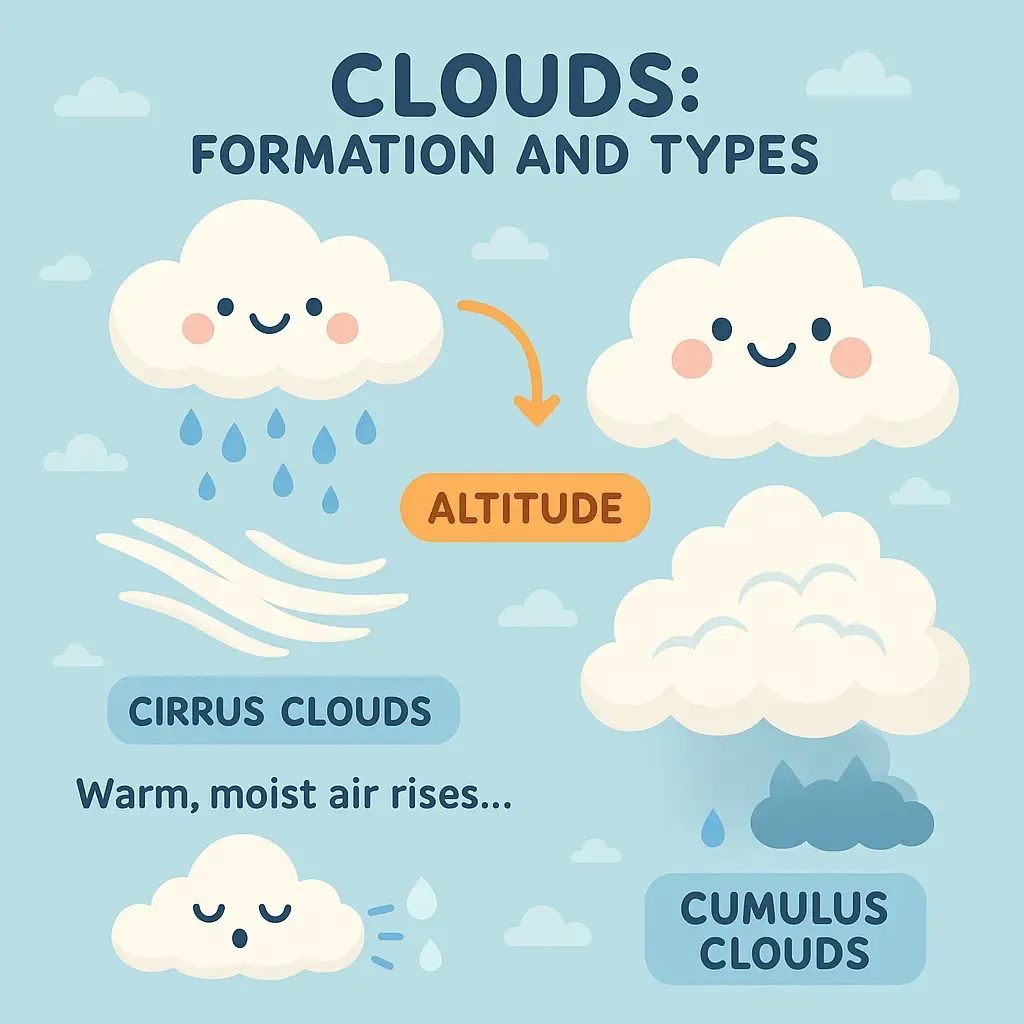
Clouds are visible masses of water droplets or ice crystals suspended in the atmosphere. They form when warm, moist air rises, cools, and reaches its dew point, the temperature at which water vapor condenses into tiny droplets.
There are three main types of clouds based on their shape and altitude:
Cirrus Clouds: High-altitude clouds that look wispy and feathery. They are made of ice crystals and often indicate fair weather.
Cumulus Clouds: Mid-altitude clouds that look fluffy and white, like cotton balls. They can develop into cumulonimbus clouds, which bring thunderstorms.
Stratus Clouds: Low-altitude clouds that form flat, gray layers. They often bring overcast skies and light rain or drizzle.
Clouds play a crucial role in the water cycle by transporting moisture and releasing it as precipitation. They also reflect sunlight, helping to regulate Earth’s temperature.
Fun fact: The highest clouds, called noctilucent clouds, form about 50 miles above the Earth’s surface and are only visible at twilight.
Comprehension quiz (8 questions)
1. What are clouds made of?
2. How do clouds form?
3. What is the dew point?
4. What type of cloud is wispy and feathery?
5. What type of cloud can bring thunderstorms?
6. What is one role of clouds in the water cycle?
7. What is the fun fact mentioned in the passage?
8. What type of cloud forms flat, gray layers?
Perfect for the way you teach
- Build comprehension skills
- Auto-graded quiz
- Differentiated reading
- Read together at home
- Improve fluency
- Quiet reading time
- Reading curriculum support
- Independent practice
- Track Lexile growth