Conservation of Mass in Reactions
Interactive passage with audio narration, comprehension questions, and printable PDF.
By completing this purchase you agree to our Terms of Use and Privacy Policy. Your subscription renews automatically until you cancel. You can cancel anytime from your account settings. All sales are final and non-refundable. Digital content is available for download in your account immediately upon purchase.
What's included
Conservation of Mass in Reactions preview and details
About this printable Conservation of Mass in Reactions science reading passage, NGSS-aligned (Grades 5-8)
Sample passage and quiz from Conservation of Mass in Reactions
Reading passage and comprehension quiz preview
Conservation of Mass in Reactions
Conservation of mass is a fundamental principle in science stating that the total mass of substances does not change during a chemical reaction. When baking soda is mixed with vinegar in a sealed container, the total mass of the system remains the same, regardless of the changes happening inside. This principle is crucial for understanding chemical reactions and predicting the outcomes of experiments in both laboratories and daily life.
How Conservation of Mass Works
During a chemical reaction, substances called reactants are transformed into new substances known as products. Although the appearance, state, or energy of substances may change, the total amount of matter stays constant. This is because atoms, the building blocks of matter, are simply rearranged, not created or destroyed. For example, when baking soda (sodium bicarbonate) and vinegar (acetic acid) react, they produce carbon dioxide gas, water, and sodium acetate. In a closed system, like a tightly sealed flask, the mass before and after the reaction is identical. Scientists measure this using precise balances to confirm that mass is conserved.
Apparent Mass Loss in Open Systems
Sometimes, it looks like mass has been lost during a reaction. This usually happens in an open system, where substances such as gases can escape. If you perform the baking soda and vinegar reaction in an open beaker, bubbles of carbon dioxide rise and leave the container. As a result, the mass measured afterward appears lower. However, the lost mass is not destroyed; it has simply left the system as a gas. Scientific experiments show that if the escaping gas is captured and measured, the total mass still matches the original amount.
Real-World Applications and Broader Implications
The law of conservation of mass is not just important for classroom experiments. It is essential in industrial chemistry, environmental science, and even cooking. For instance, engineers designing power plants must account for all materials entering and leaving a system to avoid pollution. Environmental scientists use this law to track pollutants in air and water. Understanding conservation of mass also helps explain natural cycles, such as the carbon cycle, where carbon moves between the atmosphere, plants, animals, and soil without any loss of mass. This principle connects to larger scientific ideas about the stability and predictability of natural systems.
In summary, the conservation of mass demonstrates that matter is neither created nor destroyed in chemical reactions, only changed in form. Observing mass changes in open and closed systems helps scientists understand where materials go, and why certain changes occur. Recognizing this law is essential for scientific thinking and problem-solving in real life.
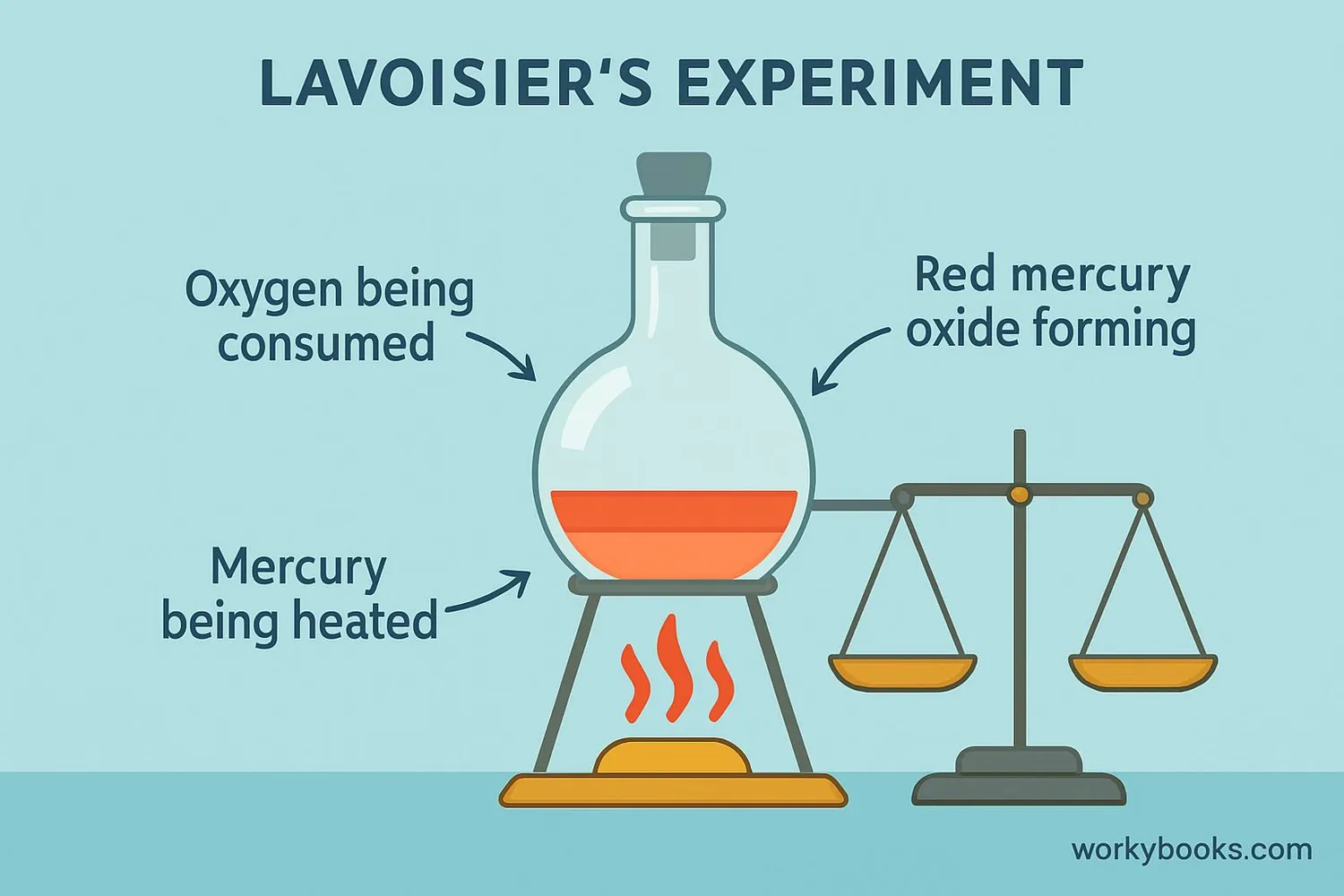
Interesting Fact: French scientist Antoine Lavoisier first demonstrated the law of conservation of mass in the late 1700s by carefully measuring chemical reactions in sealed containers.
Comprehension quiz (10 questions)
1. What does the law of conservation of mass state?
2. What happens if you mix baking soda and vinegar in a closed container?
3. Which is a correct definition of 'reactants'?
4. Which word best describes a system where matter can leave or enter?
5. Why does mass appear to decrease in an open system during a reaction?
6. What scientific tool do scientists use to measure mass?
7. In the carbon cycle, what happens to carbon atoms?
8. Which statement is true about closed systems?
9. True or False: In a closed system, the total mass before and after a reaction is different.
10. True or False: The law of conservation of mass helps scientists track pollution and resources.
Perfect for the way you teach
- Build comprehension skills
- Auto-graded quiz
- Differentiated reading
- Read together at home
- Improve fluency
- Quiet reading time
- Reading curriculum support
- Independent practice
- Track Lexile growth