Scientific Laws
Interactive passage with audio narration, comprehension questions, and printable PDF.
By completing this purchase you agree to our Terms of Use and Privacy Policy. Your subscription renews automatically until you cancel. You can cancel anytime from your account settings. All sales are final and non-refundable. Digital content is available for download in your account immediately upon purchase.
What's included
Scientific Laws preview and details
About this printable Scientific Laws science reading passage, NGSS-aligned (Grades 5-8)
Sample passage and quiz from Scientific Laws
Reading passage and comprehension quiz preview
Scientific Laws
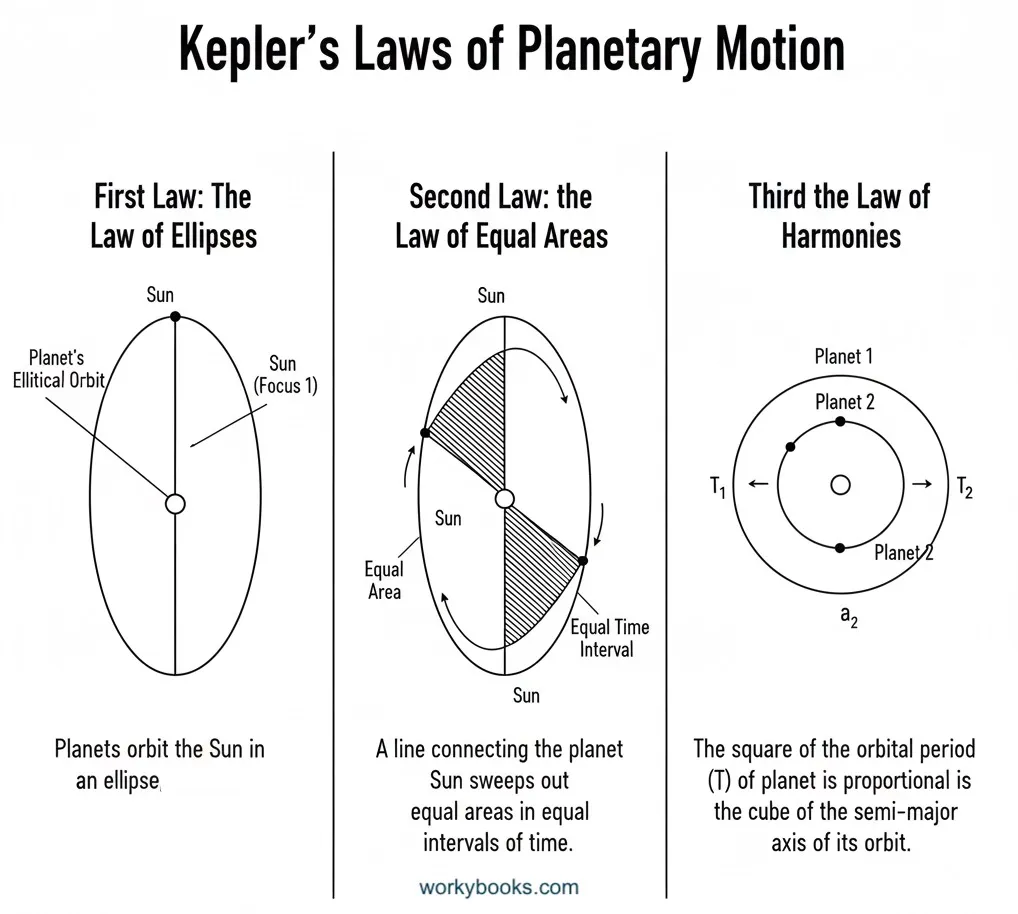
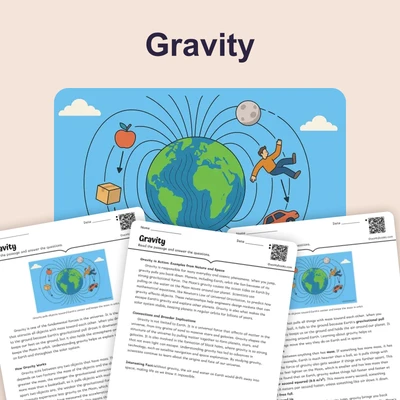
Scientific laws provide reliable descriptions of how the natural world behaves in consistent and predictable ways. Throughout history, scientists have observed patterns in nature that repeat under the same conditions. For example, objects always fall toward the ground when dropped, and the total mass in a closed system stays the same during a chemical reaction. These observations have led to the development of scientific laws, which help us understand and predict natural phenomena.
How Scientific Laws Work
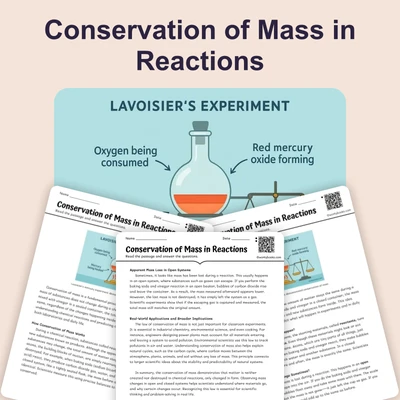
Laws in science are statements that describe what always happens in certain conditions, based on repeated observations and experiments. They do not explain why something happens, but they summarize results that have been confirmed over and over. For instance, the Law of Gravity describes the attraction between objects with mass. Isaac Newton observed that objects fall to Earth at an acceleration of about 9.8 meters per second squared. This quantitative measurement helped scientists make accurate predictions about planetary motion and falling objects. Another example is the Law of Conservation of Mass, which states that mass is neither created nor destroyed in a chemical reaction. For example, if you burn a piece of wood in a sealed container, the mass of the container and its contents remains the same before and after burning. The law describes this consistent outcome, even if the wood changes form.
Laws, Theories, and the Scientific Process
While laws describe what happens, scientific theories explain why it happens. A theory, like the theory of gravity, provides the reasoning and mechanisms behind the law. Theories are supported by a large body of evidence and can change as new discoveries are made. Laws and theories work together: laws identify patterns, and theories give the underlying explanation. For example, the Law of Gravity tells us that objects are attracted to each other, but Einstein’s theory of general relativity explains this attraction as the curvature of space-time.
Applications and Implications
Scientific laws are used in many real-world applications. Engineers apply the Law of Conservation of Mass to design chemical plants and predict product yields. Astronauts and space agencies use the Law of Gravity to plan rocket launches and satellite orbits. These laws are fundamental to technology, environmental science, and even everyday life. Understanding scientific laws helps society solve practical problems and develop new innovations. However, it is important to remember that scientific knowledge is always growing. Sometimes, laws are refined or redefined as new evidence emerges, but their core descriptions remain consistent across experiments and observations.
In conclusion, scientific laws are essential tools for describing the regularities of the natural world. By distinguishing between laws and theories, scientists can both predict what will happen and explore the reasons behind those patterns. The interaction between observation, description, and explanation is at the heart of scientific inquiry.
Interesting Fact:
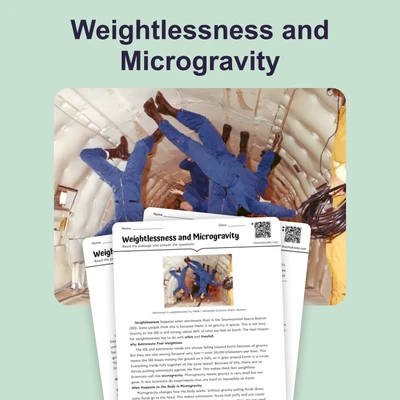
Even though the Law of Gravity is universal, astronauts on the International Space Station experience "microgravity" because they are constantly falling around the Earth!
Comprehension quiz (10 questions)
1. What does a scientific law describe?
2. Which of the following is described by the Law of Conservation of Mass?
3. According to the passage, what does a scientific theory do?
4. What is the main difference between a law and a theory?
5. What does the term 'quantitative' mean in the passage?
6. What does 'closed system' mean in this context?
7. Why do astronauts experience 'microgravity' on the International Space Station according to the passage?
8. How do scientific laws help engineers and astronauts?
9. Scientific laws can never be changed. (True/False)
10. Scientific laws are based on repeated observations and experiments. (True/False)
Perfect for the way you teach
- Build comprehension skills
- Auto-graded quiz
- Differentiated reading
- Read together at home
- Improve fluency
- Quiet reading time
- Reading curriculum support
- Independent practice
- Track Lexile growth