Reading Passage

Natural Disaster: Tornadoes

Interactive passage with audio narration, comprehension questions, and printable PDF.

No ratings yet|
711
Grades 4–5ElaReadingScienceEnglish · SpanishInteractive · Printable
Aligned toRI.3.1RI.4.4RI.4.2RI.5.2MS-ESS3-4

What's included

Reading passage
Audio narration
Comprehension quiz
Writing activity
Glossary & flashcards
Differentiated version
Spanish translation

Natural Disaster: Tornadoes preview and details

About this printable Natural Disaster: Tornadoes science reading passage, NGSS-aligned (Grades 4-5)

Tornadoes are dangerous spinning columns of air. Knowing the signs and having safety plans can help protect you from these intense storms.
Written by Neha Goel TripathiPublished by Workybooks
Preview

Sample passage and quiz from Natural Disaster: Tornadoes

Reading passage and comprehension quiz preview

Natural Disaster: Tornadoes

tornadoes, funnel clouds, Tornado Alley, EF scale, storm safety

Tornadoes are powerful, spinning columns of air that stretch from a thunderstorm down to the ground. They look like funnels and can be very dangerous. Tornadoes can happen anywhere, but they're most common in the United States in an area called "Tornado Alley."


These storms can spin faster than any other wind on Earth. They can pick up cars, destroy houses, and throw debris for miles. Tornadoes usually last for just a few minutes, but some can last for over an hour.


Scientists use weather radar to spot tornadoes forming. When they see signs of a tornado, they send out warnings to keep people safe. If a tornado is coming, the safest place to be is in a basement or a small, inside room on the lowest floor of a strong building.


Tornadoes are ranked on a scale from EF0 to EF5, with EF5 being the strongest. While tornadoes can be scary, knowing what to do and being prepared can help keep you safe during these powerful storms.

Comprehension quiz (6 questions)

1. What is a tornado?

A heavy rainstorm
A spinning column of air
A type of cloud
A strong wind blowing in one direction

2. Where are tornadoes most common in the United States?

Tornado Alley
The East Coast
Alaska
Hawaii

3. How long do most tornadoes last?

Several hours
A few days
A few minutes
About a week

4. What do scientists use to spot tornadoes forming?

Telescopes
Weather balloons
Weather radar
Seismographs

5. What is the safest place to be during a tornado?

Outside watching the storm
In a car
In a basement or small, inside room on the lowest floor
On the top floor of a building

6. How are tornadoes ranked?

By their color
By how long they last
From A to F
From EF0 to EF5
Curriculum

Common Core standards for Natural Disaster: Tornadoes

RI.3.1

Ask and answer questions to demonstrate understanding of a text, referring explicitly to the text as the basis for the answers.

RI.4.2

Determine the main idea of a text and explain how it is supported by key details; summarize the text.

RI.4.4

Determine the meaning of general academic and domain-specific words or phrases in a text relevant to a grade 4 topic or subject area.

RI.5.2

Determine two or more main ideas of a text and explain how they are supported by key details; summarize the text.

Who it's for

Perfect for the way you teach

Teachers
  • Build comprehension skills
  • Auto-graded quiz
  • Differentiated reading
Parents
  • Read together at home
  • Improve fluency
  • Quiet reading time
Homeschoolers
  • Reading curriculum support
  • Independent practice
  • Track Lexile growth
Topics

Reviews & Ratings

No reviews yet. Be the first to share your experience!

More reading you might love

19 more
Passage
Human Impact on the Biosphere - reading educational content
Grade 6

Human Impact on the Biosphere

earth and space science · MS-ESS3-4

$1.50
Passage
What Are Climate Action Plans - reading educational content
Grades 5–8

What Are Climate Action Plans

weather and climate · MS-ESS3-4

$1.50
Passage
Conservation Strategies - reading educational content
Grades 5–8

Conservation Strategies

life science · MS-LS2-5+1

$1.50
Passage
Environmental Problems and Solutions - reading educational content
Grades 5–8

Environmental Problems and Solutions

life science · MS-LS2-4+2

$1.50
Passage
Sustainability and Individual Action - reading educational content
Grades 5–8

Sustainability and Individual Action

life science · MS-ESS3-4

$1.50
Passage
Restoration Ecology - reading educational content
Grades 5–8

Restoration Ecology

life science · MS-LS2-4+1

$1.50
Passage
Climate Change: Solutions and Mitigation - reading educational content
Grades 5–8

Climate Change: Solutions and Mitigation

life science · MS-ESS3-4+1

$1.50
Passage
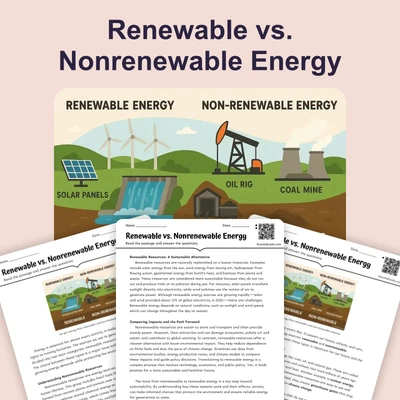
Renewable vs. Nonrenewable Energy - reading educational content
Grades 5–8

Renewable vs. Nonrenewable Energy

physical science · MS-PS3-4+2

$1.50
Passage
Fossil Fuels: Coal - reading educational content
Grades 5–8

Fossil Fuels: Coal

physical science · MS-PS3-4+2

$1.50
Passage
Solar Energy - reading educational content
Grades 5–8

Solar Energy

physical science · MS-PS3-4+2

$1.50
Passage
Wind Energy - reading educational content
Grades 5–8

Wind Energy

physical science · MS-PS3-4+2

$1.50
Passage
Hydroelectric Energy - reading educational content
Grades 5–8

Hydroelectric Energy

physical science · MS-PS3-4+2

$1.50
Passage
Soil Conservation - reading educational content
Grades 5–8

Soil Conservation

earth and space science · MS-ESS3-4

$1.50
Passage
Minerals and Rocks as Resources - reading educational content
Grades 5–8

Minerals and Rocks as Resources

earth and space science · MS-ESS3-1+1

$1.50
Passage
The Galápagos Islands - reading educational content
Grades 5–8

The Galápagos Islands

life science · MS-LS2-1+2

$1.50
Passage
Geothermal Energy - reading educational content
Grades 5–8

Geothermal Energy

physical science · MS-PS3-4+2

$1.50
Passage
Biomass and Biofuels - reading educational content
Grades 5–8

Biomass and Biofuels

physical science · MS-PS3-4+2

$1.50
Passage
Nuclear Energy as a Resource - reading educational content
Grades 5–8

Nuclear Energy as a Resource

physical science · MS-PS3-4+2

$1.50
Passage
Water as a Resource - reading educational content
Grades 5–8

Water as a Resource

earth and space science · MS-ESS3-1+1

$1.50
Copyright © 2026 Workybooks. Made with ♥ in California.