Porosity and Permeability of Soil and Rock — Reading Comprehension
Rate this|
8
Present
Present in classroom. No work saved
Assign
Classroom with student accounts, Track progress
Quick Play
No student accounts, assign with a link
Grades
5
6
7
8
Standards
RI.5.5
RI.6.9
PRINT+DIGITAL RESOURCE
This learning resource is available in interactive and printable formats. The interactive worksheet can be played online and assigned to students. The Printable PDF version can be downloaded and printed for completion by hand.
Porosity and permeability are key properties of soil and rock that affect water movement underground. They influence groundwater storage, recharge, and water resource management.
CONTENT PREVIEW
Expand content preview
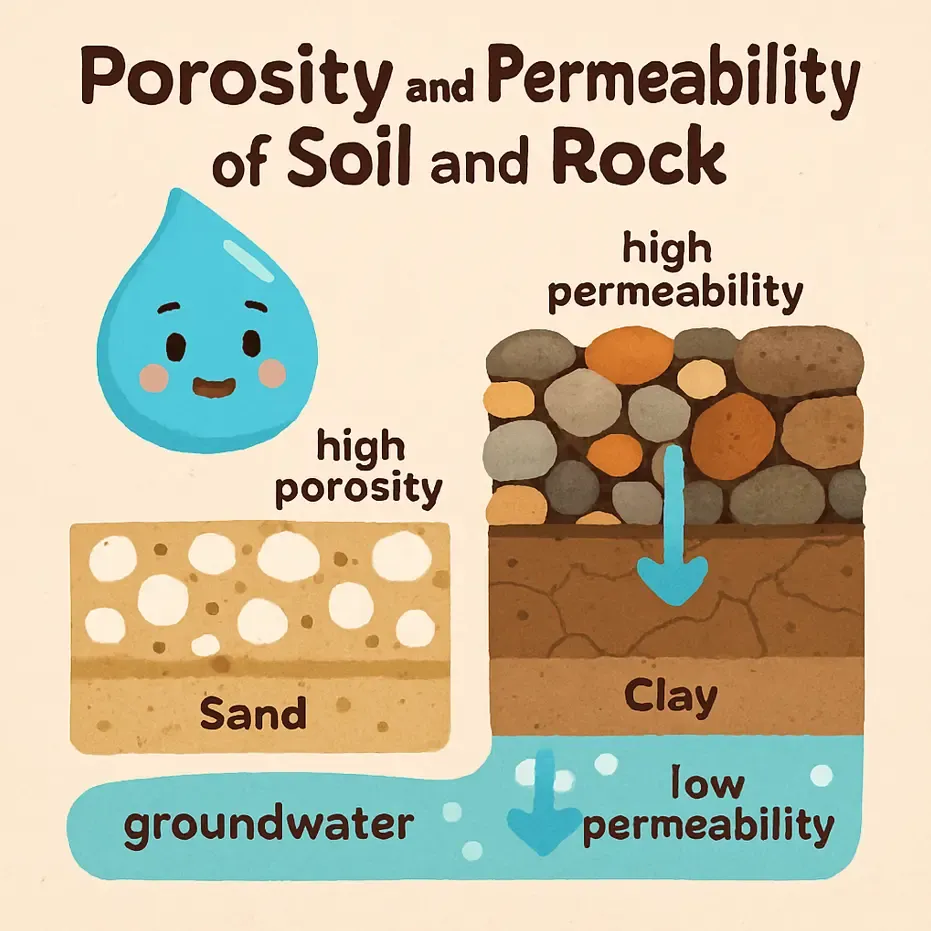
Porosity and permeability are two key properties of soil and rock that affect how water moves underground.
Porosity refers to the amount of empty space, or pores, within a material. Materials with high porosity, like sand, can hold more water. Permeability refers to how easily water can flow through a material. For example, gravel is highly permeable because water flows through it quickly, while clay has low permeability because water moves through it slowly.
These properties are important for groundwater storage and recharge. High porosity allows rocks and soil to store more water, while high permeability allows water to flow into aquifers. However, materials with high porosity but low permeability, like clay, can trap water and prevent it from reaching aquifers.
Understanding porosity and permeability helps scientists manage water resources, predict flooding, and design effective irrigation systems. For example, farmers use permeable soils to ensure water reaches plant roots, while engineers use impermeable materials to build dams and prevent leaks.
Fun fact: The Ogallala Aquifer, one of the largest aquifers in the world, has high porosity and permeability, allowing it to store and supply vast amounts of groundwater to the central United States.
What is porosity?
The ability of water to flow through a materialThe amount of empty space within a materialThe type of soilThe process of water evaporation
What is permeability?
The amount of empty space within a materialThe ability of water to flow through a materialThe type of rockThe process of water freezing
Which material has high porosity?
ClaySandGravelGranite
Which material has high permeability?
ClaySandGravelGranite
What is one importance of porosity and permeability?
They increase air pressureThey affect groundwater storage and rechargeThey stop water flowThey reduce soil quality
What is one example of a material with low permeability?
GravelSandClayGranite
What is the fun fact mentioned in the passage?
The Ogallala Aquifer has high porosity and permeabilityPorosity and permeability are the sameClay has high permeabilitySand has low porosity
What is one use of impermeable materials?
Building damsIncreasing water flowImproving soil qualityReducing groundwater storage
Perfect For:
👩🏫 Teachers
• Reading comprehension practice
• Auto-graded assessments
• Literacy skill development
👨👩👧👦 Parents
• Reading practice at home
• Comprehension improvement
• Educational reading time
🏠 Homeschoolers
• Reading curriculum support
• Independent reading practice
• Progress monitoring
Reading Features:
📖
Reading Passage
Engaging fiction or nonfiction text
❓
Comprehension Quiz
Auto-graded questions
📊
Instant Feedback
Immediate results and scoring
📄
Printable Version
Download for offline reading
🔊
Read Aloud
Voice-over with word highlighting
Reviews & Ratings
No reviews yet. Be the first to share your experience!
Related Content
Analyzing Perspective -Christopher Columbus
This worksheet has students read contradictory accounts of Christopher Columbus's 1492 voyage. It then asks multiple cho...
RI.5.6RI.5.5RI.5.8RI.5.9
Comparing Accounts of Landing on Moon
This worksheet has students read two accounts of the 1969 moon landing that provide different perspectives. It then asks...
RI.5.6RI.5.5RI.5.8RI.5.9
Comparing News Reports- Political Protest
This worksheet has students analyze contradictory news reports about a political protest. It uses multiple choice questi...
RI.5.6RI.5.5RI.5.8RI.5.9
Penguins Supporting Evidence
This informational text on penguins is a great way to practice finding the main point and reasons to support. This readi...
RI.5.6RI.5.5RI.5.8RI.5.9
Comparing and Contrasting Text Structures in Poems
RI.5.5
Comparing Accounts of the Hindenburg Disaster
Students read two accounts of the Hindenburg disaster and answer multiple choice questions comparing and contrasting the...
RI.5.5
Comparing and Contrasting Texts—Solar System
This worksheet has students read two passages about the solar system and answer multiple choice questions comparing and ...
RI.5.5
Comparing Biographies of Amelia Earhart
This worksheet has students read two biographies about Amelia Earhart and answer multiple choice questions comparing and...
RI.5.5
Comparing Accounts of the Pearl Harbor Attack
This worksheet has students read two accounts of the Pearl Harbor attack during World War II and answer multiple choice ...
RI.5.5
Cold Fronts and Warm Fronts: A Comparison
Cold fronts bring thunderstorms and cooler temperatures, while warm fronts bring light rain and warmer temperatures. Bot...
7.RI.7.3RI.5.3RI.5.5RI.6.9
Stream Flow
Stream flow refers to the movement of water in rivers and creeks. It is influenced by precipitation, slope, and human ac...
RI.5.5RI.6.9
Hydrosphere: What Is It and Its Formation
The hydrosphere includes all water on Earth, from oceans to glaciers. It formed through condensation and precipitation a...
RI.5.5
Mountain Ranges: A Key Factor Affecting Climate
Mountain ranges affect climate by creating rain shadows, blocking wind, and forming microclimates. They play a key role ...
RI.5.5
Convection Currents in the Ocean
Convection currents in the ocean are driven by temperature and density differences. They play a key role in the thermoha...
RI.5.5
Cyclones and Anticyclones: A Comparison
Cyclones are low-pressure systems that bring stormy weather, while anticyclones are high-pressure systems that bring cle...
7.RI.7.1RI.5.3RI.5.5RI.6.9
Limited Freshwater Availability and the Groundwater Table
Freshwater is a limited resource, with most stored in glaciers and aquifers. Over-pumping groundwater leads to depletion...
RI.5.5RI.6.9
Large Bodies of Water: A Key Factor Affecting Climate
Large bodies of water moderate temperatures, making coastal regions milder. They also contribute to humidity and precipi...
RI.5.5
The Colorado River
The Colorado River stretches 1,450 miles from the Rocky Mountains to the Gulf of California. It carved the Grand Canyon ...