Cyclones and Anticyclones: A Comparison — Reading Comprehension
Rate this
Present
Present in classroom. No work saved
Assign
Classroom with student accounts, Track progress
Quick Play
No student accounts, assign with a link
Grades
5
6
7
8
Standards
7.RI.7.1
RI.5.3
RI.5.5
RI.6.9
RI.6.3
PRINT+DIGITAL RESOURCE
This learning resource is available in interactive and printable formats. The interactive worksheet can be played online and assigned to students. The Printable PDF version can be downloaded and printed for completion by hand.
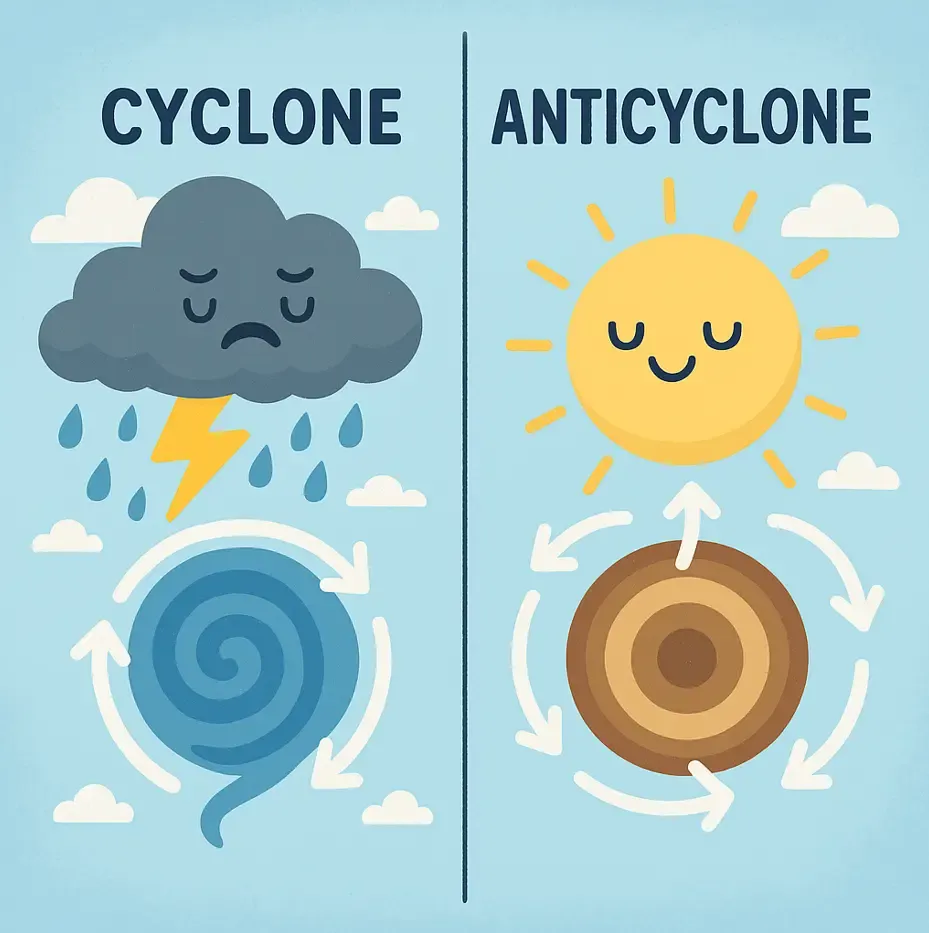
Cyclones are low-pressure systems that bring stormy weather, while anticyclones are high-pressure systems that bring clear skies. Both play key roles in global weather patterns, redistributing heat and stabilizing the atmosphere.
CONTENT PREVIEW
Expand content preview
Cyclones and anticyclones are large-scale weather systems that influence weather patterns. While they are both rotating systems, they have opposite characteristics and effects.
Cyclones are low-pressure systems where air spirals inward and upward. They are associated with stormy weather, including clouds, rain, and strong winds. Cyclones can form over warm ocean waters, leading to tropical storms or hurricanes. In the Northern Hemisphere, cyclones rotate counterclockwise, while in the Southern Hemisphere, they rotate clockwise.
Anticyclones, on the other hand, are high-pressure systems where air spirals outward and downward. They bring clear skies, calm weather, and light winds. Anticyclones are often associated with dry conditions and can lead to heatwaves in summer or cold spells in winter. In the Northern Hemisphere, anticyclones rotate clockwise, while in the Southern Hemisphere, they rotate counterclockwise.
Both cyclones and anticyclones play important roles in global weather patterns. Cyclones redistribute heat and moisture, while anticyclones stabilize the atmosphere. Understanding these systems helps meteorologists predict weather changes.
Fun fact: The strongest cyclone ever recorded was Typhoon Haiyan in 2013, with winds reaching 195 mph!
What is a cyclone?
A high-pressure system with clear skiesA low-pressure system with stormy weatherA rotating system with light windsA type of anticyclone
What weather is associated with cyclones?
Clear skies and calm weatherClouds, rain, and strong windsDry conditions and heatwavesCold spells and light winds
What is an anticyclone?
A low-pressure system with stormy weatherA high-pressure system with clear skiesA rotating system with heavy rainA type of cyclone
What weather is associated with anticyclones?
Stormy weather and strong windsClear skies and calm weatherHeavy rain and cloudsTornadoes and hurricanes
How do cyclones rotate in the Northern Hemisphere?
ClockwiseCounterclockwiseUpwardDownward
What is one role of cyclones in global weather?
They stabilize the atmosphereThey redistribute heat and moistureThey cause dry conditionsThey bring calm weather
What is the fun fact mentioned in the passage?
The strongest cyclone was Typhoon HaiyanAnticyclones cause hurricanesCyclones rotate clockwise in the Southern HemisphereAnticyclones bring heavy rain
What is one effect of anticyclones in summer?
They cause heatwavesThey bring heavy rainThey create hurricanesThey reduce temperatures
Perfect For:
👩🏫 Teachers
• Reading comprehension practice
• Auto-graded assessments
• Literacy skill development
👨👩👧👦 Parents
• Reading practice at home
• Comprehension improvement
• Educational reading time
🏠 Homeschoolers
• Reading curriculum support
• Independent reading practice
• Progress monitoring
Reading Features:
📖
Reading Passage
Engaging fiction or nonfiction text
❓
Comprehension Quiz
Auto-graded questions
📊
Instant Feedback
Immediate results and scoring
📄
Printable Version
Download for offline reading
🔊
Read Aloud
Voice-over with word highlighting
Reviews & Ratings
No reviews yet. Be the first to share your experience!
Related Content
Measuring Carbon Stored in Vegetation
Measuring carbon stored in vegetation is crucial for understanding climate change. Plants absorb CO₂ during photosynthes...
7.RI.7.1
Wind-Powered Trains In the Netherlands
The Netherlands is the first country to run all its electric trains on 100% wind power, thanks to wind farms on land and...
7.RI.7.1
Four Ways Forests Affect the Atmosphere
Forests play a vital role in regulating the atmosphere by absorbing CO₂, producing oxygen, cooling temperatures, and imp...
7.RI.7.1
Air Temperature: A Key Weather Variable
Air temperature measures how hot or cold the air is and is caused by the kinetic energy of air molecules. It is measured...
7.RI.7.1
Humidity: A Key Weather Variable
Humidity measures the amount of water vapor in the air and is caused by evaporation. It is measured using hygrometers an...
7.RI.7.1
Air Masses: Types and Characteristics
Air masses are large bodies of air with similar temperature and humidity. They form over specific regions and influence ...
7.RI.7.1
The Life and Legacy of Mahatma Gandhi
RF.5.4.ARF.5.4.BW.5.2L.5.6
Mesopotamia—Informatonal Text
This informational text on Mesopotamia is a great way to practice reading comprehension. Students will read the text the...
RI.5.3RI.5.10
The Role of Pollinators in Nature
Learn about the fascinating world of pollinators and discover their crucial role in the reproductive process of flowerin...
RI.4.2RI.4.3RI.4.4RI.5.1
Pollination: A Crucial Ecosystem Service
Explore the vital role of pollination beyond plant reproduction, as it sustains ecosystems by ensuring food security, pr...
RI.4.2RI.4.3RI.4.4RI.5.1
Seed Dispersal: How Plants Travel
Plants may seem stationary, but their seeds have amazing ways to travel! Explore the fascinating world of seed dispersal...
RI.4.2RI.4.3RI.4.4RI.5.1
The States of Matter: Solid
Discover the differences between solids, liquids and gases by exploring how their particles are arranged and move. This ...
RI.4.2RI.4.3RI.4.4RI.5.1
What is a Simple Machine
Discover the power of simple machines! This informational text explores how basic tools like levers, pulleys and incline...
RI.4.2RI.4.3RI.4.4RI.5.1
Elevation: A Key Factor Affecting Climate
Elevation influences climate by causing temperatures to drop as altitude increases. High-elevation areas receive more so...
RI.5.3
Composition of the Ocean
The ocean is made up of water, dissolved salts, gases, and organic matter. Its composition varies with depth and influen...
RI.5.3
What is Deforestation?
Deforestation is the large-scale removal of forests, primarily caused by human activities like agriculture, logging, and...
RI.5.3RI.6.3RI.7.3
Cold Fronts and Warm Fronts: A Comparison
Cold fronts bring thunderstorms and cooler temperatures, while warm fronts bring light rain and warmer temperatures. Bot...
7.RI.7.3RI.5.3RI.5.5RI.6.9
Vegetation: A Key Factor Affecting Climate
Vegetation influences climate by cooling temperatures, increasing humidity, and supporting rainfall. Forests also preven...
RI.5.3
The Great Pacific Garbage Patch
The Great Pacific Garbage Patch is a massive collection of plastic waste in the North Pacific Ocean. It harms marine lif...