The Coldest City in the World: Yakutsk — Reading Comprehension
Rate this
Premium Resource
Present
Present in classroom. No work saved
Assign
Classroom with student accounts, Track progress
Quick Play
No student accounts, assign with a link
Grades
5
6
7
8
Standards
MS-ESS2-1
PRINT+DIGITAL RESOURCE
This learning resource is available in interactive and printable formats. The interactive worksheet can be played online and assigned to students. The Printable PDF version can be downloaded and printed for completion by hand.
This NGSS-aligned science passage introduces middle school readers to Yakutsk, the coldest city on Earth. Students will discover how people live in this extreme environment, what permafrost is, and how buildings are designed to prevent thawing the frozen ground. The passage also connects to climate science, highlighting how melting permafrost can release greenhouse gases and how scientists study ancient fossils preserved in the ice. It is ideal for teaching about Earth's systems, human-environment interaction, and adaptation in extreme conditions. This reading activity supports NGSS standard MS-ESS2-1 and enhances science comprehension skills.
CONTENT PREVIEW
Expand content preview
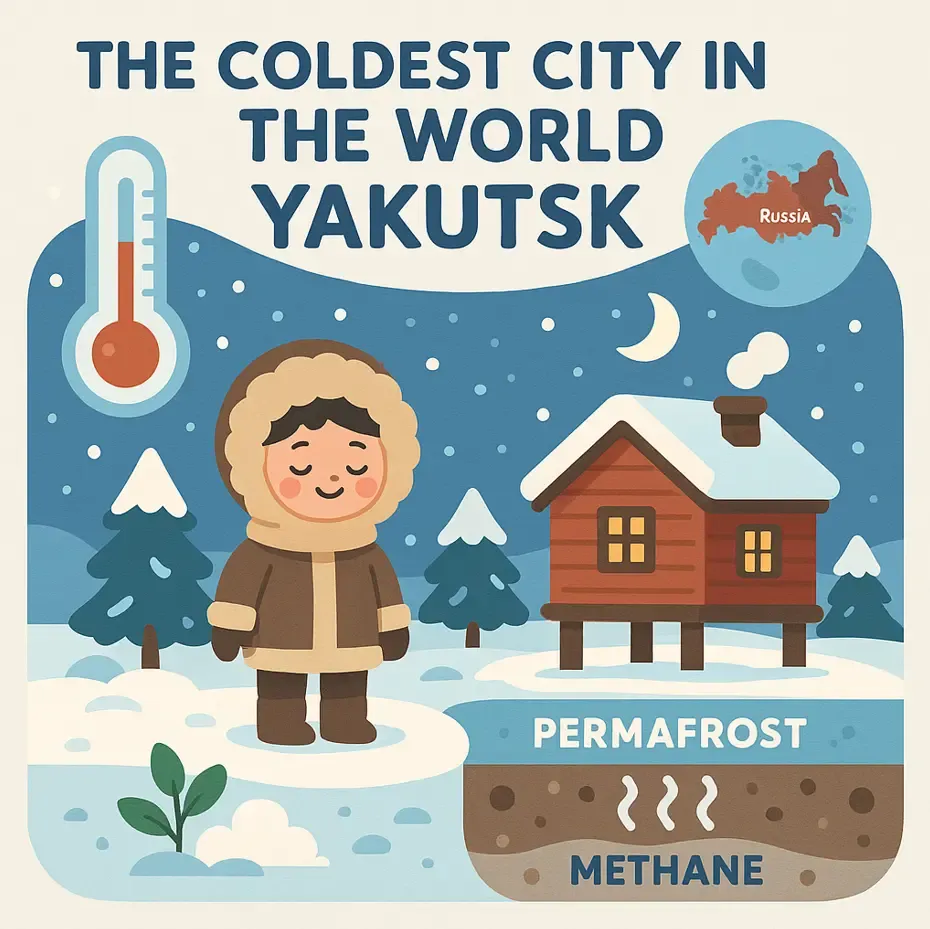
Yakutsk is known as the coldest city on Earth. Located in eastern Siberia, Russia, it lies just below the Arctic Circle. Winters in Yakutsk are extremely cold, with temperatures dropping as low as -50°C (-58°F). The average winter temperature stays around -40°C (-40°F) for months. Because of this, Yakutsk has become an important example of how people can adapt to extreme climates.
The city sits on permafrost, a layer of soil that stays frozen year-round. Buildings in Yakutsk are constructed on stilts or raised platforms so that the heat from inside doesn’t melt the ground beneath. If the permafrost melts, it can damage roads, pipelines, and buildings. This makes engineering and city planning very important in Yakutsk. Scientists also study permafrost here to understand climate change, since melting permafrost releases greenhouse gases like methane and carbon dioxide into the air.
Despite the harsh conditions, over 300,000 people live in Yakutsk. The local people wear fur-lined coats and boots to stay warm and rely on public buses with strong heaters to travel. Cars are often left running to prevent engines from freezing. Schools and businesses operate all year, and life continues, even in the bitter cold. The city also hosts cultural festivals, such as the “Cold Pole Festival,” celebrating life in the extreme north.
Yakutsk plays a role in science, too. Researchers study frozen fossils of mammoths and ancient plants found preserved in the ice. These discoveries help scientists learn about Earth’s past climate and ecosystems.
Yakutsk shows how humans can survive in one of the harshest places on Earth. It reminds us of the power of nature and the need for smart solutions to live with it.
Fun Fact: In winter, people in Yakutsk throw boiling water into the air and watch it turn into ice crystals before it hits the ground!
What is Yakutsk best known for?
Its warm summersBeing the coldest city on EarthBeing a coastal cityIts large deserts
Where is Yakutsk located?
Western CanadaNorthern AlaskaEastern Siberia, RussiaSouthern Norway
What is permafrost?
A kind of Arctic birdFrozen soil that never thawsA type of thick ice sheetWater that freezes in winter
Why are buildings in Yakutsk built on stilts?
To make them tallerTo prevent floodingTo avoid melting the permafrostTo allow snow to fall off easily
What would likely happen if the permafrost melted?
Temperatures would drop lowerPeople would leave YakutskRoads and buildings could be damagedThe city would become warmer
What do scientists study in Yakutsk’s frozen ground?
Old fossils and ancient plantsIcebergs and ocean fishHurricanes and strong windsMagnetic storms
What is the main idea of the passage?
Yakutsk is a growing tourist city.Yakutsk has mild winters.Yakutsk shows how people survive extreme cold.Yakutsk has the best schools in Russia.
If you moved to Yakutsk, what would you most likely need to do?
Use sunscreen every dayBuy waterproof clothesLearn how to build on permafrostLeave your car running in winter
Perfect For:
👩🏫 Teachers
• Reading comprehension practice
• Auto-graded assessments
• Literacy skill development
👨👩👧👦 Parents
• Reading practice at home
• Comprehension improvement
• Educational reading time
🏠 Homeschoolers
• Reading curriculum support
• Independent reading practice
• Progress monitoring
Reading Features:
📖
Reading Passage
Engaging fiction or nonfiction text
❓
Comprehension Quiz
Auto-graded questions
📊
Instant Feedback
Immediate results and scoring
📄
Printable Version
Download for offline reading
🔊
Read Aloud
Voice-over with word highlighting
Reviews & Ratings
No reviews yet. Be the first to share your experience!
Related Content
Frost Wedging: How Ice Splits Rock
This passage explains frost wedging as a mechanical weathering process. Aligned with NGSS MS-ESS2-1 (Earth’s systems) a...
MS-ESS2-1MS-ESS2-2RST.6-8.3
Limestone Caves: Nature’s Underground Wonders
This passage explains limestone cave formation through carbonation, aligned with NGSS MS-ESS2-1 (Earth’s systems) and L...
MS-ESS2-1LS2.CRST.6-8.7
Chemical Weathering: The Breakdown of Rocks Through Chemical Reactions
This passage explains chemical weathering processes, aligned with NGSS MS-ESS2-1 (Earth’s systems) and ESS2-2 (surface ...
MS-ESS2-1MS-ESS2-2RST.6-8.4
Talus Slopes: Formation and Features
This earth science passage explains talus slope formation through mechanical weathering processes, aligning with NGSS MS...
MS-ESS2-1MS-ESS2-2RST.6-8.4
Biological Weathering: Types and Examples
This passage details biological weathering processes, connecting to NGSS MS-ESS2-1 (Earth's systems) and LS2.B (ecosyste...
MS-ESS2-1MS-PS1-2RST.6-8.3
Igneous Rocks
This comprehensive passage introduces middle school students to igneous rocks, focusing on how these rocks form from mol...
MS-ESS2-1MS-ESS3-1
Sedimentary Rocks
This comprehensive middle school science passage introduces students to sedimentary rocks, detailing their step-by-step ...
MS-ESS2-1MS-ESS2-3MS-ESS3-1
Metamorphic Rocks
This engaging middle school science passage introduces students to the fascinating world of metamorphic rocks. Aligned w...
MS-ESS2-1MS-ESS3-1
Scientific Inquiry in Earth Science
This passage explores scientific inquiry in Earth science for grades 6-8, aligned with NGSS standards MS-ESS1-4, MS-ESS2...
MS-ESS1-4MS-ESS2-1MS-ESS3-5SEP
Contour Lines and Elevation
This passage, designed for grades 6-8 and aligned with NGSS standards MS-ESS2-2 and MS-ESS2-1, introduces students to th...
MS-ESS2-2MS-ESS2-1SEP.4SEP.8
Weathering
This comprehensive science reading passage for grades 6-8 focuses on the concept of weathering, aligning with NGSS stand...
MS-ESS2-1
Erosion
This comprehensive middle school science passage explains erosion—the process that transports weathered rock and soil fr...
MS-ESS2-1
Stream Erosion and Deposition
This middle school science passage, aligned to NGSS MS-ESS2-1, introduces students to the dynamic processes of stream er...
MS-ESS2-1
Wind Erosion and Deposition
This comprehensive science reading passage for grades 6-8 explores the processes of wind erosion and deposition, alignin...
MS-ESS2-1
Glacial Erosion and Deposition
This middle school science passage explores glacial erosion and deposition, focusing on the mechanisms by which glaciers...
MS-ESS2-1
Mass Movements
This NGSS-aligned passage introduces middle school students to the science of mass movements—gravity-driven motions of r...
MS-ESS2-1MS-ESS3-2
Soil Formation and Composition
This comprehensive middle school science passage explores soil formation and composition, perfectly aligned to NGSS stan...
MS-ESS2-1
Constructive and Destructive Forces
This middle school science passage explores how Earth's surface is constantly shaped by the interplay of constructive an...
MS-ESS2-1
Mountains and Mountain Building
This NGSS-aligned passage for grades 6-8 covers the fascinating processes that create Earth's highest landforms—mountain...