What Is an Atmospheric Physicist? — Reading Comprehension
Rate this
Premium Resource
Present
Present in classroom. No work saved
Assign
Classroom with student accounts, Track progress
Quick Play
No student accounts, assign with a link
Grades
3
4
5
6
7
8
PRINT+DIGITAL RESOURCE
This learning resource is available in interactive and printable formats. The interactive worksheet can be played online and assigned to students. The Printable PDF version can be downloaded and printed for completion by hand.
This NGSS-aligned middle school science passage introduces students to the role of an atmospheric physicist. It explains how these scientists study the physical forces in Earth's atmosphere—like air pressure, temperature, and radiation—and how their work helps predict weather, understand climate change, and improve safety. The passage shows how data from satellites, computers, and observations are used to build climate models and research pollution, global warming, and even atmospheres on other planets. It supports Earth Systems and Human Impact standards and builds awareness of real-world science careers.
CONTENT PREVIEW
Expand content preview
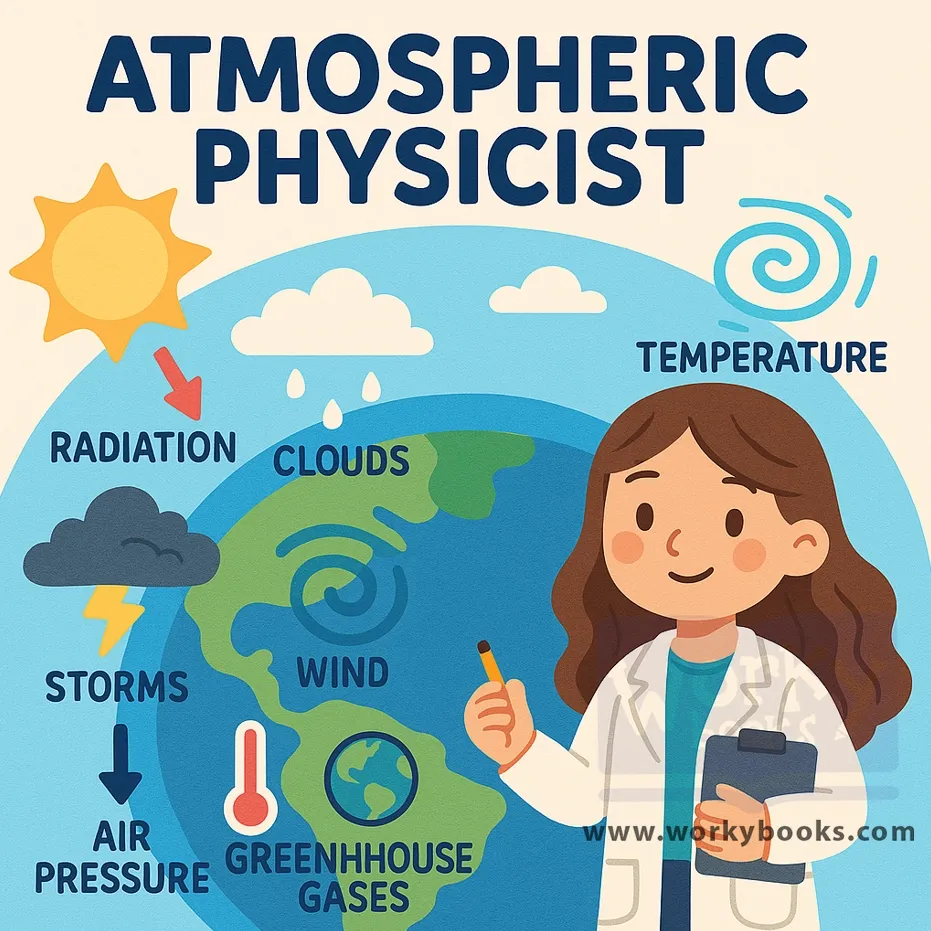
An atmospheric physicist is a scientist who studies the physical processes that happen in Earth’s atmosphere. The atmosphere is the layer of gases that surrounds our planet, and it plays a big role in weather, climate, and protecting life on Earth. Atmospheric physicists use the laws of physics to understand how the atmosphere works.
These scientists focus on things like air pressure, temperature, radiation, cloud formation, and wind patterns. They want to know how energy from the Sun interacts with the air and Earth’s surface. Their research helps explain why storms form, how heat moves through the atmosphere, and how greenhouse gases cause global warming.
To do their work, atmospheric physicists use math, computers, and satellite data. They build models to predict weather and climate events. Some also study how pollution affects the atmosphere or how changes in the atmosphere impact things like aviation or agriculture.
Atmospheric physicists play an important role in solving real-world problems. For example, their work helps improve weather forecasting, design better climate models, and understand how human activity is changing the planet. Some work with space agencies like NASA, while others teach at universities or advise governments on environmental policies.
Because the atmosphere is always changing, atmospheric physicists must think carefully and use complex tools to make sense of it all. Their work helps protect people from extreme weather and helps us understand how Earth’s systems are connected.
Fun Fact: Atmospheric physicists can even study other planets—like Mars or Venus—to learn how their atmospheres compare to Earth’s!
What does an atmospheric physicist study?
Rocks and fossilsAirplanes and enginesPhysical processes in the atmosphereAnimal migration patterns
Which of the following is part of an atmospheric physicist’s work?
Studying ocean currentsExploring underground cavesMeasuring radiation and temperature in the airBuilding skyscrapers
What tool do atmospheric physicists often use?
PaintbrushHammerComputer modelsThermos
Why is their work important for weather forecasting?
They write weather news reportsThey collect animal behavior dataThey help predict weather using physics and dataThey test snowplows
Which area might an atmospheric physicist study besides Earth?
The ocean floorForest rootsMars or VenusDinosaur bones
What is one way human activity connects to their research?
Studying ancient toolsStudying traffic noiseStudying greenhouse gases and global warmingStudying television signals
What is the main idea of this passage?
Atmospheric physicists protect animals from stormsAtmospheric physicists make weather appsAtmospheric physicists study the atmosphere using science and technologyAtmospheric physicists build weather balloons
If an atmospheric physicist is studying air pollution, what might they use?
A telescopeA drone and sensorsA fishing rodA chalkboard
Perfect For:
👩🏫 Teachers
• Reading comprehension practice
• Auto-graded assessments
• Literacy skill development
👨👩👧👦 Parents
• Reading practice at home
• Comprehension improvement
• Educational reading time
🏠 Homeschoolers
• Reading curriculum support
• Independent reading practice
• Progress monitoring
Reading Features:
📖
Reading Passage
Engaging fiction or nonfiction text
❓
Comprehension Quiz
Auto-graded questions
📊
Instant Feedback
Immediate results and scoring
📄
Printable Version
Download for offline reading
🔊
Read Aloud
Voice-over with word highlighting
Reviews & Ratings
No reviews yet. Be the first to share your experience!
Related Content
Tools and Technology in Earth Science
This middle school science reading passage explores the wide range of tools and technologies used in Earth science, from...
MS-ESS2-2MS-ESS3-2MS-ETS1-1MS-PS4-3
What Is Earth Science?
This engaging middle school science passage introduces students to the field of Earth science, aligning with NGSS standa...
MS-ESS1MS-ESS2MS-ESS3SEP
Scientific Inquiry in Earth Science
This passage explores scientific inquiry in Earth science for grades 6-8, aligned with NGSS standards MS-ESS1-4, MS-ESS2...
MS-ESS1-4MS-ESS2-1MS-ESS3-5SEP
Interpreting visual information on Layers of the Earth
This informational text on the layers of the earth is a great way to practice using images during reading. Students will...
RI.1.7RI.10RF.1.4.ARF.1.4
What's The Main Idea?
These short science texts are a great way to practice main idea. Students will read the paragraphs and then choose the m...
RI.2.6
Reading for Main Details—Birds
This informational text on birds is a great way to practice main idea. Students will read the passage, then give the mai...
RI.2.6RI.2.8
What Is Space Weather and How Does It Affect the Earth?
This NGSS-aligned science passage for middle school explains what space weather is and how it affects Earth. Students le...
MS-ESS2-2
Koi Fish—What’s the Main Idea?
This informational text on koi fish is a great introduction to teaching main idea. Students will be asked, in multiple c...
RI.3.2RF.3.4RI.3.1
Spider—Main Idea
This informational text on spiders is a great introduction to teaching main idea. Students will be asked, in multiple ch...
RI.3.2RF.3.4RI.3.1RI.2.6
Reading for Main Details—Beavers Teeth
This informational text on beavers is a great way to practice main idea. Students will read the passage, then give the m...
RI.2.6RI.2.10
Earth: Our Home in Space
This engaging Grade 4-5 science passage, aligned to NGSS, introduces students to Earth's special place in the solar syst...
Reading for Main Details—Veternarians
Practie summarizing paragraphs with this fun informational text on veternarians! Students will give the main idea of eac...
RI.2.2RI.2.10
Earth's Spheres
This middle school science passage introduces students to Earth's four major spheres: the geosphere, hydrosphere, atmosp...
MS-ESS2-4MS-ESS2-6
The Solar System—Informational Text
This informational text is a great way for early readers to practice their comprehension skills. Students will read the ...
RI.K.7
Main Idea and Supporting Details in Informational Text
RI.3.1RI.3.2RI.3.8
Penguins— Main Purpose
This informational text on penguins with comprehension questions is a great way to practice reading fluency and main ide...
RI.1.2RI.1.10RF.1.4.ARF.1.4.B
Informational Text — Astronauts
Practice this second grade context clues worksheet with this informational text on astronauts. Students will read the te...
RI.2.4RI.2.10RI.3.4RI.3.10
Reading for Main Details—Orcas
Practie summarizing paragraphs with this fun science informational text on orcas! Students will give the main idea of ea...
RI.2.2RI.2.10
Informational Text —Learn About Dinosaurs
This informational text on dinosaurs with comprehension questions to follow is perfect for teaching main idea. Students ...
RF.3.4RF.3.4.ARF.3.4.CRI.3.2
Informational Text — Habitats
This short informational text on habitats will teach your students what a habitat is, as well as provide some examples o...