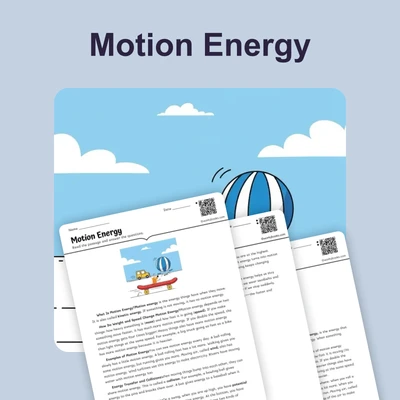
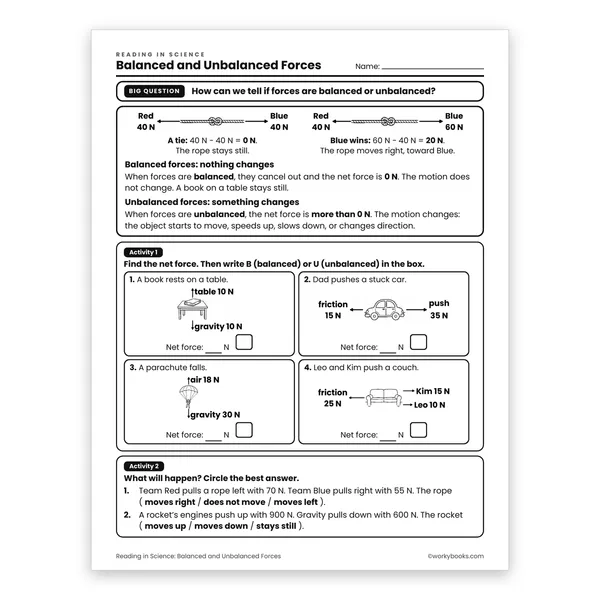
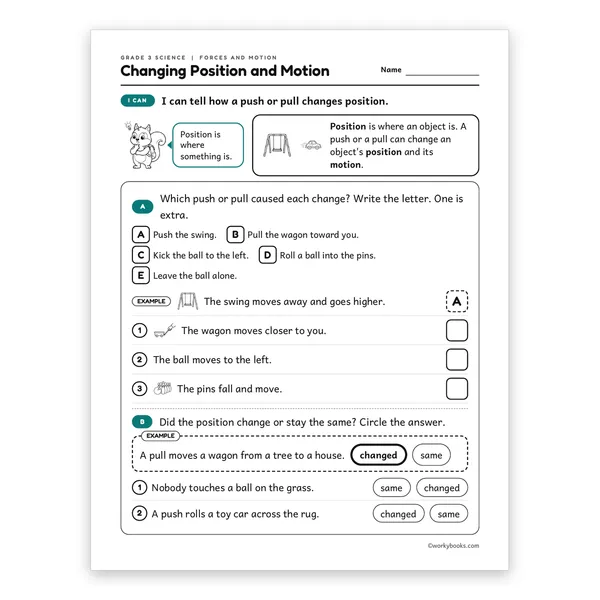
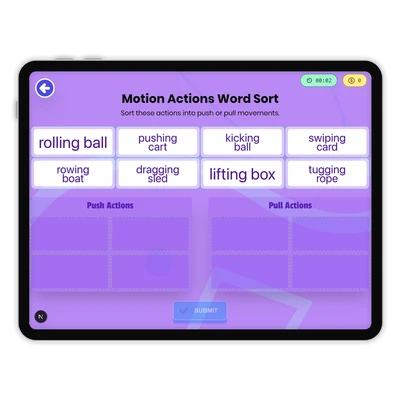
This learning resource is available in interactive and printable formats. The interactive worksheet can be played online and assigned to students. The Printable PDF version can be downloaded and printed for completion by hand.
This NGSS-aligned passage explains 'What is Motion?' in clear and simple terms for elementary students. Motion is described as a change in position, with examples such as a rolling ball, a swing, and Earth’s orbit around the Sun. The text highlights the importance of both size (distance) and direction when describing motion, supporting the NGSS standard PS2.A: Forces and Motion. It encourages students to observe and measure patterns of motion so they can predict future movement. Fun facts and examples make the content engaging, while 8 multiple-choice questions check understanding at different Depth of Knowledge levels. The passage integrates science literacy with prediction skills and offers a fun fact about Earth’s speed around the Sun. Perfect for classrooms, tutoring, or home learning, this passage is audio integrated, ensuring accessibility for all learners. Keywords such as motion, NGSS PS2.A, predict motion, and forces and motion support SEO and make the content easy to find for educators and parents.
CONTENT PREVIEW
Expand content preview
Motion is the word scientists use to describe any change in an object's position or location over time. If something moves from one place to another, it is in motion. We can tell an object is moving by comparing where it is now to where it was before. The things around it, called reference points, help us see this change. For example, when you walk to school, your position changes compared to the houses and trees you pass.
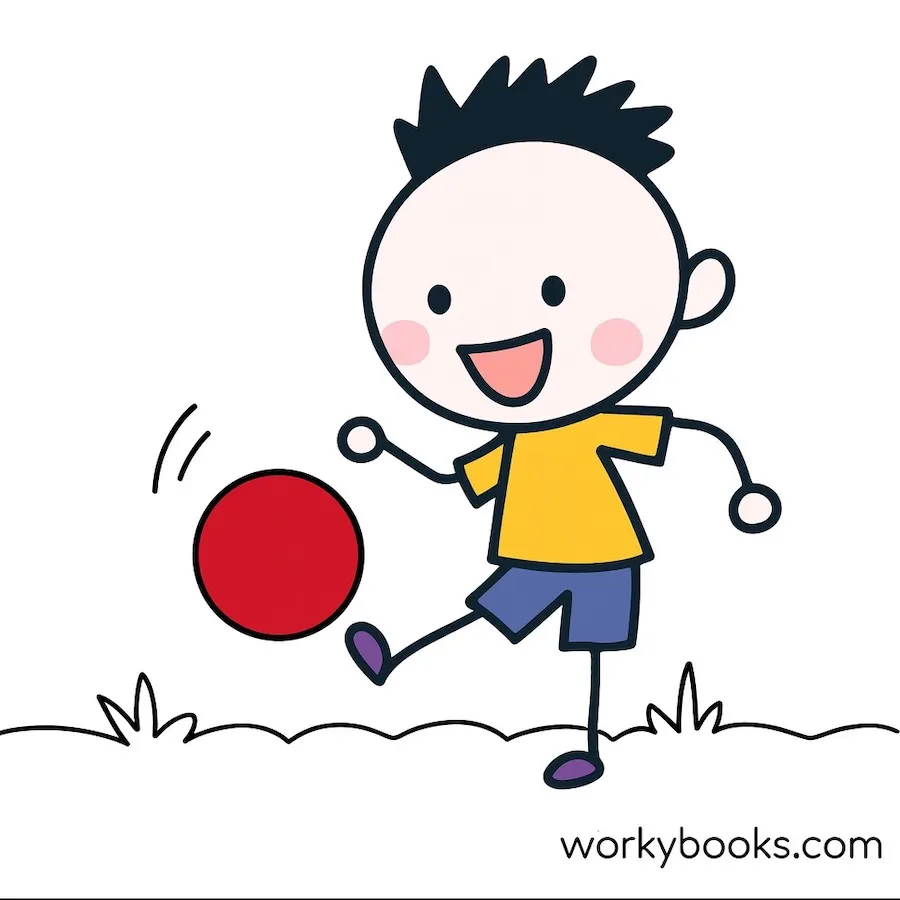
How do we know something is moving? We observe motion by looking at how an object changes its place compared to other things that stay still. If the ball you kicked rolls away from your foot, you know it is moving because its position is different than before. Even the hands on a clock change their position as time passes. By watching and observing, we discover what is moving and what is standing still.
Types of Motion There are many ways things can move. Some objects move in a straight line, like a soccer ball being kicked across a field. Others move in a circular path, like a merry-go-round or the Earth spinning on its axis. Some things move back and forth, like a swing in the playground. This is called back-and-forth motion. Sometimes, objects move in a zigzag pattern, like a squirrel running across a yard.
Starting Points and Measuring Motion To measure motion, we need a starting point. This helps us know how far and in what direction something has moved. For example, you can measure how far you walked from your classroom door to your desk. Scientists use starting points and reference points to describe motion clearly.
Motion is Everywhere! Everything around us can be in motion, even things that seem still. The Earth is always spinning and traveling around the sun. In the classroom, you can see motion when students walk, pencils roll, or papers fall to the floor. Motion is like playing tag—you are always changing your location!
Interesting Fact: Even when you are sitting still, the Earth is spinning at about 1,000 miles per hour!
What is motion?
A change in positionA kind of plantA place to sitA type of weather
Which is a reference point?
A tree next to youThe windA moving ballYour laugh
What moves in a circular path?
A merry-go-roundA pencilA deskA book
Why do we need a starting point?
To measure motionTo eat lunchTo make noiseTo count trees
Which is an example of back-and-forth motion?
A swingA clockA cloudA shoe
How do we observe motion?
By watching changesBy closing eyesBy being silentBy eating
The Earth is always moving.
TrueFalse
What does 'zigzag' mean?
Sharp turns left and rightMoving in a circleStanding stillJumping up
Perfect For:
👩🏫 Teachers
• Reading comprehension practice
• Auto-graded assessments
• Literacy skill development
👨👩👧👦 Parents
• Reading practice at home
• Comprehension improvement
• Educational reading time
🏠 Homeschoolers
• Reading curriculum support
• Independent reading practice
• Progress monitoring
Reading Features:
📖
Reading Passage
Engaging fiction or nonfiction text
❓
Comprehension Quiz
Auto-graded questions
📊
Instant Feedback
Immediate results and scoring
📄
Printable Version
Download for offline reading
🔊
Read Aloud
Voice-over with word highlighting
Reviews & Ratings
No reviews yet. Be the first to share your experience!
Related Content
What's The Main Idea?
These short science texts are a great way to practice main idea. Students will read the paragraphs and then choose the m...
RI.2.6
Reading for Main Details—Birds
This informational text on birds is a great way to practice main idea. Students will read the passage, then give the mai...
RI.2.6RI.2.8
Koi Fish—What’s the Main Idea?
This informational text on koi fish is a great introduction to teaching main idea. Students will be asked, in multiple c...
RI.3.2RF.3.4RI.3.1
Spider—Main Idea
This informational text on spiders is a great introduction to teaching main idea. Students will be asked, in multiple ch...
RI.3.2RF.3.4RI.3.1RI.2.6
Reading for Main Details—Beavers Teeth
This informational text on beavers is a great way to practice main idea. Students will read the passage, then give the m...
RI.2.6RI.2.10
Reading for Main Details—Veternarians
Practie summarizing paragraphs with this fun informational text on veternarians! Students will give the main idea of eac...
RI.2.2RI.2.10
Main Idea and Supporting Details in Informational Text
RI.3.1RI.3.2RI.3.8
Penguins— Main Purpose
This informational text on penguins with comprehension questions is a great way to practice reading fluency and main ide...
RI.1.2RI.1.10RF.1.4.ARF.1.4.B
Informational Text —Learn About Dinosaurs
This informational text on dinosaurs with comprehension questions to follow is perfect for teaching main idea. Students ...
RF.3.4RF.3.4.ARF.3.4.CRI.3.2
Reading for Main Details—Orcas
Practie summarizing paragraphs with this fun science informational text on orcas! Students will give the main idea of ea...
RI.2.2RI.2.10
Informational Text — Habitats
This short informational text on habitats will teach your students what a habitat is, as well as provide some examples o...
RF.3.4.A
Informational Text —Elephants Facts
This informational text on elephants with comprehension questions to follow is perfect for teaching main idea. Students ...
RF.2.4.ARI.2.1RI.2.2RI.2.6
Informational Text — Astronauts
Practice this second grade context clues worksheet with this informational text on astronauts. Students will read the te...
RI.2.4RI.2.10RI.3.4RI.3.10
Informational Text —Importance of Sound
This Reading Informational Text Common Core standards calls for 4th graders to be able to effectively describe and analy...
RI.4.5
Informational Text — Penguins
This informational text on penguins is a great way to practice reading comprehension. Students will read the short passa...
RI.2.1RI.2.10
Informational Text — Armadillos
This informational text on armadillos is a great way to practice reading comprehension. Students will read the short pas...
RI.2.1RI.2.10
Informational Text —Sea Stars
Use this second grade worksheet on context clues with this informational text on sea stars. Students will read the text ...
RI.2.4RI.2.10RI.3.4RI.3.10
Informational Text —Bioluminescence
This informational text on bioluminescence will teach your students about this phenomenon. Examples in nature are provid...
RI.3.10RF.3.4RF.3.4.ARI.3.1
Informational Text —Snowflakes
This informational text on snowflakes will teach your students how snowflakes are formed. Images of several different fl...
RI.3.10RF.3.4RF.3.4.ARI.3.1
Bats and Butterflies—Informational Text
This informational text on bats and butterflies is a great way to practice spotting similarities between texts. Students...