Why Real-World Phenomena and Connections Matter in NGSS Science Classrooms
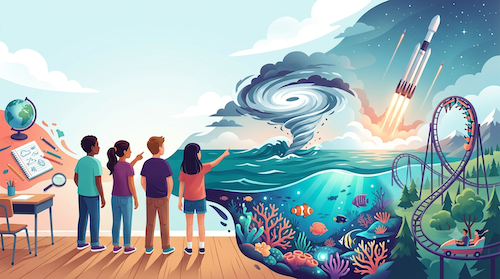
Students shouldn’t learn science just to pass a test—they should learn science to make sense of the world around them.
Imagine asking students to memorize the parts of a hurricane, the stages of the water cycle, or Newton’s laws without ever discussing the storms they see on the news, the weather they experience every day, or the roller coaster they rode last summer. They may remember facts for a quiz, but they are less likely to understand why those ideas matter.
This is exactly why the Next Generation Science Standards (NGSS) place such a strong emphasis on real-world phenomena, phenomenon-based learning, and authentic problem-solving.
Science Begins with Curiosity
Scientists don’t start with vocabulary lists or chapter reviews. They begin with observations and questions.
- Why are coral reefs disappearing?
- How can an electric car travel hundreds of miles on one charge?
- Why are wildfires becoming more frequent?
- How can an entire coral reef remain hidden for decades?
In NGSS classrooms, questions like these act as anchoring phenomena—surprising, observable events that launch a unit and give students a reason to learn. They naturally spark curiosity because they connect science to the real world. Students become motivated to learn because they want to explain something surprising, not simply complete another worksheet.
From Learning About Science to Doing Science
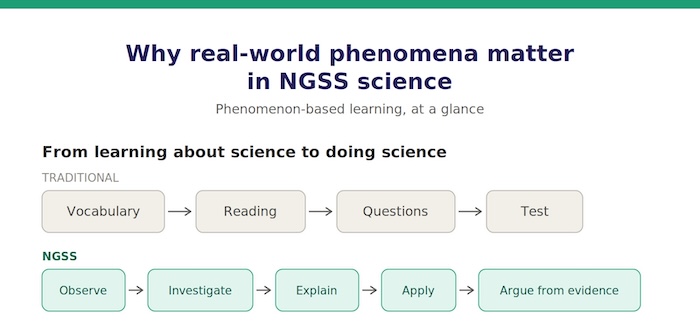
Traditional science instruction often follows this sequence:
Vocabulary → Reading → Questions → Test
NGSS encourages a different approach, built on three-dimensional learning—weaving together science and engineering practices, crosscutting concepts, and disciplinary core ideas:
Observe → Investigate → Explain → Apply → Argue from Evidence
Instead of memorizing facts first, students use scientific ideas to explain real events. This process—often called sensemaking—means students learn science by thinking and reasoning like scientists.
Why Real-World Connections Improve Learning
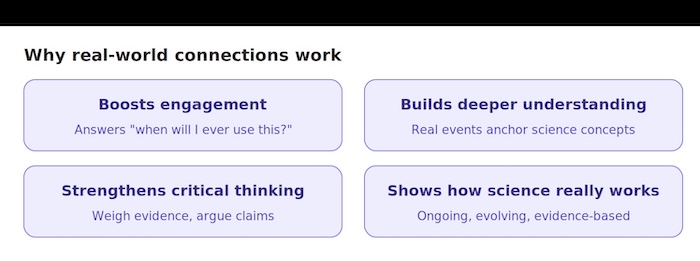
They Increase Student Engagement
Middle school students frequently ask, “When will I ever use this?”
Real-world connections answer that question immediately. Whether students are exploring hurricanes, renewable energy, endangered species, or space exploration, they see that science affects their daily lives and future careers. Student engagement in science rises when the content feels current, relevant, and real.
They Build Deeper Understanding
Students remember stories better than isolated facts.
A student may forget the definition of biodiversity, but they are more likely to remember reading a science passage about a hidden coral reef that supported dozens of species. The real event becomes a mental anchor for the scientific concept—which is why short, engaging science reading passages built around real phenomena are such a powerful tool for comprehension.
They Strengthen Critical Thinking
Authentic scientific questions rarely have one simple answer.
- Should governments spend money exploring the deep ocean?
- Should communities rebuild after repeated flooding?
- Should plastic pollution laws become stricter?
These questions encourage students to analyze evidence, evaluate multiple viewpoints, and support their ideas with reasoning. This kind of scientific argumentation—learning to argue from evidence—builds critical thinking skills that extend beyond science class.
They Reflect How Science Really Works
Science is an ongoing process of asking questions, collecting evidence, revising explanations, and communicating findings.
When students read about current discoveries and science current events, they see that science is not a finished collection of facts in a textbook. It is a dynamic process that continues every day.
What Makes a Strong Phenomenon-Based Science Lesson?
An effective lesson does more than present an interesting article. It guides students through a process of sensemaking.
A simple framework might look like this:
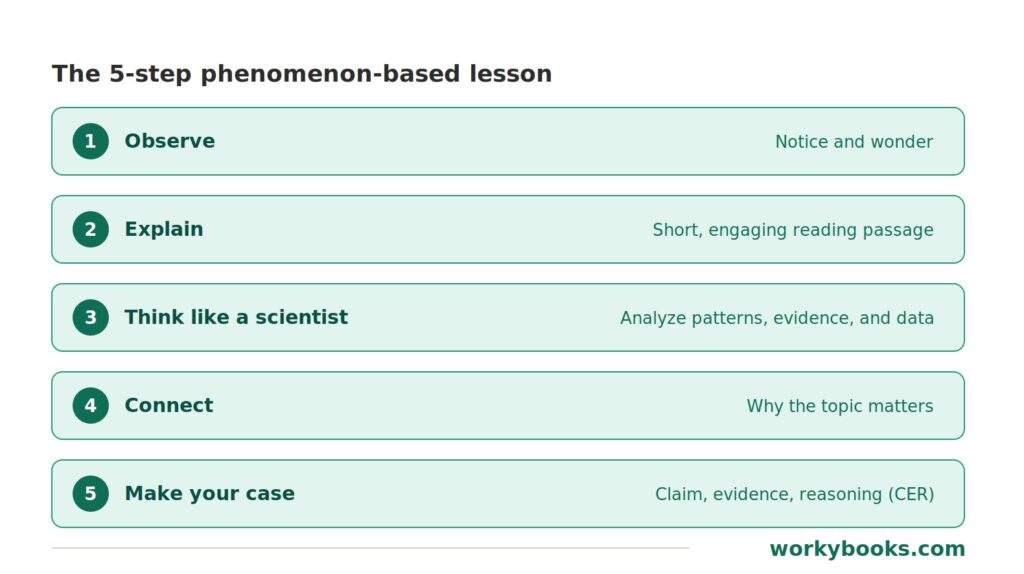
1. Observe
Begin with a photograph, headline, graph, or surprising phenomenon.
Use a classic notice and wonder routine:
- What do you notice?
- What do you wonder?
2. Explain
Provide a concise, engaging reading passage that introduces the scientific concepts needed to understand the phenomenon.
Keep the focus on the central driving question rather than overwhelming students with background information.
3. Think Like a Scientist
Ask students to explain patterns, analyze evidence, make predictions, or interpret data.
These questions move beyond recall and put NGSS science and engineering practices to work—encouraging genuine scientific reasoning instead of memorization.
4. Connect
Help students understand why the topic matters.
How does this discovery affect people, ecosystems, technology, or the future?
How might it connect to their own community?
5. Make Your Case
Finish with a Claim–Evidence–Reasoning (CER) task or another evidence-based writing activity.
CER writing asks students to state a claim, support it with evidence from the lesson, and explain their reasoning—just as scientists communicate and defend their conclusions.
Ideas for Real-World Science Connections
Almost every NGSS topic can begin with a compelling real-world phenomenon.
| Science Topic | Real-World Connection |
|---|---|
| Ecosystems | Hidden coral reefs, invasive species, wolf reintroduction |
| Weather | Hurricanes, tornado outbreaks, atmospheric rivers |
| Climate | Heat waves, melting glaciers, coral bleaching |
| Earth Science | Earthquakes, volcanoes, sinkholes, landslides |
| Forces & Motion | Roller coasters, crash tests, sports technology |
| Energy | Solar farms, electric vehicles, battery innovations |
| Waves | Noise-canceling headphones, medical ultrasound, fiber optics |
| Space | Artemis missions, asteroid samples, eclipses, Mars exploration |
When students see science in the headlines, they begin to understand that the concepts they learn in class help explain the world around them.
Practical Tips for Teachers
You don’t need to redesign your entire curriculum.
Try incorporating one current events science lesson each week:
- Begin with an intriguing photograph or Wikimedia -Picture of the Day.
- Ask students what they notice and wonder.
- Read a short, age-appropriate science news article written for students.
- Discuss the science behind the event.
- End with an evidence-based writing prompt such as a CER response.
Even a 20-minute investigation—a warm-up, a bell ringer, or a short NGSS-aligned worksheet—can transform a lesson from fact memorization into meaningful scientific thinking.
Bringing Science to Life
The goal of science education is not simply to help students remember vocabulary or pass assessments. It is to build genuine science literacy: helping students understand the natural world, ask thoughtful questions, evaluate evidence, and make informed decisions.
Real-world phenomena make science meaningful because they answer one of the most important questions students ask:
“Why does this matter?”
When students recognize science in the news, in their communities, and in everyday life, they begin to see themselves not just as learners of science, but as thinkers who can use science to understand—and improve—the world around them.
At Workybooks, this is exactly what we work hard to do every day—creating NGSS-aligned science worksheets and reading passages, worksheets, and current events lessons designed to build that genuine science literacy in every student, one real-world phenomenon at a time.
Enjoying learning – NGT.
Related Posts
Louisiana Purchase Teaching Resources
Fun Facts About Jupiter